


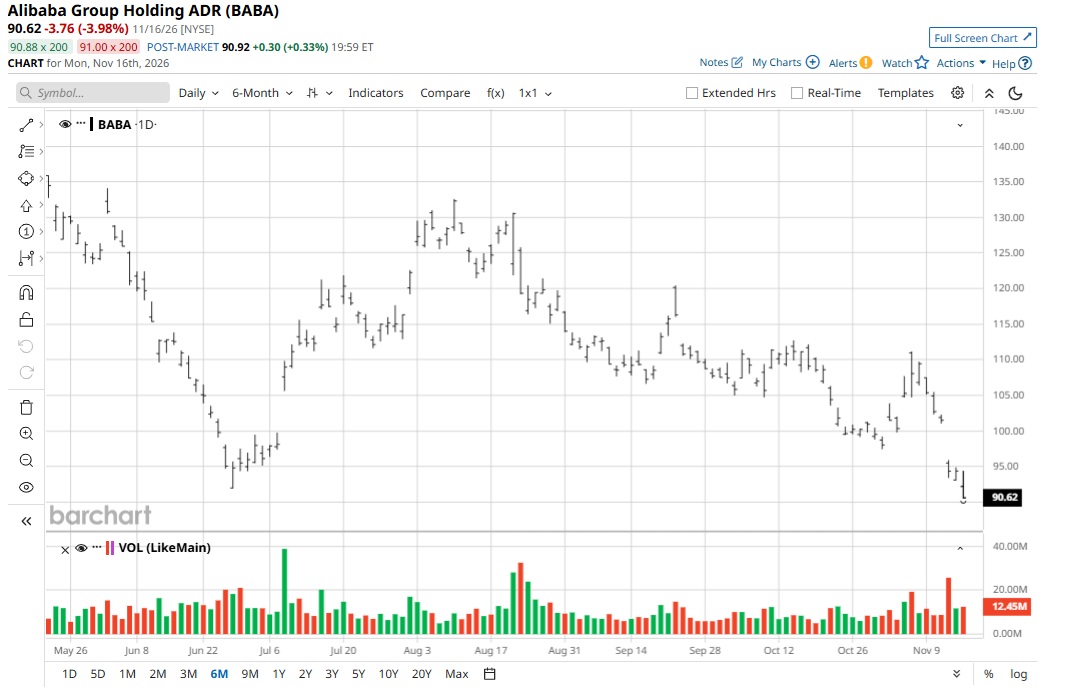
Alibaba (BABA) stock has been in an extended period of downtrend. Over the last 52 weeks, BABA stock has declined by about 45%. Multiple factors have translated into the bearish sentiment surrounding shares.
First, consumer demand has weakened in China, resulting in relatively weaker sales growth. Further, the company’s artificial intelligence (AI) and cloud buildout is consuming significant cash, and markets remain skeptical about the returns from these investments. These factors have resulted in margin contraction and, as earnings have collapsed, the stock has reacted negatively. Additionally, geopolitical tensions have impacted sentiment as well.
However, markets tend to overreact, and Alibaba stock seems attractive from a long-term perspective. With the company’s second-quarter earnings report around the corner on Nov. 19, it might be a good time for investors to consider some exposure. The ramp-up in AI monetization is a potential factor that could trigger a trend reversal. At the same time, the company’s fundamentals remain strong, providing ample flexibility for continued investments.
About Alibaba Stock
Headquartered in Hangzhou, China, Alibaba provides technology infrastructure and marketing reach that supports merchants, brands, retailers, and other businesses both in China and globally. Further, the company provides enterprises with full-stack AI capabilities and services.
For Q1 fiscal 2026, Alibaba reported revenue growth of 9% year-over-year (YOY) to $39.6 billion. For the same period, adjusted EBITA declined 30% to about $4 billion. This decline was primarily due to the company’s investment in technology, which was partially offset by improved operating results in the cloud business.
With relatively muted top-line growth coupled with EBITDA margin compression, BABA stock has declined by 35% in the last six months. However, at a forward price-to-earnings (P/E) ratio of 16 times, BABA stock seems attractive.
Positives From Alibaba's Q1 Numbers
In Q1 fiscal 2026, Alibaba reported Alibaba Cloud external revenue growth of 45%. Further, AI-related product revenue delivered triple-digit growth for the 12th-straight quarter. With management pointing to an AI monetization ramp-up, the company’s EBITDA margin will likely witness improvement.
From a fundamentals perspective, Alibaba reported cash and liquid investments of $69.9 billion as of Q1. Further, operating cash flow for the same period was $3.4 billion, implying annualized OCF potential of $13.6 billion. While cloud infrastructure investments have concerned markets, Alibaba's fundamentals remain strong, with ample flexibility for aggressive investments. A strong balance sheet has also enabled continued share repurchases.
Another possible catalyst for Alibaba is a potential improvement in the macroeconomic scenario, coupled with lower geopolitical tensions. If frictional issues between China and the United States are ironed out, that would likely have a positive impact on growth. This is particularly true in regard to further clarity on chip rules.
Overall, valuations point to a possible reversal for BABA stock. Additionally, as the company's big investments start delivering results, shares may be rerated.
What Do Analysts Say About BABA Stock?
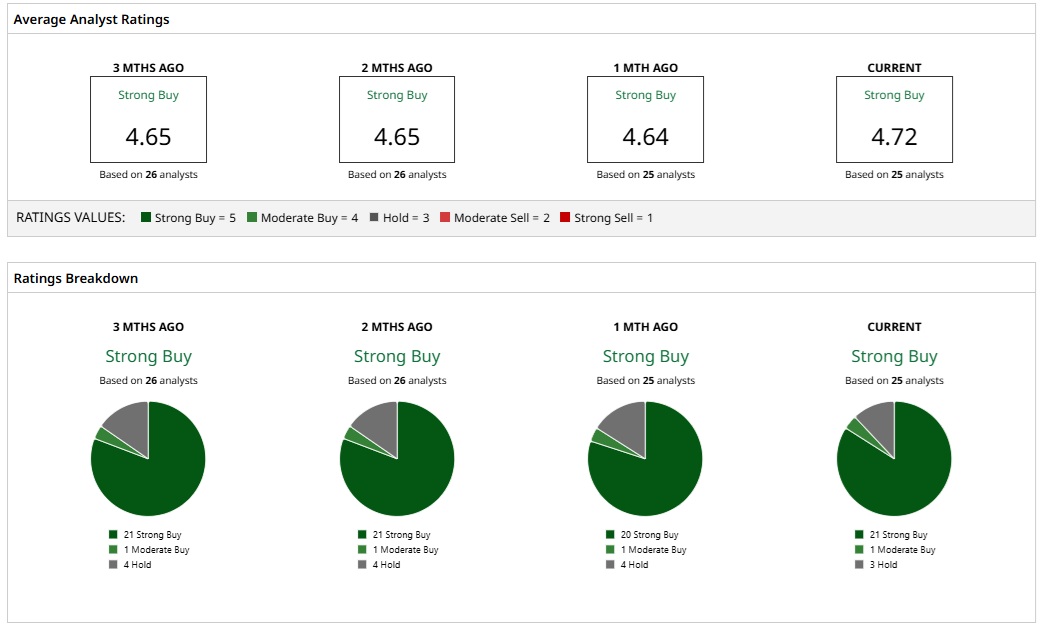
Considering Alibaba’s full-stack AI capabilities, AI monetization ramp-up, and valuations, the outlook appears optimistic after a deep correction. Based on 25 analysts with coverage, BABA stock has a consensus “Strong Buy” rating. While 21 analysts have a “Strong Buy” rating, one has a “Moderate Buy” rating, and three have a “Hold” rating.
The mean price target of $182.70 represents potential upside of 111% from current levels. Further, the most bullish price target of $220.10 suggests that BABA stock could climb as much as 154% from here.
On the date of publication, Faisal Humayun Khan did not directly have a position in any of the securities mentioned in this article. All information and data in this article is solely for informational purposes. For more information please view the Barchart Disclosure Policy here.