


Since November 11, the Hong Kong stock price of Corfu Healthcare (01187) has broken out of a wave of market conditions. From November 11 to November 17, the biggest increase in the company's stock price range reached 16.40%.
At the same time, in-market trading of Corfu Healthcare Hong Kong stocks is also clearly more active than before. During the three trading days from November 13 to 17, the intraday trading volume was over 500,000 shares, which is a significant increase over the previous few days. Under the catalyst of the recent three-quarter report and the emotional fermentation of the market's brain-computer interface concept, Corfu Healthcare's H shares, which have shown significant discounts and a higher margin of valuation safety compared to A-shares, may enter a new round of market.
After bottoming out and rebounding, how far can this round of the market go?
Looking at the market, from November 11 to 17, the cumulative increase in the range of Corfu Healthcare H shares was 10.41%, and the maximum amplitude in the range reached 16.40%; at the same time, the range turnover rate of the company's stock price soared from 0.36% to an average of more than 2% per day, breaking out of a typical low volume starting market.
The Zhitong Finance App observed that on November 11, although Corfu Healthcare's stock price closed up only slightly by 0.37%, it formed a sideways pattern of shrinking at the end of the previous period, stopping the downward trend of the company's stock price since November 6 and stabilizing the closing price above BOLL's offline trajectory on the same day.
After that, from November 12 to 17, Corfu Healthcare's H shares emerged from a three-stage market in just four trading days, from starting a breakthrough to changing hands at a high level, and then accelerating upward twice.
Judging from the corresponding volume and price performance, the intraday trading volume for the four trading days was 196,000 shares, 719,800 shares, 666,300 shares, and 588,700 shares, respectively, showing a shrinking upward pattern “from the daily volume of the range to a new contraction high”; judging from cross-verification of the OBV index, the indicator continued to rise from 142,900 to 1,5941 million, which is completely in sync with the company's range stock price trend, and there was no deviation from the top in volume and price. This shows to a certain extent that in this round of the market, the rise in the H share price of Corfu Healthcare was accompanied by a reduction in market selling pressure, rather than a continuous withdrawal of funds.
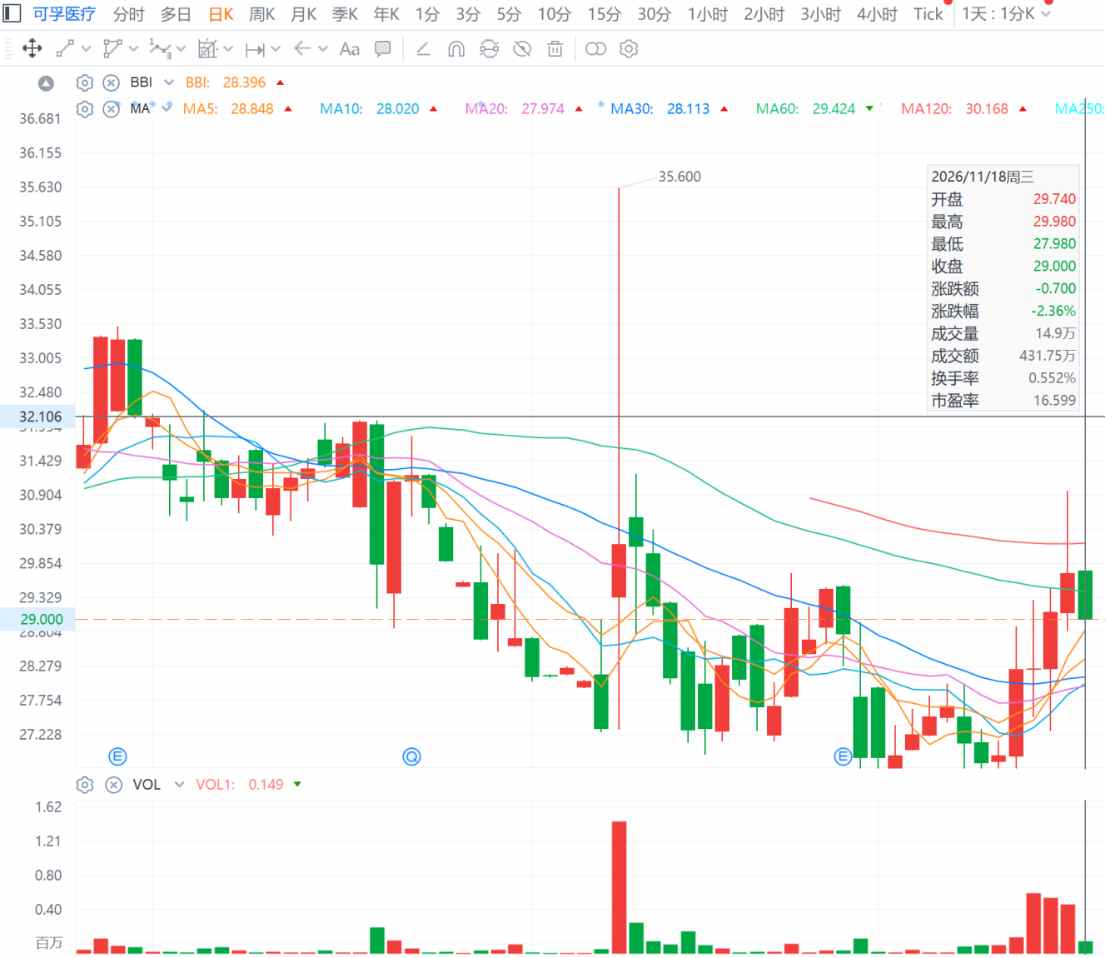
In terms of technical performance, the MACD indicator shows that from November 11 to 17, the DIF continued to recover from -0.607 to -0.097; at the same time, the DEA index rebounded from -0.588 to -0.406, and the corresponding MACD bar expanded from -0.038 to 0.617, showing that Corfu Healthcare's bullish momentum is being released at an accelerated pace within this range; in terms of RSI indicators, although it fluctuated upward in the 50-53 range, it never touched the 70 overbought line. 43.2 (unbroken 50), then rebounded again to 52.9 on the 16th. The RSI bottom lift structure is complete, indicating that the medium-term momentum of Corfu Healthcare's stock price remains healthy. In contrast, the KDJ value continued to diverge upward after the gold fork, and the J value >90 for two consecutive days constituted short-term overbought.
On November 18, Corfu Healthcare's stock price recovered, corresponding to the MACD column shrinking to 0.613, which indicated that the margin of momentum weakened for the first time, but the overall indicator still points to the bullish range; however, the KDJ-J value, which previously showed that short-term overbought values fell back to 75.5 on the same day and showed a high downward trend, further confirming the short-term adjustment signal for Corfu Healthcare's stock price, but even so, its K value remained above the D value, indicating that its KDJ gold fork structure was not damaged.
Combined with the funding direction indicated by the OBV index, Corfu Medical's OBV remained at 1.464,400 on November 18. Although it fell slightly from the previous day, it was still far higher than the level of 142,900 before launch, and the overall capital inflow was still showing a net inflow.
In summary, although the stock price of Corfu Healthcare H shares broke through the 5-day EMA and fell to an intraday low of HK$27.98 during the November 18 pullback, the final closing price remained at HK$29 on the 5-day line. In other words, Corfu Healthcare's current performance is still a technical backlash confirmation after the surge. Unbroken bulls mean that its stock price is still likely to rise twice in the future.
When will the emotion-driven short-term market turn to a reversal trend?
Recently, the fifth batch of industry standard revision plans for 2026 was officially released, and 9 industry standards organized by the Brain-Computer Interface Standardization Technical Committee (MIIT/TC4) were approved for approval. The favorable policy side has become one of the important reasons affecting recent market sentiment.
According to the Zhitong Finance App, although Corfu Medical's main business is not involved in the brain-computer interface business, in recent years, the company has already laid out brain-computer interface-related fields through strategic investment: in 2024, the company invested in NKrypton Healthcare, involving implantable brain-computer interface projects; at the end of 2025, the company once again invested in intelligence and deployed non-intrusive brain-computer interface robots.
However, at present, the domestic brain-computer interface sector mainly shows the characteristics of “high volatility and strong differentiation”, and conceptual generalization has become the main problem in the brain-computer interface sector at this stage. For Corfu Healthcare, this concept is also essentially a shareholding investment option, and the company has clearly stated that “the contribution to performance in the short term is limited.”
In fact, the main factors driving this round of secondary market sentiment may be the recent bottoming rebound trend of Corfu Healthcare's H shares and the three-quarter report.
According to the Zhitong Finance App, taking the A-share market as an example, this year's three-quarter report shows that the total revenue of 5,572 companies was 56.66 trillion yuan, up 5.66% year on year; corresponding net profit to mother was 5.1 trillion yuan, up 8.3% year on year, of which 73.15% of listed companies achieved profit.
According to the 26Q3 financial report disclosed by Kefu Healthcare after the market on October 29, the company's revenue for the first three quarters reached 3.191 billion yuan, up 33.08% year on year; corresponding net profit to mother reached 305 million yuan, up 17.30% year on year; at the same time, the company's current comprehensive gross margin reached 56.24%, up 2.88 percentage points year on year. The gross margin for the third quarter reached 56.88% in a single quarter. As can be seen, the steady fundamental performance shown in the three-quarter report actually played an important supporting role in the recent market of Corfu Healthcare.
As Corfu Healthcare's H share price bottomed out and rebounded, Southbound Capital reversed its previous left-hand trading strategy and chose right-side trading to follow the trend and increase its positions.
Looking at the long-term timeline, Corfu Healthcare's southbound shareholding ratio climbed from 21.64% to 23.73% from November 5 to 17. Based on the total share capital of H shares of 27 million shares, Southbound Capital increased its net holdings of Corfu Medical by about 560,000 shares within 11 trading days, with a total holdings of about 6.41 million shares. In this process, the pace of increasing southbound capital positions was highly synchronized with the rebound in the stock price of Corfu Healthcare's H shares. In particular, on November 13, Corfu Healthcare increased its shareholding by 40,200 shares in a single day; on November 17, Corfu Healthcare's stock price hit a new high in the range, and the corresponding Southbound Capital shareholding ratio jumped to 23.73%.
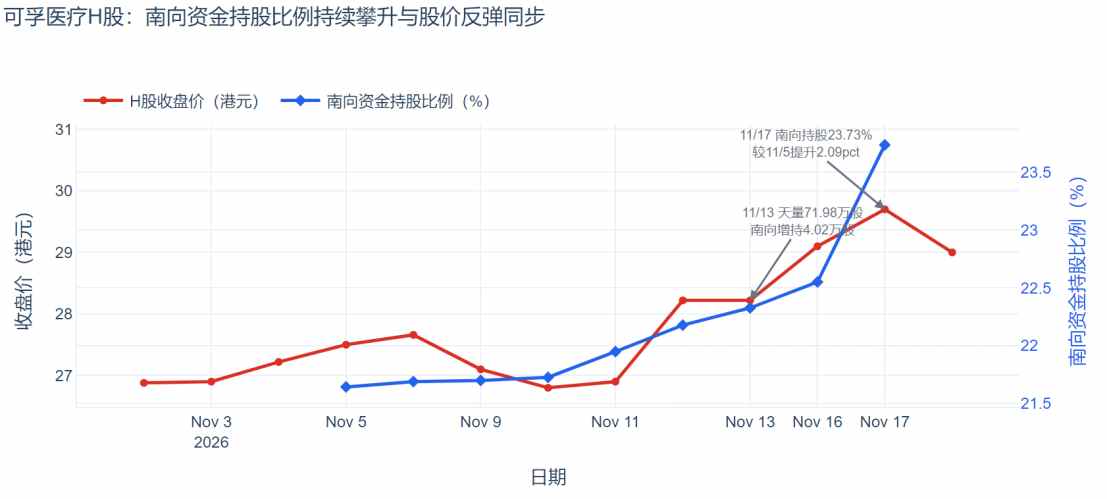
In fact, Southbound Capital's shareholding ratio mainly began to rise at an accelerated pace after Cornerstone was lifted on November 5. Therefore, it is not ruled out that the reason some Southbound Capital increased their holdings of companies or that the Cornerstone lifted the ban window to accept chips, but in fact, Southbound Capital also has the logic of actively buying Corfu Healthcare.
According to the Zhitong Finance App, 2027 is the first commercialization year for Corfu CGM devices. Under the combined influence of the current domestic CGM circuit facing domestic replacement windows and the double-edged sword of the price war, Corfu's CGM devices are expected to rely on the reuse capabilities of the company's channel ecosystem and their own “shelf-style delivery efficiency”, which is expected to overtake cars at corners at significantly lower unit customer acquisition costs than their peers. Due to the current performance of H shares, the secondary market does not set any price for the company's CGM expectations, so there may be a large difference in expectations, and this may become an important foundation for the company's stock price reversal in the future.