


Since FERC 2222 opened up institutional channels for distributed energy aggregation, the North American energy storage market is undergoing a profound change in role: household energy storage is no longer just a backup power source during power outages; its positioning is gradually shifting to distributed resources that can be scheduled by power grids.
The Zhitong Finance App learned that recently, at the Las Vegas RE+ Photovoltaic Energy Storage Exhibition, Huabao Xinneng (301327.SZ) showcased the latest progress in collaboration between its consumer-grade optical storage products and virtual power plants. Compared to simple hardware releases, what is more noteworthy is that consumer-grade energy storage devices are entering the B-side energy service system through plug-and-play deployment, AI energy management, and aggregation platforms.
If this path is continuously verified, the competitive focus of the portable storage industry is expected to shift from “selling a device” to “operating a pool of schedulable resources.”
The policy window is compounded by demand expansion, and virtual power plants are on the eve of large-scale expansion
The overseas residential electricity backup market is shifting from “improved consumption” to “defensive immediate demand.” Fluctuations in electricity prices, aging power grids, and the risk of power outages driven by extreme weather, compounded by additional loads such as data centers, have jointly increased the strategic value of households to adjust resources flexibly.
According to the QYResearch report, the global virtual power plant market is in a period of rapid growth. The global virtual power plant market is US$23.94 billion in 2025, and is expected to reach US$72.97 billion in 2032. The compound annual growth rate (CAGR) during the forecast period is 17.26%, with outstanding growth elasticity.
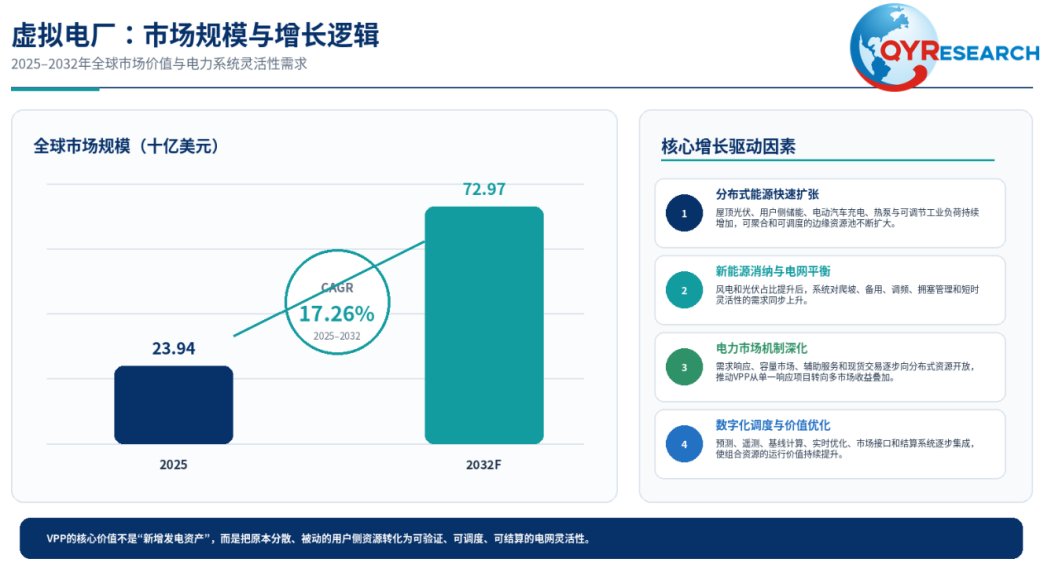
(Source: QYResearch)
At the policy level, the US Department of Energy proposed increasing the US virtual power plant (VPP) capacity to 80-160 GW by 2030, about three times larger than the current scale to cope with peak load pressure and extended grid investment cycles; FERC Order 2222 requires that the US regional electricity market be opened to distributed resource aggregation, allowing distributed energy (DER) to participate through aggregators, and the minimum scale of aggregate resources can be as low as 100 kW. Currently, this policy has been implemented first in markets such as California and New York.
In the future, portable energy storage will not only be a “single point of backup” in the sense of C-end consumer goods, but will also become a distributed resource node that can be scheduled, operated, and settled in the B-side energy service system.
For hardware companies, this means a structural opportunity: as policy channels open, aggregators, utilities, and energy software platforms are looking for distributed terminals that can be quickly accessed. Huabao Xinneng has deployed consumer-grade energy storage equipment networks in millions of households, which just forms its ready resource pool for entering the virtual power plant market.
Scale, Product Matrix and AI Technology: Huabao Xinneng's VPP Capability Puzzle
The essence of a virtual power plant is to aggregate resources such as energy storage, photovoltaics, and controllable loads scattered on the user side to participate in power grid scheduling like a traditional power plant. For aggregators, utility companies, and energy software platforms, resource scale is certainly the starting point, but the degree of standardization, access efficiency, and scheduling stability are also considerations that cannot be circumvented.
Under this logic, Huabao Xinneng's huge business scale has provided aggregators with a ready-made terminal pool with the potential for standardized interfaces. As of the third quarter of 2026, Huabao Xinneng's “Jackery Electric 2” brand had cumulative global sales volume exceeding 8 million units, and its business covered more than 50 countries and regions; according to Sullivan's 2026 white paper, by the end of 2025, it had the highest cumulative sales volume and sales in the global Solar Generator category, and remained at the forefront of the consumer optical storage industry.
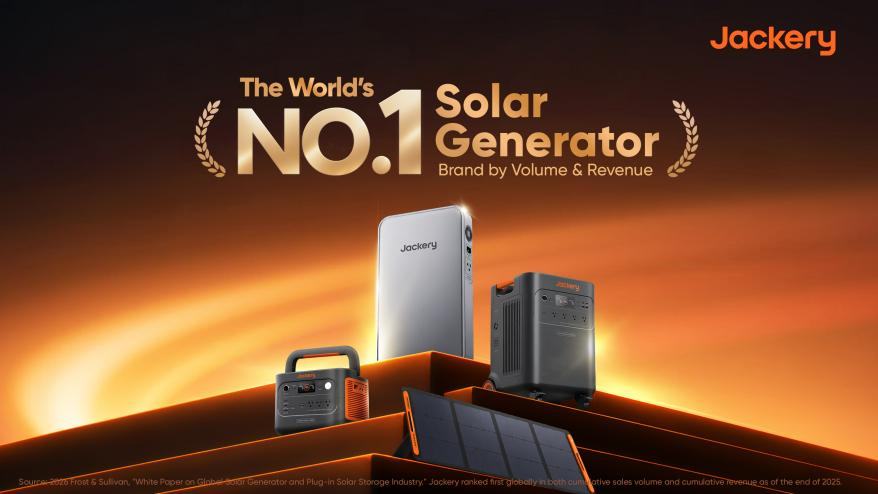
More importantly, these devices are not limited to sales figures on books, but have been deployed in large numbers in actual electricity use scenarios such as homes, apartments, garages, and patios, and have a potential basis for cloud recognition, scheduling, and settlement. This means that aggregators can quickly build aggregation capabilities with an existing network of devices without having to deploy a terminal from scratch. Therefore, the scale itself constitutes bargaining power on the resource side. In the period of rapid development of the industry, it also means that Huabao Xinneng has a first-mover advantage on the resource side.
Further, the value of a resource pool depends not only on its size, but also on its internal structure. Huabao Xinneng's full-scene household green electricity matrix provides a resource base that can be hierarchically combined according to scenario and capacity.
At present, Huabao Xinneng has formed a multi-level, full-scenario household green electricity matrix: it has small-capacity portable optical storage with 1-3 kilowatts of electricity, suitable for apartments, rental, short-term outdoor power backup and mobile scenarios; it also has emergency backup products with 3 degrees or more and can be connected to core loads for key circuits such as refrigerators, HVAC, and lighting; it also includes garden balcony optical storage, photovoltaics, and larger capacity household energy storage systems, covering the complete spectrum from “portable” to “whole house use”. At this exhibition, the company exhibited a combination of 5000 Plus and ATS, power packs and photovoltaic panels to further complement the garage, key circuit, and whole-house electricity backup scenarios.
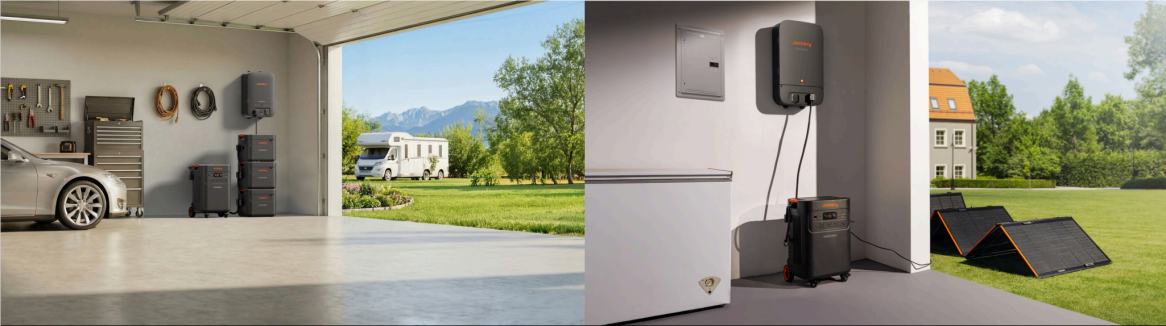
For virtual power plant projects, the breadth of the product spectrum directly determines the choice space for aggregators: they can no longer only rely on single-capacity, single-scenario energy storage resources, but can combine different devices according to regional power grid requirements. Small to medium capacity products are suitable for rapid deployment, lowering the user participation threshold, and increasing the scale of aggregation, while high-capacity products such as balcony light storage and photovoltaic tiles have stronger power generation side coordination capabilities, can improve spontaneous self-use rate and scheduling flexibility, and can participate in cutting peaks and valleys on a longer scale. For aggregators, this is equivalent to obtaining a pool of resources that can be operated hierarchically by capacity, load type, and response reliability, helping to improve the overall stability, availability, and revenue structure of VPP.
At the same time, Huabao Xinneng's AI and cloud scheduling capabilities have further upgraded “can be accessed” to “can be scheduled, settled, and profitable.” Jackery Ark AI EMS, the AI home energy management system launched by the company in June this year, is positioned as the “smart energy brain” of the home, which can optimize the storage, distribution and use of energy according to users' energy goals; previously, products such as the SolarVault 3 series had reserved VPP interfaces in the technical architecture.
Taken together, large-scale terminals solved the problem of resource pools, full-scenario matrices solved the problem of resource stratification, and AI energy management solved the problems of scheduling quality and continuity of participation. Three levels of competency are progressing step by step, and a comprehensive set of competitive barriers that are difficult to replicate in the short term has begun to take shape.
From “Single Point of Backup” to Distributed Resource Nodes: Real Scenario Verification of Virtual Power Plants
By the end of 2026, virtual power plants (VPP) have been commercialized in some regions and scenarios, but overall they are still in the “transition from pilot to large-scale” stage, and a sustainable, mature commercial closed loop for the entire industry has not yet taken shape.
Wood Mackenzie (Wood Mackenzie)'s “2025 North American Virtual Power Plant Market Report” shows that only about 20% of North America's distributed energy capacity actually participates in virtual power plant projects, and much potential has yet to be activated. The high cost of upgrading existing equipment, complicated user registration processes, and lack of stable expectations on the revenue side are still major constraints.
How can virtual power plant projects go from being theoretically “usable” to economically “usable” or even “easy to use”? The latest progress of the cooperative project with Every Electric revealed by Huabao Xinneng at this exhibition provided a representative sample of a resident-side virtual power plant.
According to information, the project is Huabao Xinneng's first plug-and-play virtual power plant (VPP) project launched in North America. Its customized Explorer 2000 v2 product can be connected to compatible household appliances (air conditioning in this project). The customized model has an open cloud API, supports Every Electric access and centralized scheduling, and adjusts charging and discharging strategies according to grid demand response plans.
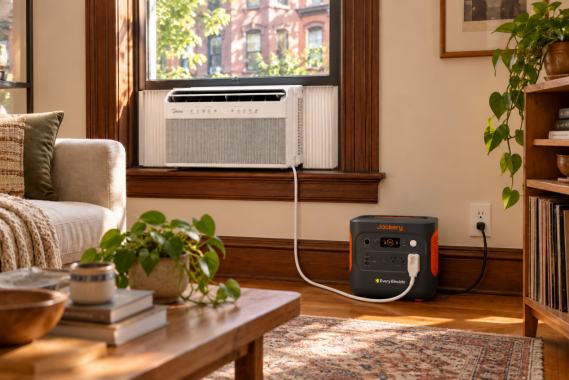
(Source: Huabao Xinneng)
Since the operation of the EE project, about 1,000 households have registered, 2,000 units of equipment have been delivered, and more than 15,000 air conditioners are on the waiting list; the project has relieved the Con Edison power grid of about 4 MWH (4,000 kWh) of electricity pressure; in the second and third quarters of this year, project users are expected to receive a total revenue of about 200,000 US dollars, which is enough to offset a month's summer electricity bill.
According to information, energy storage equipment is delivered directly from EE to residents. The setup process only takes 15 minutes. Plug-and-play and portable equipment have lowered the installation threshold and broadened the potential user pool of VPP: it is no longer limited to high-income households with their own homes; renters and low-income households that were previously excluded from traditional household storage are also included.
The project not only verified the viability of consumer-grade energy storage equipment as standardized terminals to participate in grid collaboration and complete response to residents' demand through cloud scheduling, but also demonstrated the economy of its business model: for aggregators, low installation costs, high standardization, and batch delivery characteristics mean that the friction cost of terminal access has decreased, and the business model is easier to scale.
Profit restoration in the main business to support the gradual migration of business logic
On the financial side, the restoration of the profitability of Huabao Xinneng's main business and the improvement of operational efficiency have given it more momentum to expand its VPP business.
Financial reports show that in the third quarter of 2026, the company achieved revenue of 1,469 billion yuan, an increase of 12.58%; net profit to mother increased 65.81% year on year, net profit without return to mother increased 1,212.10% year on year, and the profit improvement signal for a single quarter was clear; at the same time, gross margin increased 0.86 percentage points year on year to 37.95%, and sales expenses fell sharply by 5.87 percentage points year on year to 21.86% year on year. Both indicators improved simultaneously, confirming substantial progress in product structure upgrading and marketing efficiency optimization.
In the first three quarters, the company's revenue in Europe, North America and domestic markets all achieved significant year-on-year growth, with year-on-year growth rates of 91.35%, 26.05%, and 38.22% respectively. Overseas market growth provided more implementation scenarios for subsequent B-side cooperation; the revenue of core emergency backup products exceeded 600 million yuan, offline channels entered more than 10,000 physical stores, and the delivery, after-sales and service networks continued to increase.
As the company enters the virtual power plant business, its business logic is also shifting at multiple levels.
First, the definition of product value is changing. Traditional portable energy storage mainly addresses the need for “electricity during power outages” and is a value proposition for low-frequency, passive, one-time purchases. After being connected to VPP, the equipment can continuously generate revenue through peak and valley arbitrage and demand response during the non-power outage period, and the purchasing logic shifts from cost items to household energy assets, which is particularly attractive to the North American market where electricity prices fluctuate greatly and the VPP mechanism is more mature.
Second, the customer structure extends from the C-side to the B-side ecosystem. Huabao Xinneng's previous consumer group was mainly C-end individual users. Under the VPP model, its partners expanded to include utilities, VPP aggregators, installers, channel retailers, and energy service providers. This type of B-side customer has a long procurement cycle and a high certification threshold, but once they enter the qualified supplier system, order continuity and scale are far from comparable to C-side retail fluctuations.
Third, barriers to competition are shifting from channels and brands to “scheduling scale.” As industry evaluation standards shift from “who sells more” to “who aggregates more and can move”, Huabao Xinneng's cumulative sales volume of over 8 million units will sink into a considerable potential resource pool. If a higher activation rate is achieved through VPP access in the future, it is expected to not only contribute to increased performance, but also establish resource barriers that are difficult to replicate in the short term.
Overall, the progress revealed by Huabao Xinneng at this RE+ exhibition has outlined a path for the industry to enter the energy service ecosystem for consumer-grade optical storage. Revitalizing the huge stock of equipment into continuous service revenue is expected not only to reshape its profit structure, but the company's valuation logic is also expected to gradually upgrade from a consumer retail brand to a standardized terminal supplier in the energy service ecosystem.