


The Zhitong Finance App learned that the euro has fallen to a low of 18 points, and there is little sign that its decline is easing. Markets increasingly expect that next year's French election will continue to put pressure on the euro against the backdrop of France facing the double dilemma of increased political division and pressure on the fiscal situation. As of press release, the EUR/USD exchange rate was reported at 1.0966.
Weeks of political turmoil in France and market concerns about whether the country can pass the budget have pushed the EUR/USD exchange rate below the key mark of 1.10 this week, bringing the cumulative decline since late August to 6%. At the same time, France's fiscal difficulties have also raised questions about the ECB's room to raise interest rates, weakening the appeal of the euro.
Traders have shied away from the euro due to uncertainty about the fiscal policies of the two leading candidates in the 2027 French election poll. The two candidates are far-right leader Marina Le Pen and far-left leader Jean-Luc Mélenchon, respectively.
Le Pen said this week that he plans to lower the retirement age in France to a minimum of 60 years. Currently, she is leading the polls by a clear advantage. As the leader of the National League, Le Pen promised to cut France's payments to the European Union. If elected, this could cause tension between France and other EU member states.
The collapse of France's political center has heightened market concerns about how the country will manage its 3.6 trillion euro sovereign debt. Currently ranked second after Le Pen in most polls, Melanchon argues that he simply refuses to repay part of this debt (about 600 billion euros). He also called for heavy taxes on the rich.
James Bilson, a global fixed income strategist at Schroder Investments, said, “If France's current political environment is very difficult, then it actually underestimates the complexity of the situation.” He added: “From a political perspective, it seems extremely difficult to find a long-term solution to the budget problem — at this stage, I'm not sure exactly how to achieve this goal.
Thu Lan Nguyen, head of foreign exchange and commodity research at Commerzbank, said: “In 2027, political risk will once again shift in a direction that is not favorable to the euro.” Lynda Schweitzer, co-head of the global fixed income business of Loomis Sayles & Co., said that the agency established a short position in the euro in the past month due to political turmoil in France.
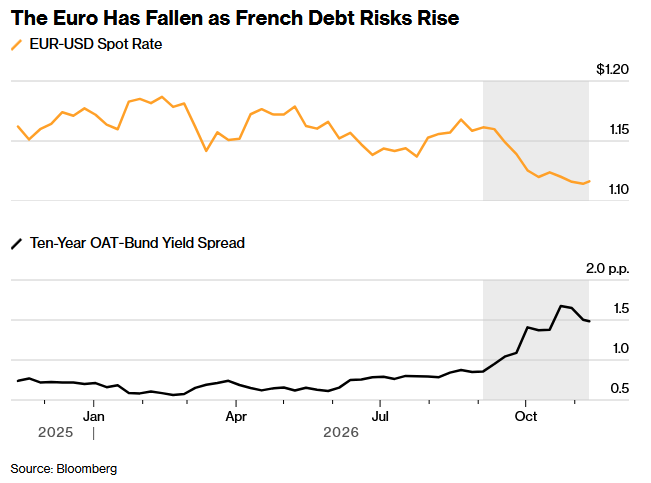
Euro continues to fall as French debt risk rises
Furthermore, Mizuho fixed income strategist Leejun Foo said that if French treasury bonds are sold more suddenly, the risk may spread to the entire Eurozone bond market and impact the euro. Leejun Foo said, “If the pressure on the French treasury bond market expands further and evolves into a broader sovereign debt crisis or market fragmentation event, it will push up the risk premium in the Eurozone and cause the EUR/USD exchange rate to face more significant downside.”
Investors were shocked by the speed and severity of the sell-off in French treasury bonds in September and October. On October 22, the wave of sell-offs reached its peak, and the spread on French treasury yields compared to safer German treasury yields rose to 178 basis points — more than doubling in just seven weeks, and reminiscent of the Eurozone sovereign debt crisis. Although bond yields have declined somewhat since then, Rabobank's macro strategists have described France's plight as a “slowly unfolding crisis.”
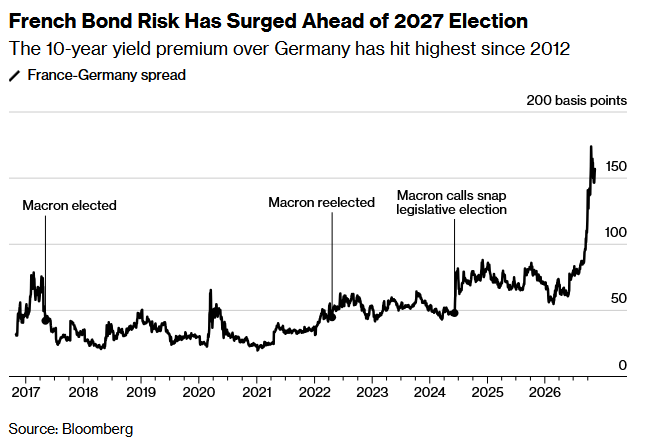
The risk of French treasury bonds rose sharply before the 2027 general election
The market's speculative bets on a further weakening of the euro have risen to the highest level in more than six years. According to weekly position data released by the US Commodity Futures Trading Commission (CFTC), hedge funds and other speculators are betting on weakening positions in the euro, which have reached around the highest level since the beginning of 2020. Meanwhile, according to market participants, traders who plan to sell when the euro rebounds are continuously lowering their selling price levels. This indicates that the market's confidence in the euro's prospects is weakening.
Regarding the future trend of the euro, Morgan Stanley and Commerzbank expect the exchange rate of the euro to fall to 1.08 against the US dollar next year. Roberto Mialich, senior global foreign exchange strategist at the Bank of San Paolo in Italy, said that as the EUR/USD exchange rate falls further below 1.10, market volatility may increase. If the EUR/USD exchange rate falls below the support level near the current level, it may fall further to 1.0730 — the low hit in March 2025. “The market is likely to quickly set a new trading range of 1.05 to 1.10 for the EUR/USD exchange rate,” he said.