


Mingchuang Premium once again issued a financial report showing an increase in revenue without an increase in profit.
On November 17, Mingchuang Premium (09896/MNSO.US) handed over the report card for the third quarter of 2026, with revenue of 6.625 billion yuan, a year-on-year increase of 14.3% and a gross profit margin of 45.3%, a record high of recent years; however, profit for the period was 290.6 million yuan, down 34.4% year on year, and adjusted net profit of 715 million yuan, down 3.5% year on year.
This is not the first time that Mingchuang Premium has increased revenue without increasing profits. In 2025, Mingchuang Premium's annual revenue was 21.44 billion yuan, up 26.2% year on year; profit during the year was 1,210 billion yuan, down 54.1% year on year. This is also the first time since the Hong Kong stock listing. In Q3 2025, revenue for the quarter increased by 28.2%, and net profit decreased by 31.6%.
While confirming the future narrative of Mingchuang Premium, some brokerage firms were also very straightforward in their analysis. At the same time, they expressed concern about continuing “revenue growth without profit growth.”
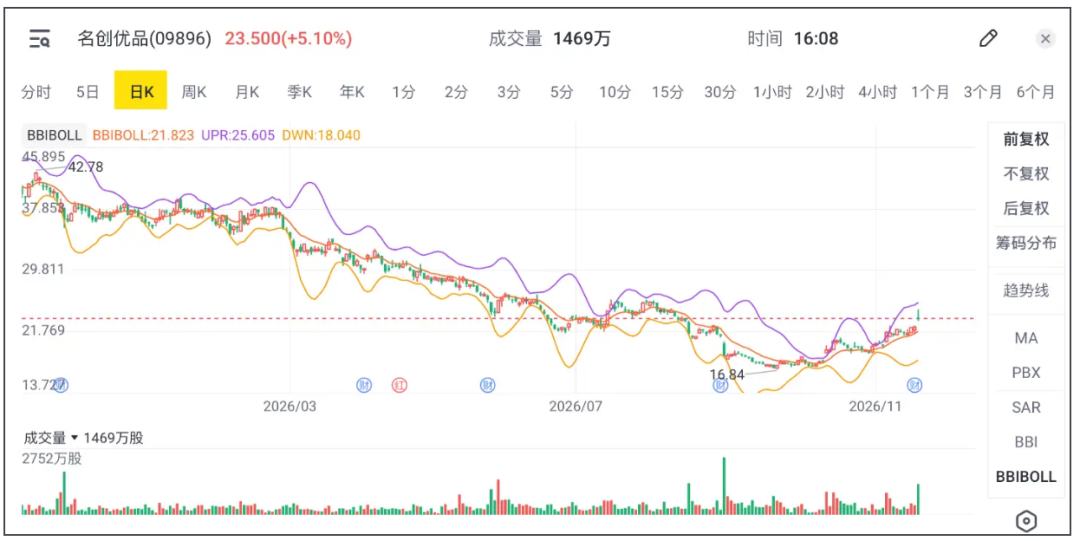
Chart: Mingchuang Premium Stock Price Chart
Source: Screenshot of Tiger Securities's “Handset Tech”
The question is, what are the profits of Mingchuang Premium being eaten up by? What are the profits that were eaten up in exchange for? If I can't get it back, what's the cost? These are the answers financial reports are worth seeking.
-01-Three places to lose profits
Judging from financial reports, this quarter, Mingchuang Premium's profit fell 34.4% year on year. This was not due to a single factor; it was the result of several branch lines running side by side.
The first line is that the store structure is getting heavier.
According to Mingchuang Premium's 2026 interim results conference, there are more than 120 major domestic amusement park stores, with an average of 1,200 square meters. The floor efficiency is about twice that of regular stores. The payback period is less than one year, and early stores can pay back as fast as six months.
In the third quarter, Mingchuang Premium's mainland stores achieved high single-digit growth, and have maintained positive growth for six consecutive quarters; however, the country's total net sales in the first three quarters increased by only 1.1% year-on-year. Under this kind of consumer market, the park store model is answering whether this investment is actually worth it.
However, one point to note is that the premise for the establishment of the big store logic is that Ping Xiao continues to climb the slope.
According to this market analysis, when amusement park stores advance from 120 to 1,200-1500 as planned by management, the quality of marginal site selection will inevitably decline, but rent and renovation costs will not be discounted at the same time.
Same-store growth and profit decline occurred at the same time, which also means that the output improvement in large stores has not outperformed the rate of rising costs.

Figure: Mingchuang Premium's revenue for the third quarter of 2026
Source: Screenshot of Mingchuang Premium's financial report “Handset Tech”
Second, the money is spent on rigid investment in IP, but our own IP is far from taking over.
According to the data, Mingchuang Premium's IP licensing fee was 356 million yuan in the first half of the year, an increase of 47.7% over the previous year; promotion and advertising expenses were 383 million yuan, an increase of 45.6% over the previous year. Both growth rates were far ahead of revenue.
In the first three quarters, the share of private IP and designer IP “reached a high single digit”. YOYO's GMV of an IP in the first three quarters exceeded 1 billion yuan. This sounds good.
However, if you look closely, the structural problems of Mingchuang Premium have not changed. It is more like an “Android” open IP ecosystem, which relies on massive authorized IPs to drive traffic, and license fees suppress profit margins for a long time.
For example, the share of private IP only climbed to a high single digit, and license fees rose sharply over the same period last year, indicating that the right to bargain is still in the hands of the authorized party, not in their own hands. This also means that IP incubation is a probabilistic business, but the costs are definitely deterministic.
The noise of non-main investment has also caused the profit of Mingchuang Premium to decline.
According to the data, in the third quarter, the investment in AI company MiniMax recorded a fair value change of 192 million yuan. The loss was a book loss, not a cash outflow. Yonghui's share loss narrowed from 145 million yuan in the same period last year to 32.1 million yuan, but it is still dragging down.
At the same time, TOP TOY actively reduced outsourced products, with revenue of 503 million yuan in a single quarter, down 12.5% year-on-year, from increase to decline.
Overall, big stores and IP are business decisions, and costs can be hedged with management improvements, but investing in AI and supermarkets is a capital decision, and losses can only be covered by the next capital decision.
The three lines were superimposed, causing Mingchuang Premium's sales expenses to increase by 28.8% year on year, sales expenses rose 2.9 percentage points year on year to 25.9%, and adjusted operating profit margin was reduced by 2.6 percentage points.
In other words, the cost growth rate is ahead of the revenue growth rate; this is an honest sign of the profit statement.
-02-Domestic boom, overseas stalled
Whether the money spent by Mingchuang Premium is worth it still depends on the actual growth rate of the store.
Looking at the region, there is no dispute that at home, Mingchuang Premium products are very popular.
According to data, in the third quarter, Mingchuang Premium's domestic revenue was 3.77 billion yuan, an increase of 29.6% over the previous year; the same store grew by a high single digit, which was positive for six consecutive quarters.
The membership system data is also quite solid. By the end of the third quarter, the number of members in China was about 140 million, single-quarter membership sales contributed more than 80%, and the number of black gold card members doubled year-on-year.
This shows that the “big store+IP+member” combo punch has indeed gone through a positive cycle in the domestic market.
But concerns about high domestic growth are also obvious.
For example, as the growth base rises, high-quality business district locations suitable for big stores become more scarce. Today, the flagship stores of the Amusement Park Group account for more than 15% of domestic stores. As stores continue to expand, there is downward pressure on the quality of site selection, and it will become more and more difficult to grow the same stores.

Figure: Status of Mingchuang Premium Store Network (as of September 30, 2026)
Source: Screenshot of Mingchuang Premium's financial report “Handset Tech”
If the domestic market is hot, the performance of Mingchuang Premium in overseas markets is more like slowly flowing water.
In the third quarter, Mingchuang Premium's overseas revenue was 2.35 billion yuan, an increase of only 1.7% over the previous year, which is a significant gap with domestic revenue of 29.6%.
Ye Guofu's statement at the performance meeting was to pursue “sustainable growth, not simply scale expansion.” But this also means that the profit model for overseas direct sales expansion is not as simple as expected in overseas markets.
The truth is that in the past few years, Mingchuang Premium's overseas direct-run stores have rapidly expanded, and rents, labor, and depreciation have increased along with the number of stores, but the output and profit of individual stores have yet to be verified over time.
If you look closely, the reasons are complex.
The company took the initiative to shrink agency channels and promote direct management transformation. Agents removed inventory and superimposed store closures in Southeast Asia and other places, which dragged down growth.
In addition, North America maintained relatively rapid growth, but in the second quarter, the growth rate slowed from about 50% in the first quarter to 25%.
Actively shrinking agency channels is a strategic choice, but direct-marketing itself is a matter of burning money, as rent, depreciation, and personnel costs of directly-managed stores rise along with the number of stores.
At the mid-term results meeting in August 2026, Ye Guofu also confessed that the direct business outside of North America “is still in the early stages of investment and has not yet been profitable.”
What can be seen is that Mingchuang Premium has begun to shift to an asset-light path. In the third quarter, Mingchuang Premium entered Lebanon and Austria in an asset-light model, covering 115 countries and regions around the world, moving in a lighter direction.
In fact, the shift from “heavy” to “light” overseas is a stop loss, and it is also a good thing. But it also means that as dependence on local partners deepens, control and profit sharing will be reduced.
The combination of cold and heat can be described as a rhythm, or it can also be described as domestic pits being filled for overseas. It's just when it will be filled up, and the company hasn't given a timeline.
Earlier, after the August Interim Report was released, Bank of China International lowered its target price for H shares from HK$34.4 to HK$20.6. At the same time, it also reiterated its “purchase”, predicting that the operating inflection point will occur as early as 2027.
-03-What is the market forgiving and betting on?
Of course, the market is still looking forward to Mingchuang Premium products.
After the financial report was released, US stocks rose more than 8%, and Hong Kong stocks rose more than 6% the next day. It shows that the market's pricing of this financial report has broken out of the single-quarter profit framework.
But the agency's attitude is interesting.
On November 18, after the financial report was released, Citi maintained a “neutral” rating, but raised the target price from HK$22.2 to HK$22.6. The reason was that China's business performance in the third quarter was outstanding and slightly better than expected, but there was still uncertainty overseas, which may drag down the peak season in the fourth quarter.
Qunyi Securities offered a “buy” with a target price of HK$23; Everbright Securities maintained a “buy”, but their logic was based on the simultaneous fulfillment of the three conditions of “same store efficiency improvement+overseas recovery+IP volume”.
According to many analysts, the market's affirmation of Mingchuang Premium is to reserve a place in advance for its narrative of changing from a channel provider to an IP operator.
After all, the major amusement park stores that create premium products are physical carriers. The membership system is a user base, and own IP is also a profit lever, and the TOP TOY spin-off is also a successful capital footnote.
However, the market still believes that this narrative is logically founded, but there are still a few cracks that cannot be covered up by financial reports.
First of all, Mingchuang Premium needs to solve the problem of the incubation speed of its own IP and whether it can beat the rigid growth rate of licensing fees and promotion fees.
Judging from the financial report for the third quarter, the year-on-year growth rate of the company's licensing fees has risen to 47.7%, and the proportion of private IP only reached a large single digit.
If the share of private IP climbs to 15% to 20% in the next two years, the leverage effect of licensing fees will only be released; however, if it does not climb up, cost rigidity will slide from strategic investment to structural issues.
Also, if the slow growth rate overseas continues, the market's patience may be repriced. After all, the difficulties of the self-operated model and whether the asset-light model can reduce reporting pressure are all an afterthought.
Needless to say, in the face of changes in the fair value of AI investment and the narrowing of Yonghui's losses, Mingchuang Premium is not within the scope of its main business capacity.
The current pricing logic in the market is very clear; that is, betting ahead of time for a slower, heavier, but likely longer lasting story. The game has already started, and the chips have been pushed to the center of the table, but the cards haven't been turned over yet.
The possibility of continuous pricing is based on the premise of whether high domestic growth can carry the base, whether overseas adjustments can see an inflection point around 2027, and whether private IP can rise from a single digit share to the top.
What Mingchuang Premium will do next is not to tell the story of the big stores and IPs again, but to let the next quarter's profit statement prove that the money spent has begun to go back and forth.
This article is reprinted from the WeChat account “Handset Tech”, Zhitong Finance Editor: Chen Yufeng.