


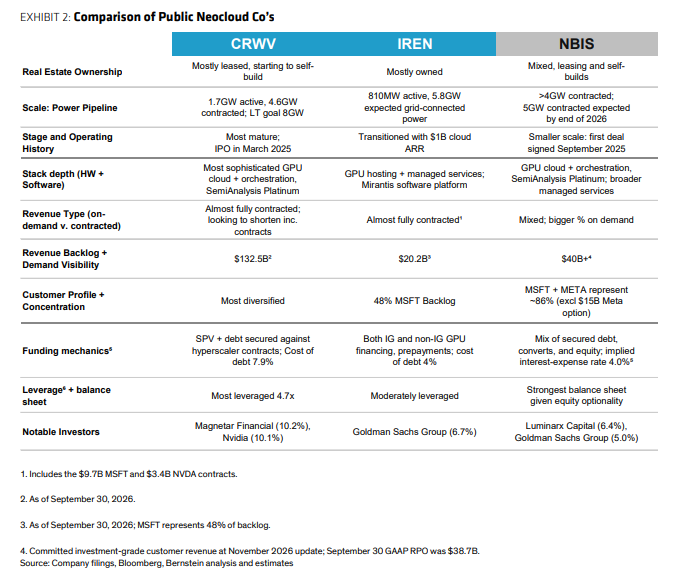
The Zhitong Finance App learned that Bernstein released an industry research report entitled “Neocloud in the Quarter 3Q26: Assembly Required”, which analyzed the third quarter business performance of the three leading AI computing power cloud vendors CoreWeave (CRWV.US), IREN (IREN.US), and Nebius (NBIS.US). The bank pointed out that the current demand for AI computing power is still hot, with customers signing longer-cycle contracts and increasing the scale of prepaid cash, but the pace of production capacity delivery is clearly divided, and changes in the capital market environment are forcing the industry to shift to a financing model driven by customer advance payments; at the same time, Nvidia (NVDA.US) is gradually shrinking its underwriting support for new cloud vendors, and the industry competition pattern is undergoing subtle changes.
Computing power prices have generally risen, and older generation GPUs have achieved price increases and contract renewals
Bernstein pointed out in the report that AI computing power supply and demand were tight in the third quarter. Not only did prices for new hardware rise, but the computing power prices of previous generation GPUs such as Ampere and Hopper also rose 30%-50% month-on-month. The economic benefits of short-term spot contracts were significantly superior to long-term locked contracts.
Following a 25% increase in all categories in July, CoreWeave raised prices again by 10% this quarter. According to company data, the annual revenue per megawatt of short-term contracts can exceed 40 million US dollars, while long-term contracts of 4 to 5 years only maintain 20 to 25 million US dollars/megawatts.
IREN's newly signed five-year long-term contract unit annual revenue of about US$22 million in megawatts, and the short-term contract surpassed 40 million US dollars/megawatt. After re-renewing the existing H100 GPUs, the contract price doubled.
Nebius, which was not officially covered and was used only as a comparison sample, quoted more than US$25 million per megawatt for projects signed in the third quarter, compared to US$20-25 million per megawatt in the second quarter. Customers are generally willing to accept longer contract periods while paying large upfront payments to lock in scarce computing power. However, the bank said that as the entire industry gradually starts production with the supply of new computing power, whether the current high prices can continue is the biggest point of disagreement in the market.
Signed production capacity ≠ actual revenue, and the delivery schedule of the three companies is significantly divided
Although the three companies have huge orders to be executed, there are multiple links in the middle, from obtaining electricity indicators, building construction, and completing cluster commissioning to finally generating revenue, and the pace of implementation of the three companies widened the gap.
At the end of the third quarter, CoreWeave achieved 1.7 gigawatts of computing power in use, maintained its target of 1.85 gigawatts or more at the end of the year, and raised the year-end annualized recurring revenue (ARR) guideline to US$20-21 billion. The company's backlog reached $132.5 billion, up 138% year over year and 27% month over month; delivery of more than half of the orders is scheduled to begin before the end of the year.
The company has signed an agreement to expand the total power scale to 4.6 gigawatts, of which 1.3 gigawatts are distributed outside the US. It has entered the Indian and Indonesian markets this quarter, while also expanding its business in Denmark and Spain. Revenue for the quarter was US$3.66 billion, up 168% year on year and 42% month-on-month; adjusted EBITDA reached US$2.26 billion, and profit margin expanded to 62%. Adjusted operating profit of US$379 million was achieved for the first time, achieving double-digit profit margins for the first time, reaching the target one quarter ahead of schedule.
It is worth noting that a large number of existing contracts for GPU devices will expire from 2027 to 2028:130,000 GPU contracts will expire in 2027, and 170,000 new units will be added in 2028; based on current price estimates, this batch of existing devices will be re-contracted, bringing in annualized revenue of nearly $4 billion in 2027, adding up to the 2028 batch of nearly $10 billion. However, the bank also pointed out that this part is a potential business opportunity, does not include confirmed in-hand orders, and is highly dependent on the future market pricing environment.
IREN postponed its $4 billion operating annualized revenue target from the end of 2026 to early January-February 2027 due to customer demand for network transformation and disruptions in hardware supply chain delivery times. As of the third quarter, IREN's cloud business's annualized operating revenue exceeded $1 billion, with overall on-hand orders of $20.2 billion. Two-thirds of the orders came from investment-level customers, including Microsoft (MSFT.US) orders of $9.6 billion, Nvidia (NVDA.US) orders of $3.4 billion, and the remaining $7.2 billion went to AI R&D companies, cutting-edge AI laboratories, and channel partners.
The company holds 5.8 gigawatts of stored electricity resources that have been connected to the grid. The total long-term pipeline size has reached 35 gigawatts, distributed in North America, Europe, and Asia Pacific. According to the phased construction plan: the first phase of the 0.3 gigawatt computing power plan will be implemented in February 2027; the target for the full year of 2027 will be increased by 0.5 gigawatts; resources from sites such as Spain, Oklahoma, and Australia will continue to be released after 2028.
Nebius also postponed its annualized revenue target of over $7 billion to February 2027, falling short of expectations due to the construction of a third-party hosted computer room. The company narrowed its 2026 full-year revenue guidance to US$3-3.2 billion; expected revenue for 2027 was US$120-13 billion, capital expenditure was US$40-45 billion, and plans to add 1 gigawatt of computing power, and the progress of its own site project was in line with expectations. Nebius recorded revenue of $981 million in the third quarter, of which $325 million was non-recurring revenue from the partner funding model.
The capital market environment is tightening, and the industry is turning to customer advance payments as a core source of capital
High capital expenditure is still the biggest characteristic of the new cloud industry, but external open market financing conditions have deteriorated. All three companies put customer advance payments and asset-level collateral financing first, and carefully control new unsecured debts at the parent company level.
CoreWeave raised the lower limit of capital expenditure guidance for the full year of 2026 to US$37 billion, capital expenditure for the third quarter of a single quarter was US$14.5 billion, and some equipment deliveries were brought forward from the fourth quarter to the current quarter. The company expects to receive $9 billion in advance payments and security deposits from customers over the next three months, of which more than $3 billion comes from renewals of existing depreciated infrastructure without additional capital investment.
By the end of the quarter, the company's cash, restricted cash and marketable securities totaled $6.5 billion, and the amount of unused deferred drawing loans was close to $5 billion; the weighted average cost of debt fell to 7.9%. Management determined that at the end of 2027, the new capital requirement at the parent company level was less than $5 billion, and the current contract cash flow could cover the principal and interest of the debt. But the risk was also significant: interest expenses for the third quarter were $846 million, more than double the adjusted operating profit ($379 million). Bernstein questioned that once industry supply is released, the environment of high premium contracts and high advance payments will no longer exist, and the company will face tremendous pressure to transition to its own hematopoietic model.
IREN cut capital expenditure for the remaining three quarters of fiscal year 2027 to $15 billion, and cut capital expenditure for the full fiscal year to $20 billion from the previous guidance of $25-30 billion. The $9 billion fund is already covered by cash on book and promised credit, and the remaining $6 billion is planned to be funded through special GPU financing, customer prepayments, and loans secured by $6 billion in unsecured data center assets.
Recently, the average prepayment ratio for GPU capital expenditure has reached 50%, and the prepayment ratio for some contract customers has reached 90%. The GPU-related capital expenditure of the Mackenzie project has already been fully covered by prepayment + special financing. The first phase of the company's 0.3 gigawatts of capacity funding corresponding to 4 billion US dollars of annualized revenue has already been implemented. Most of the future 0.5 gigawatts of incremental computing power has yet to be contracted, and subsequent financing capabilities depend on the customer structure.
Nebius signed more than 90% of the contracts in the third quarter with advance payment terms. The advance payment can cover 100% of the corresponding project capital expenses. In the second quarter, the ratio was only 50-60%. Management clearly stated that the capital market financing environment will directly affect contract strategy: when the financing environment is poor, there will be more preference for long-term, high-advance payment orders; when financing costs are low, more computing power can be retained to do high-premium short-term spot business.
Nvidia promises to shrink its undercover, and current leading manufacturers are expected to usher in a relatively favorable situation
Bernstein also specifically analyzes a major shift in Nvidia's support for the new cloud industry. In the past, Nvidia supported the entire Xinyun ecosystem through equity investment and order underwriting, etc., and the maximum amount of underwritten transactions promised to the outside world reached 118 billion US dollars. However, along with changes in management personnel, the company is tightening such underwriting commitments: the size of contingent commitments in the new cloud sector was reduced by $4 billion in a single quarter, from $36 billion to $32 billion; at the same time, a clear upper limit was set. If the agreed prerequisites cannot be met, the relevant commitments can be cut or even simply cancelled.
As far as the industry landscape is concerned, this change has two sides. On the one hand, it is difficult for new entrants to the market to obtain financial endorsements from Nvidia; on the other hand, CoreWeave and IREN, which have already completed large-scale construction, will benefit. Taking CoreWeave as an example, its data center leasing business is no longer backed by Nvidia. The debt collateral comes from commercial contracts from Microsoft, OpenAI, and Meta (META.US), and priority is given to completing the credit-driven model transition to customers.
However, the risk is objective: Nvidia holds about 10.1% of CoreWeave's shares. If the company's financial strategy is further tightened, the potential increase in stock supply will put pressure on the stock price. Judging comprehensively, Nvidia stepped behind the scenes and constituted a short-term stock price catalyst for CoreWeave and IREN, the two leading stock companies.
Bernstein maintained CoreWeave's “outperforming market” rating in the report, with a target price of $54. The bank said that although it acknowledged that the company's execution capacity improved and the financing plan was more clear this quarter, the core concerns were not dispelled: whether high pricing, generous advance payments, and the high benefits of renewing old GPUs will continue after the industry launches a large number of new production capacity. The valuation uses the forward enterprise value/adjusted EBIT multiplier, and the value is 22.5 times. The main upside risks come from delays in production capacity built by hyperscale cloud vendors, barriers to building their own software platforms, and continued shortage of electricity supply.
IREN maintains an “outperforming the market” rating, with a target price of $55. Optimistic about the new vertically integrated cloud business model. The customer structure is scattered to cover hyperscale cloud vendors, enterprises, and AI laboratories; with 5.8 gigawatts of electricity reserves connected to the power grid, they have the right to choose in a market environment where power resources are increasingly scarce, and can continue to expand with Blackwell and Vera Rubin's next-generation chip iterations. Risk points focus on high capital expenditure intensity, changes in the financing environment, delivery of land equipment falling short of expectations, and the need to continuously obtain orders from various types of customers.
Nebius is not covered by official ratings and is used only as a peer comparison target.