


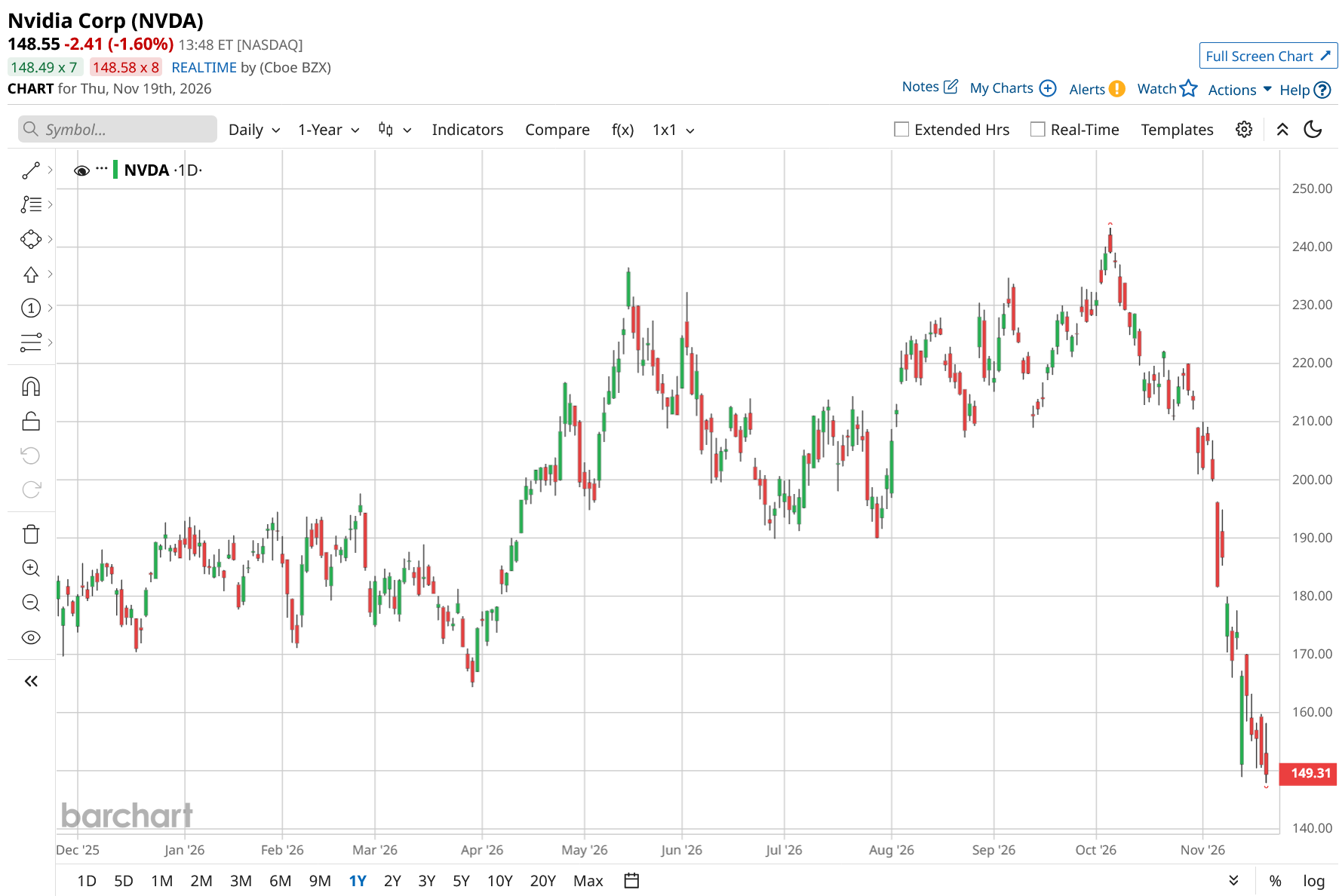
Nvidia (NVDA) hit a record $243.37 on Oct. 6, then fell to a 52-week low of $148.80 on Nov. 12, the day Jensen Huang resigned as CEO, president, and a board member. The selloff erased roughly $1 trillion in market value in six trading sessions. CFO Colette Kress took over as interim CEO, and NVDA stock was still about 35% below its peak heading into earnings.
On Nov. 12, “The Big Short” investor Michael Burry said he’d doubled his put position against the Nasdaq-100 ($IUXX) and that he expects chip stocks to get cheaper. Then, hours before the Nov. 17 earnings report, Muddy Waters disclosed a short position on Nvidia. The short seller questioned whether a former Nvidia executive had ties to a Super Micro (SMCI) executive named in a lawsuit involving alleged chip diversion to China. The stock was already down about 2% that day, and short interest stood at 1.16%.
Yet in its Q3 earnings results, Nvidia went on to beat Wall Street’s expectations, reporting $115.8 billion in revenue, up 103% from a year earlier. But it broke with its usual practice by reporting earnings without filing its quarterly Form 10-Q at the same time. The filing wasn’t overdue, but investors will have to wait for the fuller picture. So does Muddy Waters have a point, or do the latest results make NVDA stock harder to bet against? Let’s find out.
Is Muddy Waters’ Short Call on Nvidia Justified?
Muddy Waters is right to ask where Nvidia's chips actually end up, but the report doesn’t make a strong case that the stock is overvalued. The report asks whether restricted chips are reaching China through server suppliers. It points to a federal indictment alleging that three people tied to Super Micro Computer helped divert about $2.5 billion worth of servers containing the chips to China.
If some sales booked outside China ultimately depend on Chinese buyers, tighter enforcement could hurt demand. But the $2.5 billion is the alleged value of the servers, not what the chipmaker earned or what it stands to lose.
The report is less convincing when it tries to tie Nvidia directly to the alleged diversion. It cites photos of former executive Ajay Puri with a woman it hadn’t confirmed was Cenly Chen, who was named in a separate shareholder lawsuit. Super Micro Computer said Chen didn’t manage the relationship with the chipmaker or decide where the chips went. Even if the woman was Chen, the photos wouldn’t show that Nvidia knew about the alleged diversion.
What matters for investors is how much demand could disappear if export rules are enforced more tightly. Muddy Waters doesn’t put a number on it, and founder Carson Block said the short call wasn’t based on the company’s financial performance or valuation. It’s a risk worth watching, but the report doesn’t show that it’s big enough to change the earnings outlook or make the stock too expensive.
Results Set a High Bar
NVDA stock is down 20% over the past 52 weeks and also 20% year-to-date (YTD). It trades at 16.82x expected earnings, compared with 18.81x for the sector.
Sales are still growing quickly. In its Nov. 17 report for fiscal Q3 2027, which ended Oct. 25, Nvidia posted $115.8 billion in revenue, up 20% from the previous quarter and 103% from a year earlier.
Data Center revenue rose 21% from the prior quarter and 110% year-over-year (YoY) to $107.6 billion, or about 93% of total sales. Edge Computing revenue reached $8.2 billion, up 14% from the previous quarter and 42% from a year earlier. GAAP gross margin was 74.8%, with diluted earnings of $2.70 per share. On an adjusted basis, those figures were 74.9% and $2.68.
For Q4, Nvidia expects revenue to climb from $126.1 billion to $133.9 billion, even as gross margins fall to 71%-72% on both a GAAP and adjusted basis. It expects operating expenses of about $11 billion under GAAP and $10.7 billion on an adjusted basis. The full-year tax rate is expected to land between 16% and 18% on both bases, excluding one-off tax items and major changes to the company’s tax environment.
What Analysts Expect From NVDA Stock Next
Analysts expect Nvidia to earn $2.72 per share in the quarter ending January 2027, up 73.25% from $1.57 a year earlier. For all of fiscal year 2027, they expect earnings to more than double to $9.26 per share from $4.57, a gain of 102.63%.
Analysts are still upbeat about earnings, but some are less willing to pay up for the stock. James Schneider of Goldman Sachs kept his “Buy” rating but cut his price target from $300 to $220. He doesn’t expect Jensen Huang’s departure to hurt earnings much over the next 12 to 18 months, given the company’s 12- to 24-month order backlog and two- to three-year product plan. He compared it to Apple (AAPL) after Steve Jobs took medical leave in 2011: Investors paid less for each dollar of earnings at first, but the business kept delivering and won back their confidence.
Timothy Arcuri of UBS also kept his “Buy” rating and lowered his target from $300 to $240. He called worries about the product plan “overblown,” pointing to the company’s hardware and software lineup and its upcoming Rubin platform. Joseph Moore of Morgan Stanley kept his “Overweight” rating but cut his target from $300 to $267. He still likes the business but sees risks tied to China and uncertainty after Huang’s exit.
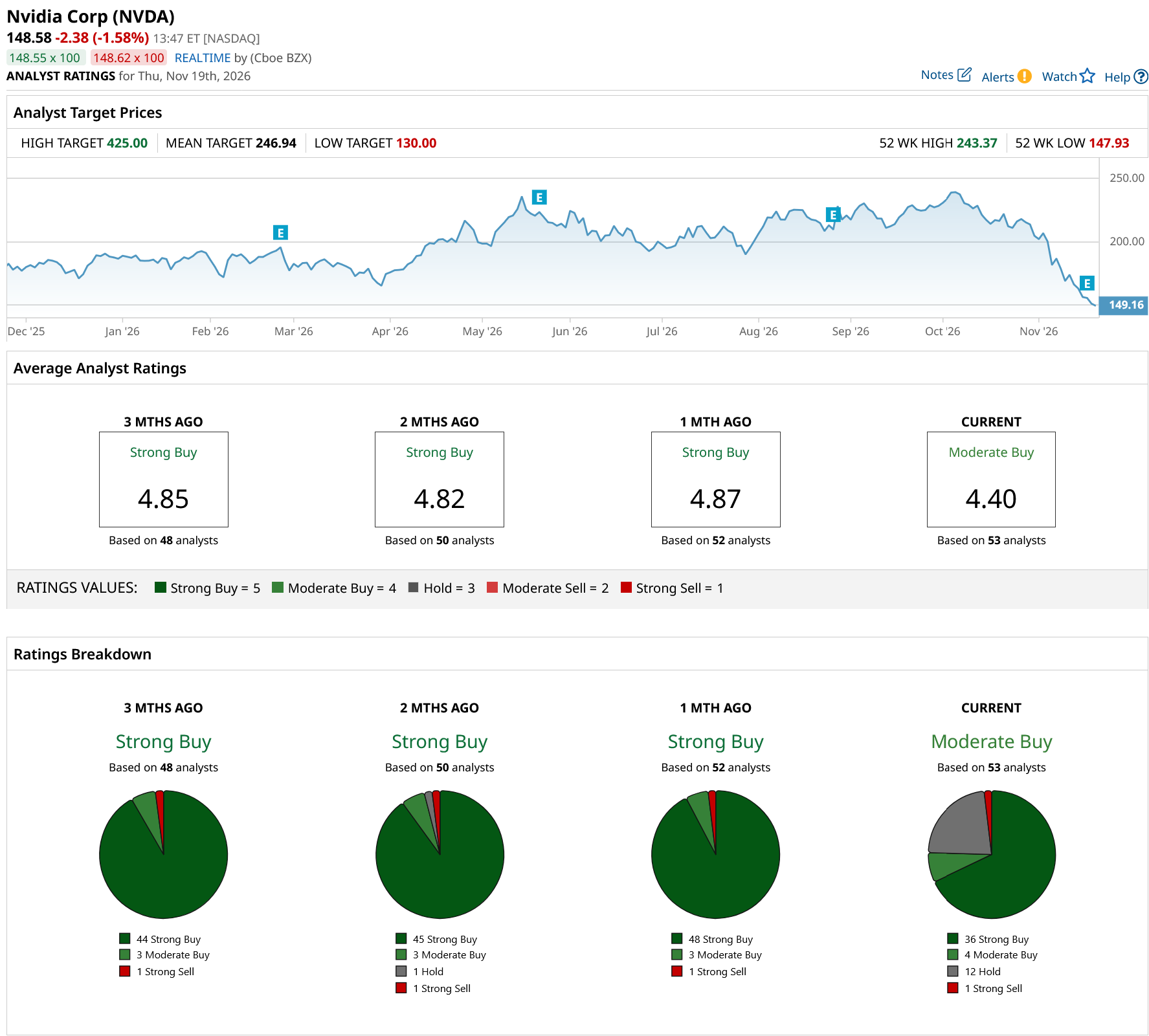
The consensus across 53 analysts is a “Moderate Buy.” Although it was a “Strong Buy” just a month ago. Their average target of $246.94 implies 66% upside from recent price levels.
Conclusion
Muddy Waters’ short is a reason to look closer at Nvidia, not a reason to sell on its own. The earnings beat shows that demand is still strong, but lower margin guidance and a 10-Q that hasn’t been filed yet give investors reasons to be cautious. My base case is that NVDA stays choppy in the near term but is more likely to grind higher over the next few quarters than fall further, provided the filing brings no material surprises and earnings keep growing. If margins come in weaker than Nvidia expects, even strong sales may not be enough to lift the stock.
On the date of publication, Ebube Jones did not directly have a position in any of the securities mentioned in this article. All information and data in this article is solely for informational purposes. For more information please view the Barchart Disclosure Policy here.