


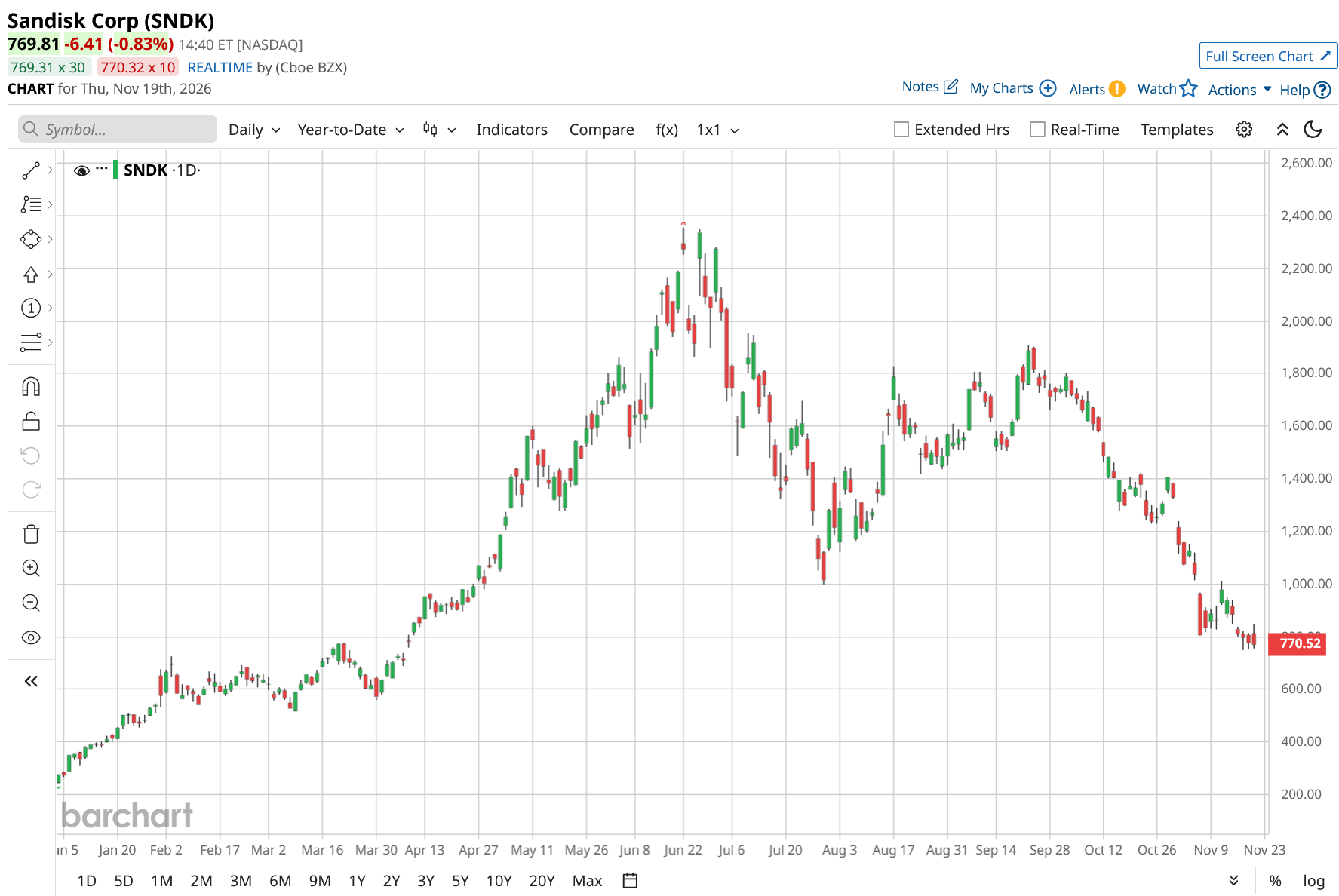
Sandisk (SNDK) has been one of the most dramatic winners in the AI-driven memory boom this year, but the stock has now entered a sharp correction. Shares have fallen 43.8% over the past month, extending a selloff that has erased a significant portion of the gains built earlier this year. The latest weakness comes despite the company reporting a record fiscal first quarter and issuing stronger-than-expected guidance for the current quarter.
The pullback reflects growing concerns about the sustainability of AI infrastructure spending, elevated NAND flash prices, and the possibility that memory demand could cool after a massive run. Sandisk has also been caught in the broader AI-stock selloff, with concerns surrounding Nvidia (NVDA) and data center spending weighing on memory and storage stocks. Moreover, investors are reassessing whether Sandisk’s exceptionally strong margins and earnings growth can be sustained.
With SNDK stock now sharply below its recent peak, is the recent plunge creating an attractive entry point, or is it signaling that Sandisk’s AI-driven growth story has become too dependent on peak memory pricing?
About Sandisk Stock
Sandisk is a leading data storage and flash memory company headquartered in Milpitas, California. The company designs, develops, and manufactures a broad portfolio of NAND flash storage products, including solid-state drives (SSDs), memory cards, USB flash drives, and embedded storage solutions. The company’s market cap has expanded dramatically, with its current standing at $110.5 billion.
Sandisk has delivered extraordinary returns over the past year, but the stock has recently undergone a brutal reversal. Shares are up 213% over the past 52 weeks and 225% year-to-date (YTD), reflecting the explosive investor enthusiasm surrounding the company’s exposure to the AI-driven surge in data center storage and NAND flash demand.
However, that momentum has broken sharply. Sandisk stock has slumped 44.3% over the past six months and is now 67% below its 52-week peak, highlighting the severity of the recent correction.
The selloff has been driven less by a deterioration in Sandisk’s near-term fundamentals and more by mounting concerns over the sustainability of elevated NAND prices, the potential for a 2027 memory glut, and broader doubts about the pace of AI infrastructure spending.
GF Securities recently warned that NAND oversupply could emerge next year as supply growth accelerates while consumer electronics demand weakens. As a pure-play NAND company, Sandisk is particularly exposed to any deterioration in memory pricing.
Moreover, the stock has also been caught in a broader semiconductor selloff, while concerns over AI spending, regulatory uncertainty surrounding data center construction, and weakness across memory peers have amplified the pressure on SNDK.
Notably, amid this pullback, the company is completing an 8-for-1 forward stock split after the market closes today, Nov. 19, with shares set to begin trading on a split-adjusted basis (at roughly one-eighth of the pre-split price) at the market open on Friday, Nov. 20.
SNDK stock is currently trading at a discount compared to the sector median, at 6.22 times sales and 3.92 times earnings.
Robust Q1 Financial Performance
Sandisk reported its fiscal first-quarter 2027 results on Oct. 29, for the quarter ended Oct. 2. Revenue jumped 378% year-over-year (YoY) to $11 billion. The growth was broad across the company’s end markets, although data center demand was the standout.
Data center revenue surged to $4.8 billion from $269 million a year earlier, while Edge revenue climbed 320% to $5.8 billion from $1.4 billion. Consumer revenue, however, declined 39% to $397 million from $652 million, showing that the current growth story is being driven overwhelmingly by enterprise and AI-related storage rather than consumer demand.
Profitability improved even more dramatically as non-GAAP gross margin increased to 85.1% from 29.9%. Its operating expenses rose 17% to $598 million, while operating income jumped to $8.8 billion.
Its non-GAAP net income surged to $7.6 billion from $181 million, and non-GAAP EPS increased to $49.51 from $1.22, ahead of expectations. The magnitude of the improvement underscores how dramatically the company’s earnings profile has changed as memory pricing and AI-driven storage demand have strengthened.
Cash generation was another major positive. Operating cash flow jumped to $6.4 billion from $488 million, while free cash flow increased to $6.3 billion from $438 million. Sandisk also returned $5 billion to shareholders through share repurchases during the quarter, buying back approximately 3.2 million shares.
Furthermore, management issued another strong outlook for fiscal Q2 2027, calling for revenue of $12.2 billion to $12.6 billion. The company expects non-GAAP gross margin to be 84.5% to 85.5%. Non-GAAP EPS is expected at $55 to $57 on a pre-split basis. Management also expects non-GAAP operating expenses of $540 million to $560 million.
Analysts remain optimistic, forecasting EPS of $226.01 for fiscal 2027, a substantial 225.7% YoY jump, followed by a further 26% rise to $284.86 in 2028.
What Do Analysts Expect for SNDK Stock?
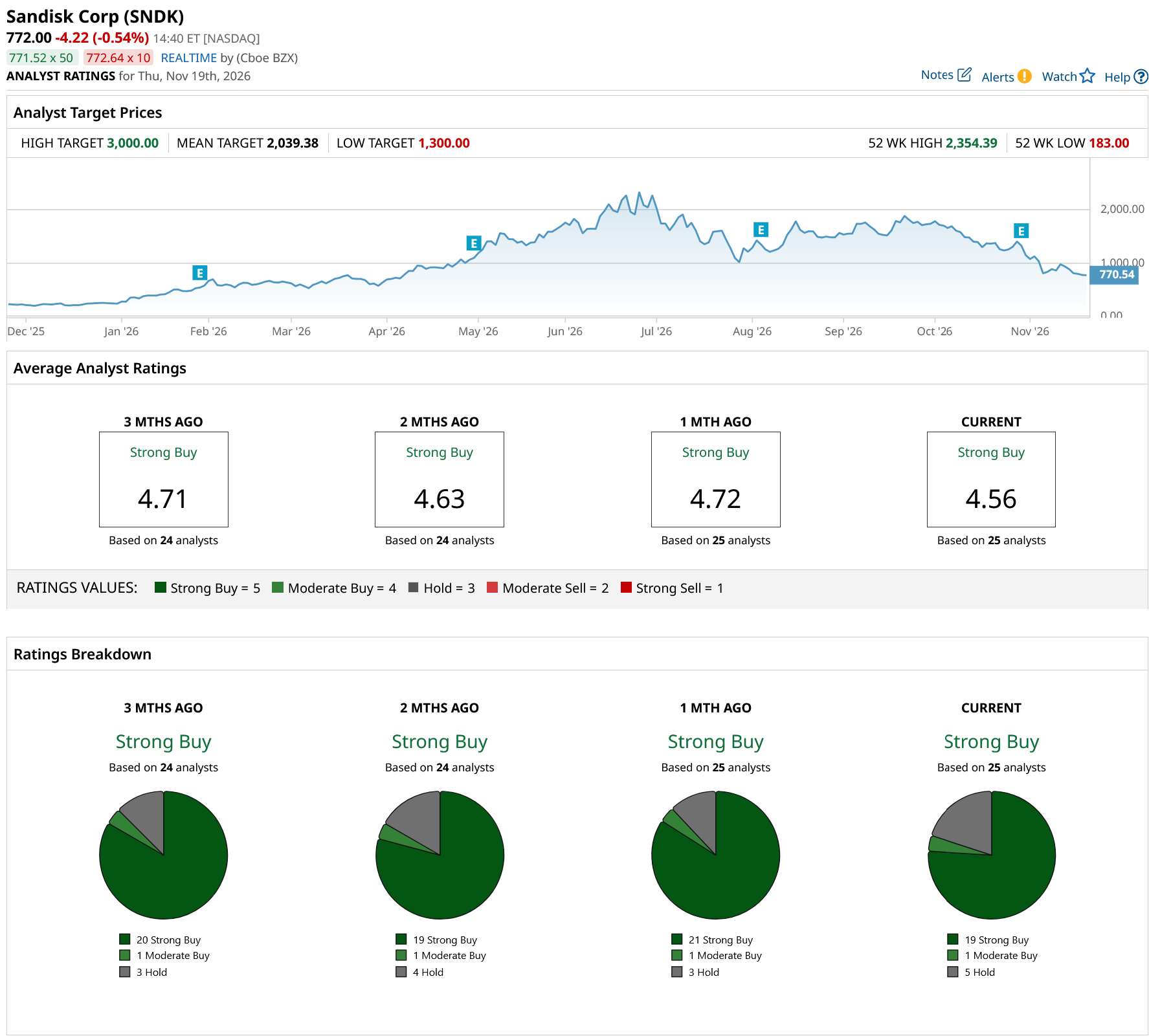
Most recently, Bernstein analyst Mark Newman maintained a “Buy” rating and a $3,000 price target on SNDK, reiterating his bullish long-term view despite the stock’s recent sharp pullback.
Furthermore, Morgan Stanley analyst Joseph Moore maintained an “Overweight” rating and a $1,750 price target on Sandisk following its fiscal Q1 results.
Overall, SNDK stock has a consensus “Strong Buy” rating. Of the 25 analysts covering it, 19 advise a “Strong Buy,” one suggests a “Moderate Buy,” and the remaining five analysts are on the sidelines, giving it a “Hold” rating.
SNDK’s average analyst price target of $2,039.38 indicates an upside of 164%, while Bernstein’s Street-high target price of $3,000 indicates that the stock could rally as much as 289%.
On the date of publication, Subhasree Kar did not directly have a position in any of the securities mentioned in this article. All information and data in this article is solely for informational purposes. For more information please view the Barchart Disclosure Policy here.