


The Zhitong Finance App learned that the increase in consumer prices in Japan in October accelerated to the fastest rate in the year, further consolidating the reason why the Bank of Japan will raise the benchmark interest rate next month. According to data released by Japan's Ministry of Internal Affairs and Communications on Friday, the consumer price index (CPI), which excludes fresh food, rose 2.2% year over year — the biggest increase since December last year, but still slightly below the 2.3% median forecast by economists. Excluding fresh food and energy, the core CPI — the basic inflation indicator closely monitored by the Bank of Japan — also rose 2.2%; overall CPI rose 2.3%.
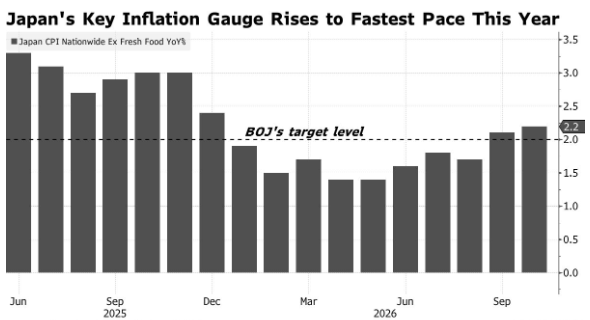
The increase in the latest month was mainly driven by energy costs: overall energy prices rose 2.2% year on year, reversing the September decline; the increase in expenses related to mobile phones accelerated from 10.9% to 17.2%, which also boosted the overall index. Policymakers are now increasingly concerned about the upward risks brought about by rising energy costs, the continued weakness of the yen, and rising semiconductor prices under the AI boom.
The Bank of Japan's goal shift: from “push up” to “pin down”
Friday's data will provide strong support for the Bank of Japan's December meeting to adjust the benchmark interest rate. The Bank of Japan has made it clear that the policy goal is no longer to push underlying inflation to the 2% target, but to stabilize it around this level. Last month (October 30 meeting), the central bank indicated that underlying inflation had reached the target level for the first time since setting the target in 2013 — a Reuters report at the time marked a “victory” in an anti-deflation battle that had continued for nearly 14 years, entering a new phase of more hawkish policy, and raising interest rates every few months thereafter became an option.
Governor Ueda Kazuo reiterated this position in Congress this week: the central bank is preparing to continue to raise interest rates to ensure that underlying inflation is stable and anchored around 2%; he warned that the core CPI increase could clearly exceed 2% — companies are shifting labor costs, high oil prices, and the continued weakening yen. Coupled with global demand brought about by the AI construction boom, all injecting additional inflationary impetus.
The wholesale side's signal is one step earlier: the corporate commodity price index rose 7.1% year on year in October, higher than the expected median value of 6.5%, and the increase in energy and industrial materials prices is being fully transmitted downstream.
The probability of interest rate hikes in December is as high as 86%
As of press release, the swap contract shows that the probability that the Bank of Japan will raise interest rates on December 18 in the market is about 86%. According to the agency's November 11-18 survey of 71 economists, 61 (86%) expect the central bank to raise interest rates in December — if true, this will be the first time in 37 years that they will raise interest rates three times in a natural year; of the 61 people who expect to raise interest rates, nearly 60% believe that policy interest rates will rise by another 25 basis points to 1.75% by the end of March next year. The current policy interest rate is 1.25%, which is the highest level since 1995.
The 30% drop in rice prices has overshadowed broader pressure to increase prices
The price of services — a key measure of the sustainability of inflation — rose 1.4% year over year. Excluding fresh food, the increase in food prices slowed to 2.2% because the price of rice fell by nearly 30% year on year, the biggest drop since data were available in 1971; just a year ago, rice was one of the main drivers of overall inflation. The sharp drop in rice prices is actually a base effect of the previous year's high: the price of rice in Tokyo's leading indicator for October fell by 31.3%, due to surplus inventory and low prices for new rice.
According to the Dai-ichi Life Economics Research Institute, the apparent slowdown was mainly due to the decline in special factors — rice prices and the misaligned water price last year were lower, and the upward trend continued after exclusion, and reminded that core inflation may exceed 3% in early 2027. Ryosuke Katagi, a market economist at Mizuho Securities, also pointed out earlier that due to the situation in the Middle East, prices of foodstuffs and daily necessities without rice are expected to maintain a strong rise.
Transfer of enterprises and wage increases for workers
Companies have always been flexible in dealing with rising operating burdens in all aspects, from energy to transportation and packaging — this is a product of the weakening of the Japanese yen under the dollar due to the intensification of the war in Iran. Labor shortages have also forced companies to raise wages to retain people. According to statistics from Teikoku Databank (Teikoku Databank), major Japanese food and beverage companies plan to raise prices for 1,477 products this month, almost ten times that of a year ago.
However, although the reasons for raising interest rates are being strengthened, the constraints are also clear. According to data released by the Cabinet Office on November 16, Japan's actual GDP contracted by 0.1% at an annual rate in the third quarter, the first negative growth in four quarters. Private consumption fell 0.3% month-on-month and was negative for two consecutive quarters — Ueda said that consumption fell within the expectations of the central bank, mainly due to rising living costs and bad weather, and consumption is expected to return to moderate growth.
Within the central bank, there was no one-size-fits-all: two members voted against the September interest rate hike resolution, and the dovish member Asada Unichiro, nominated by Prime Minister Takaichi Sanae, recently expressed caution about the pace of interest rate hikes; while at the October meeting, hawkish member Takada Hajime proposed a direct interest rate hike to 1.5%, but it was not approved. The consumption tax reduction bill currently being considered by the National Assembly may lower consumer prices by about 1.3 percentage points on a statistical scale — this means that the next few months may diverge from the core inflation trend, adding another judgment question to the “data-dependent” central bank.
“The Bank of Japan's policy focus has changed from 'getting rid of deflation' to 'preventing excessive inflation',” Maeda Kazutaka, a senior economist at the Meiji Yasuda Research Institute, commented after the October meeting. “Instead of sticking to the six-month interval previously assumed, the central bank may now consider raising interest rates every three months. The December meeting is a credible window for the next rate hike.”