


Memory chips used to be the most cyclical, generic corner of the semiconductor market. In 2026, Micron Technology (NASDAQ:MU) changed that.
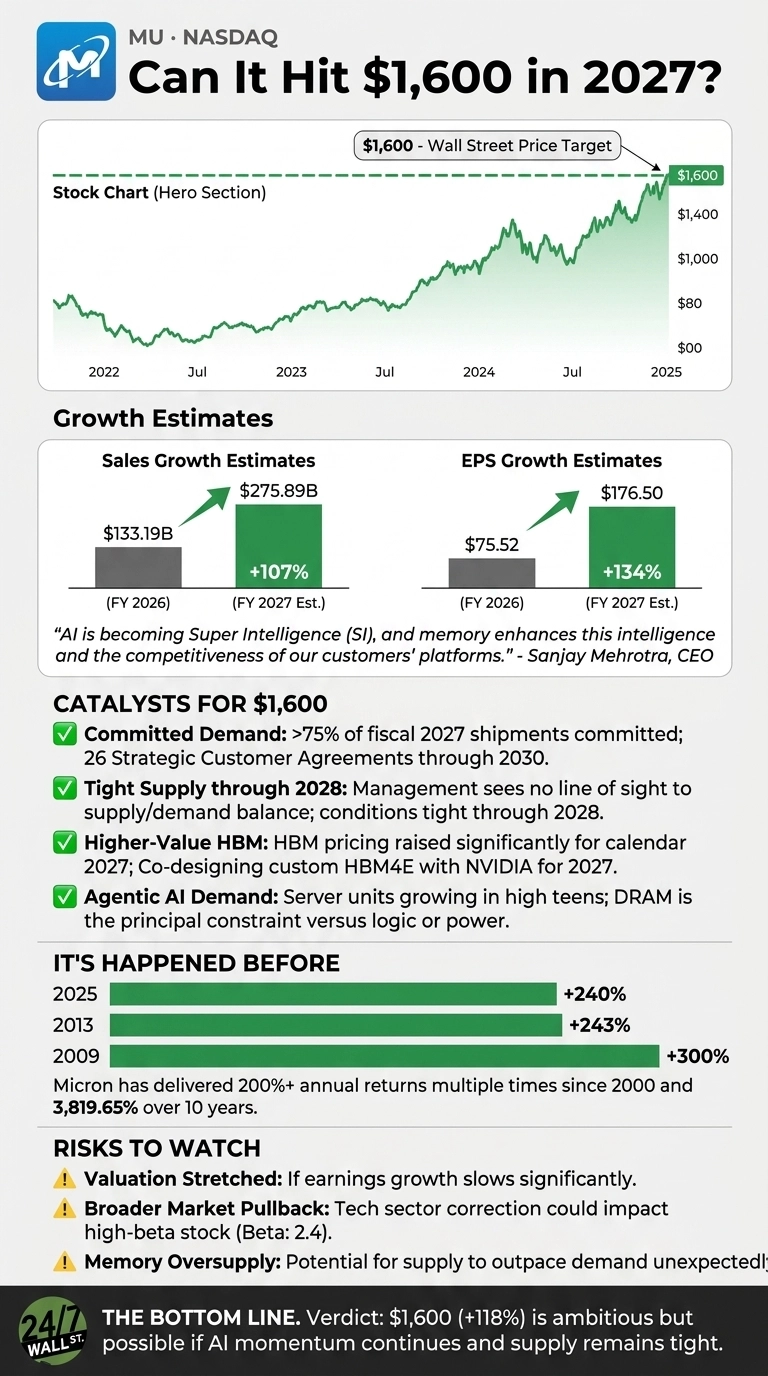
Fiscal 2026 revenue reached $133.19 billion, up 256.3%, and fiscal Q4 non-GAAP gross margin hit 87% versus 45.7% a year earlier. The Q4 release is out. In it, CEO Sanjay Mehrotra said: “AI is becoming Super Intelligence (SI), and memory enhances this intelligence and the competitiveness of our customers’ platforms.”
Shares are up 157.38% year to date. They have also fallen 18.89% over the past month, leaving the stock about 41% below its 52-week high of $1,254.61. That pullback raises the question for this article: what would Micron need to do to reach $1,600 in 2027?
Analysts See More Than 100% Upside for MicronThe average analyst price target of $1,561.91 implies about 113% upside from today’s $734. Analysts are heavily bullish: 45 rate the stock a Buy or Strong Buy, and only 1 rates it a Strong Sell.
 24/7 Wall St.
For fiscal 2027 (ending August), the consensus calls for $275.89 billion in revenue, about 107% growth. The EPS estimate of $176.5017 is roughly 134% above fiscal 2026’s $75.52.
Ninety days ago, that EPS estimate was $155.7946. Micron has also beaten EPS estimates nine straight quarters, so actual results could land above these forecasts.
Here’s What It Takes for Micron to Reach $1,600At $734, Micron trades at just 4x fiscal 2027 estimates. At $1,600, that multiple would still be only 9x, far below the S&P 500’s forward multiple of roughly 22x. On fiscal 2028 EPS estimates of $207.7605, $1,600 works out to about 8x.
Memory stocks usually get low multiples because investors are pricing in the next downturn, but the bull case says Micron’s long-term customer contracts take some of that cycle risk away.
What Could Push Micron to $1,600?- Committed demand: Micron has signed 26 Strategic Customer Agreements running through 2030, and more than 75% of fiscal 2027 shipments are already committed.
- Supply is tight. Management said, “We really don’t have line of sight to when supply and demand balance.” CFO Mark Murphy expects conditions to stay tight through 2028.
- Higher-value HBM: Micron raised HBM pricing “significantly” for calendar 2027. It is also co-designing a custom HBM4E product with NVIDIA (NASDAQ:NVDA), with HBM4E volume production targeted for calendar 2027.
- Agentic AI: Server units are growing “in the high teens,”. Management called DRAM “the principal constraint versus logic or power to the data center.”
- Near-term guidance: Fiscal Q1 2027 guidance calls for $61.5 billion ± $1.5 billion in revenue and $38.15 ± $1.00 in non-GAAP EPS.
Getting to $1,600 requires a gain of about 118%. Based on split-adjusted prices, Micron has topped that in three full calendar years since 2000: 300% in 2009, 243% in 2013, and 240% in 2025. The 157.38% gain so far in 2026 would make a fourth. Over 10 years, shares have returned 3,819.65%.
With a market cap near $798 billion, doubling again is harder. A beta of 2.398 also means losses can be as sharp as gains. We reverse-engineered what the biggest tech successes looked like before their runs and turned it into a free playbook you can grab here.
Is $1,600 Realistic? Here’s My TakeReaching $1,600 would require Micron to gain about 118%. Analysts already see 113% upside, earnings estimates keep going up, and even $1,600 would value the stock at only 9x forward earnings.
The main risks are a memory oversupply or a slowdown in AI spending, but management sees tight supply through 2028, and three-quarters of next year’s shipments are already committed. Returns at this level are rare, and this is the pattern for how Micron could deliver outsized gains in 2027.