


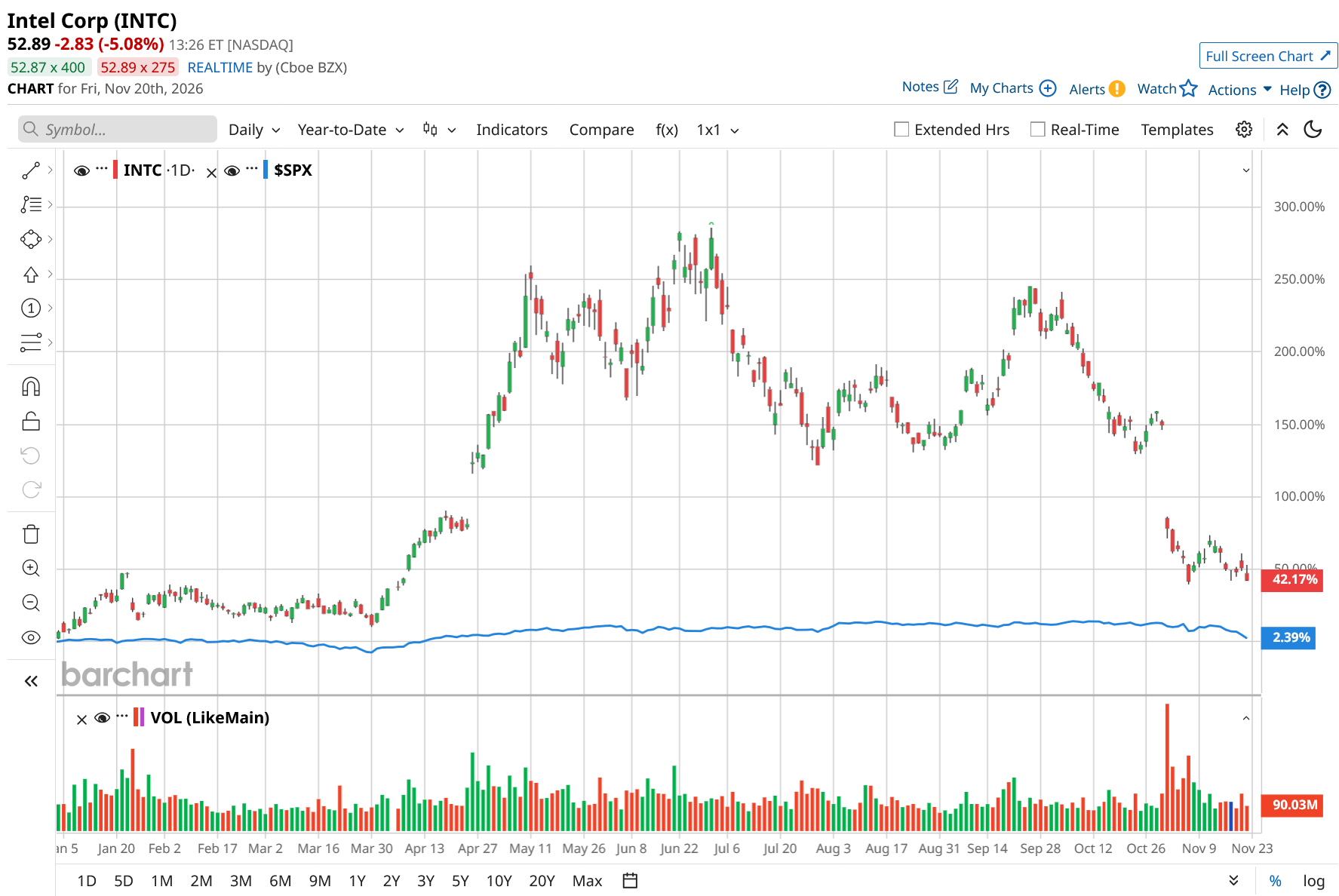
Chip giant Intel (INTC) has had a bumpy 2026, and investors have felt every jolt. The stock hit as high as $142.35 in June, only to give up those gains and fall to around $53. The big hit came after Intel’s third-quarter earnings on Oct. 29. The results looked good on paper, but the company warned that fourth-quarter revenue would come in lower than expected, blaming a sluggish PC market and manufacturing bottlenecks. Investors didn’t take it well.
On Oct. 30, INTC stock dropped nearly 29%, its biggest one-day fall in decades. The steep drop has since opened another front for the company, with shareholders taking legal action over alleged misleading disclosures. This month, shareholders filed a lawsuit against Intel, claiming CEO Lip-Bu Tan and CFO David Zinsner “engaged in a scheme to deceive the market.” The proposed class action, filed in federal court in California by Robbins Geller Rudman & Dowd for The City of Southfield Fire and Police Retirement System, says the two leaders didn’t share how big the PC slowdown really was.
Investors argue this “artificially inflated” the stock price and amounted to fraud. Intel is also reportedly cutting jobs again, according to Business Insider. Employees have posted on social media about layoffs in the company’s IT team. The company had about 81,000 employees at the end of September, down from roughly 85,000 at the end of 2025. The good news for investors is that layoffs are costing less than before. Intel spent $55 million on severance and benefits last quarter, compared with $146 million in the September 2025 quarter.
So far this year, the company has spent $290 million, versus $1.754 billion in 2025. With operational challenges persisting and investor confidence under pressure, the road ahead looks increasingly uncertain. So, should investors approach INTC stock now?
About Intel Stock
Intel has spent the past few years navigating a difficult stretch, but the semiconductor heavyweight is now undergoing a significant transformation. Founded in 1968 and headquartered in Santa Clara, California, the company built its reputation on the processors that power PCs. However, its ambitions now reach well beyond traditional computing.
Intel's business spans client computing, data center and artificial intelligence (AI) processors, networking and edge computing, as well as Intel Foundry Services (IFS), its expanding contract chip manufacturing business. This strategic shift comes at a pivotal time for the semiconductor industry, as the AI boom reshapes competition and creates new opportunities for chipmakers. Intel is looking to reclaim its competitive edge on two fronts: chip design and advanced semiconductor manufacturing. However, the road to recovery is far from straightforward.
Years of slowing growth, margin compression, declining earnings, and eroding investor confidence have allowed rivals such as Nvidia (NVDA) and Advanced Micro Devices (AMD) to pull ahead, particularly in the AI chip market. With a market capitalization of approximately $296.15 billion, Intel has also delivered a rollercoaster performance in 2026. After scaling a 52-week high of $142.35 in June, the stock has since retreated nearly 61%.
The recent pressure has been particularly severe, with shares tumbling approximately 42% over the past month as uncertainty surrounding the company's third-quarter earnings and outlook weighed on sentiment. Yet, zooming out paints a different picture. Intel shares remain up roughly 57% over the past year and 43% so far in 2026, comfortably outperforming the broader S&P 500 Index ($SPX), which has gained 7.3% over the past year and 2.5% in 2026.
Inside the Q3 Earnings Report
Intel delivered a strong fiscal 2026 third-quarter performance, comfortably beating Wall Street's revenue and earnings expectations. However, the upbeat results were overshadowed by a disappointing fourth-quarter outlook, as management flagged continued weakness in the PC market. The cautious guidance caught investors off guard, triggering a sharp double-digit decline in the stock.
For the quarter, revenue climbed 21% year-over-year (YoY) to $16.5 billion, edging past analysts' consensus estimate of $16.4 billion. The improvement extended to profitability, with gross margin expanding to 43% from 38.2% in the year-ago quarter. Operating margin also advanced 10.3 percentage points to 15.3%. Adjusted earnings came in at $0.52 per share, surging 126% YoY and comfortably beating Wall Street's estimate of $0.40.
Meanwhile, Intel generated $5.1 billion in cash from operations, underscoring stronger cash generation during the quarter. A closer look at the segment breakdown reveals a shifting growth profile, with enterprise AI infrastructure and manufacturing services gaining momentum even as consumer-facing PC demand remained under pressure.
The Data Center and AI (DCAI) group emerged as the standout performer, with revenue soaring 78% YoY to $7.3 billion. Intel Foundry also delivered impressive growth, with revenue jumping 58% to $6.7 billion. In contrast, the newly renamed Client Computing and Physical AI Group (CCPG) recorded a 5% YoY revenue decline to $8.1 billion, reflecting continued headwinds across the PC market.
Intel also took a major step toward strengthening its financial flexibility and funding its long-term manufacturing and AI ambitions. During the quarter, the company completed a $23 billion public equity offering, helping expand total current assets to $82.6 billion and reinforcing its investment-grade credit rating. However, the strong quarterly performance failed to translate into a positive market reaction, largely because of Intel's cautious forward guidance.
For fiscal Q4 2026, management projected revenue of $15 billion to $16 billion, falling short of Wall Street's consensus estimate of approximately $17 billion. The company also guided for GAAP EPS of $0.10 and adjusted EPS of $0.25. With the revenue outlook pointing to a potential slowdown despite a strong quarterly beat, investors are left weighing Intel's improving fundamentals against the challenges still confronting its turnaround.
How Do Analysts View INTC Stock?
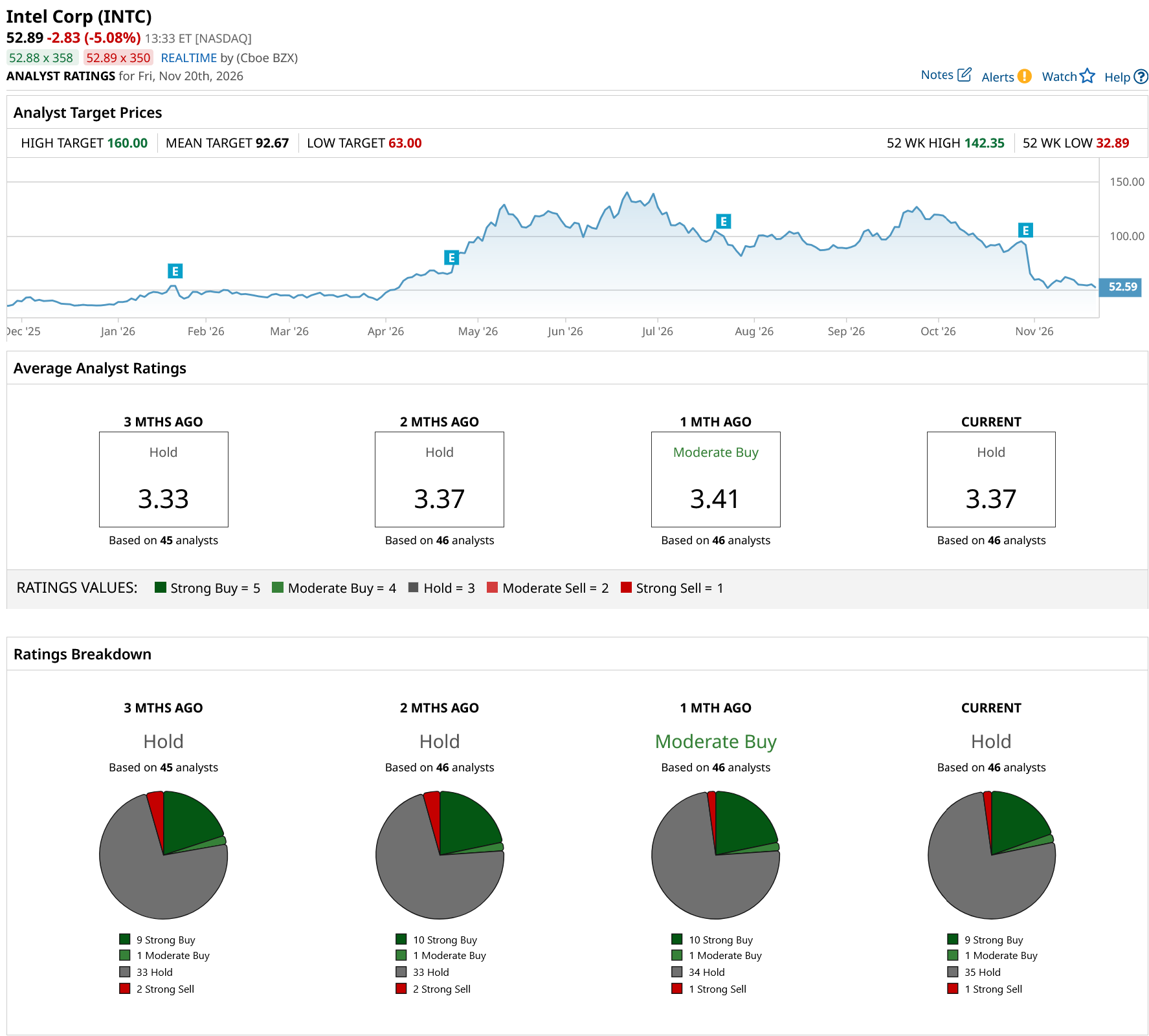
Wall Street is taking a wait-and-see approach to Intel, with the stock carrying a consensus “Hold” rating. Among the 46 analysts covering INTC stock, nine recommend a “Strong Buy,” one assigns a “Moderate Buy,” 35 maintain a “Hold,” and one gives a “Strong Sell.” However, the price targets suggest considerable upside potential. The average target of $92.67 points to a potential 75% rally, while the Street-high target of $160 signals a whopping 203% upside from current levels.
On the date of publication, Anushka Mukherji did not directly have a position in any of the securities mentioned in this article. All information and data in this article is solely for informational purposes. For more information please view the Barchart Disclosure Policy here.