


- Johnson & Johnson has completed the first commercial installation of its OTTAVA robotic surgical system at Memorial Hermann-Texas Medical Center and reported Phase 4 TREMFYA data showing clinically meaningful improvements in psoriatic arthritis with axial involvement.
- The OTTAVA launch and TREMFYA results both speak directly to Johnson & Johnson’s push to strengthen MedTech execution while deepening its immunology drug portfolio for complex inflammatory disease.
- We will now look at how Johnson & Johnson’s investment narrative may shift as OTTAVA’s rollout begins to shape MedTech expectations.
Scan how Johnson & Johnson’s push into surgical robotics compares with other hospital tech plays by reviewing a curated set of 53 AI infrastructure stocks.
Johnson & Johnson Investment Narrative Recap
To own Johnson & Johnson, you need to believe the mix of MedTech and Innovative Medicine can keep generating dependable cash flows while new products offset legacy headwinds and tighter margins. According to LunaRodas, an investor in the Simply Wall St Community, management already acknowledged MedTech underperformance as self inflicted, so a key short term catalyst is proof that execution improves from here.
The biggest risk right now is pressure on profitability, with net margins at 16.2% compared with 27.2% last year and large one off items in the numbers. OTTAVA’s early commercial launch is important for confidence, but if uptake is slow or capital budgets stay cautious, that margin strain may feel more persistent than management suggests.
The OTTAVA install makes Johnson & Johnson’s broader MedTech pipeline more relevant, but TREMFYA’s Phase 4 STAR data is arguably the cleaner operational catalyst. TREMFYA delivered clinically meaningful symptom improvements and more than 2x greater MRI inflammation reduction versus placebo in psoriatic arthritis with axial involvement, an area that has been relatively under served.
For you as a shareholder, TREMFYA helps the immunology story that LunaRodas links to management’s push to replace older franchises such as STELARA. Stronger evidence in axial PsA supports label depth and treatment persistence, and it also helps offset headline risk from talc litigation and margin compression, which investors are still watching closely after the recent Louisiana verdict.
LunaRodas anchors a fair value of $240.69 per Johnson & Johnson share on the idea that management’s own admission of underperformance, paired with concrete delivery on drugs like INLEXZO, TECVAYLI and IMAAVY and the visible OTTAVA focus, sets a clearer and more accountable execution bar for both MedTech and Innovative Medicine.
Uncover why Johnson & Johnson's fair value indicates an 11% potential downside to its current price that leaves little room for error.
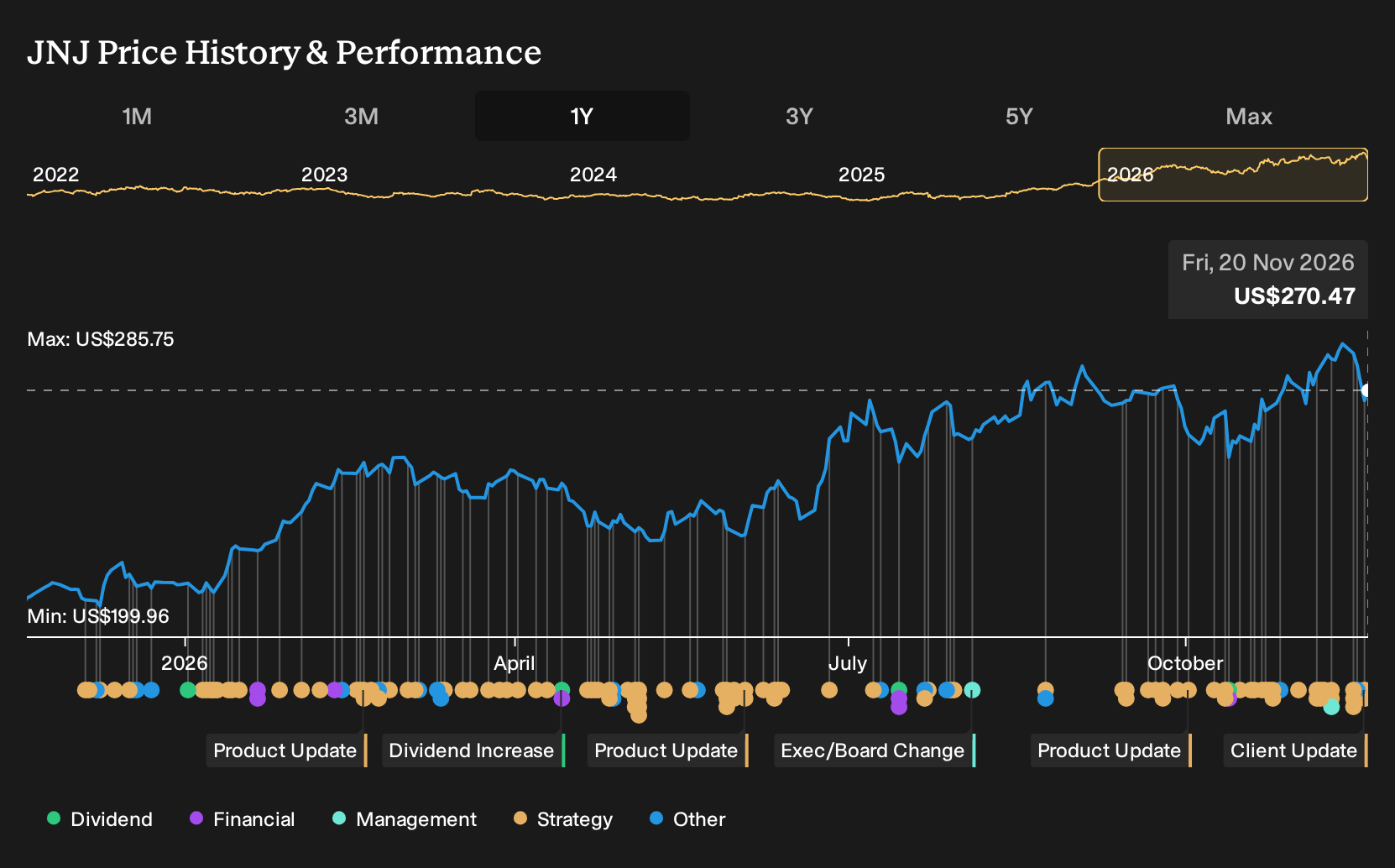
Exploring Other Perspectives
Not every analyst sees Johnson & Johnson’s MedTech reset as the main swing factor. The most optimistic forecasts before this OTTAVA milestone were centered on pharma, assuming revenue of about US$126.7b and earnings of US$31.6b by 2029. That is a far more upbeat story than baseline margins or talc risks suggest, and it is worth comparing alongside other viewpoints.
Explore 9 other Johnson & Johnson fair value estimates, including one that suggests as much as 73% upside from the current price!
Reach Your Own Conclusion
Don't just follow the ticker; dig into the data and build a conviction that's truly your own.
- A great starting point for your Johnson & Johnson research is our analysis highlighting 3 key rewards and 2 important warning signs that could impact your investment decision.
- See our latest analysis for Johnson & Johnson. The report includes a comprehensive fundamental analysis summarized in a single visual, the Snowflake, making it easy to evaluate Johnson & Johnson's overall financial health at a glance.
Looking for more investment ideas beyond Johnson & Johnson?
Once you have a view on Johnson & Johnson, it can help to widen the lens and compare it with other opportunities that fit your risk, income, and quality preferences using the Simply Wall St Screener.
- For investors hunting for quality at a reasonable entry point, review a curated set of 42 high quality undervalued stocks that combine fundamentals with more modest pricing.
- If capital preservation and balance sheet strength are high on your checklist, scan a list of solid balance sheet and fundamentals (24 results) that can help you focus on sturdier businesses.
- Income focused portfolios may benefit from a shortlist of 8 dividend fortresses that aim to pair yield with resilience rather than just headline payout figures.
Have feedback on this article? Concerned about the content? Get in touch with us directly. Alternatively, email editorial-team@simplywallst.com