


The Zhitong Finance App learned that as of the closing of the US stock market on November 20, EST, the US stock market and even the global stock market evolved from Thursday's technology stock pullback and the three major US stock indices falling more than 2% to a “Black Friday” in the global stock market dominated by the global AI computing infrastructure theme and the sharp decline in a wide range of technology stocks.
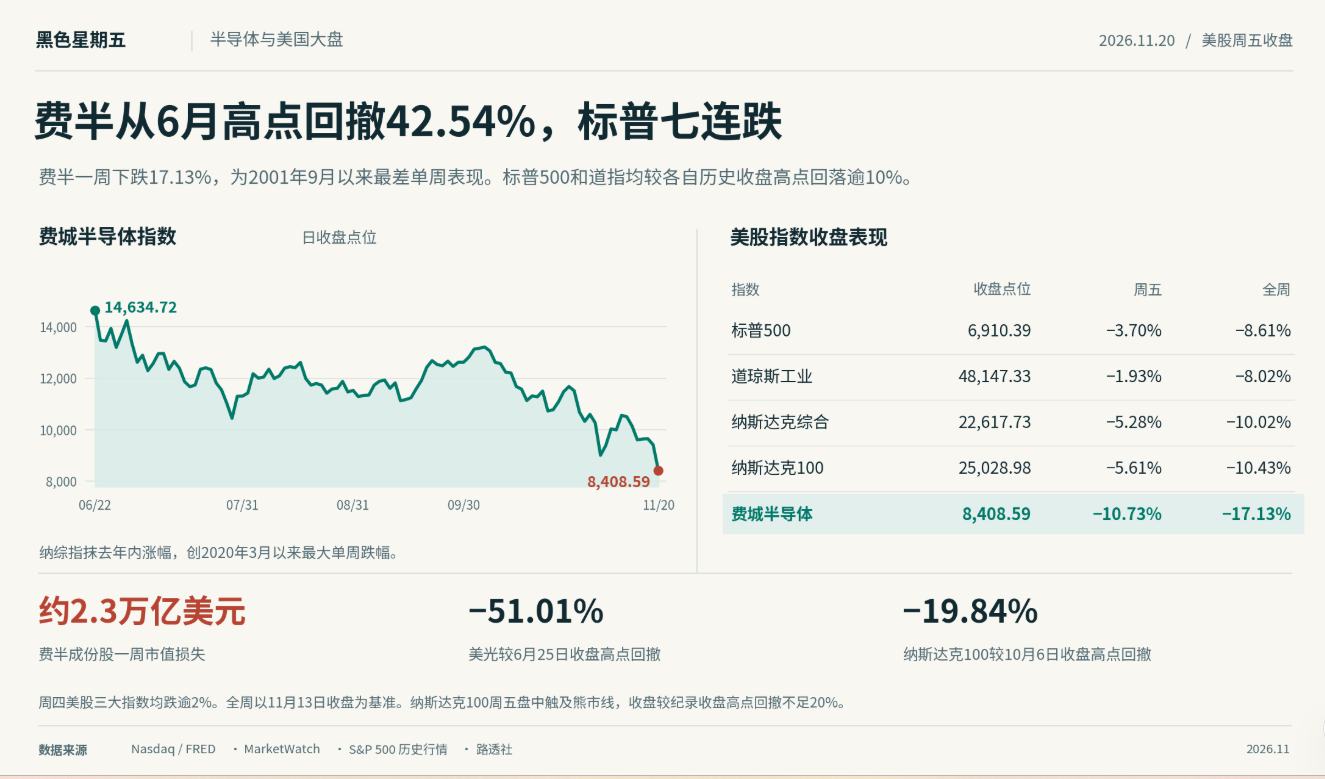
Following the extremely weak trend of the four trading days this week, the S&P 500 index can be described as having a sharp drop of 3.70% to 6,910.39 points on Friday, closing lower for the seventh consecutive trading day. The Dow, which fell 1.93%, both retracted more than 10% from their historical closing high, confirming a technical adjustment. The Nasdaq Composite Index fell 5.28%, erasing gains during the year; the Nasdaq 100 Index fell 5.61%, about 19.84% lower than its historical closing high on October 6. At one point, the intraday decline of more than 20% entered the so-called “technical bear market zone.” In terms of the Nasdaq Composite Index (NASDAQ), which covers a wider range of technology stocks, the total market value of the NASDAQ Composite Index components shrunk by more than 4 trillion US dollars in the week ending November 20 EST.
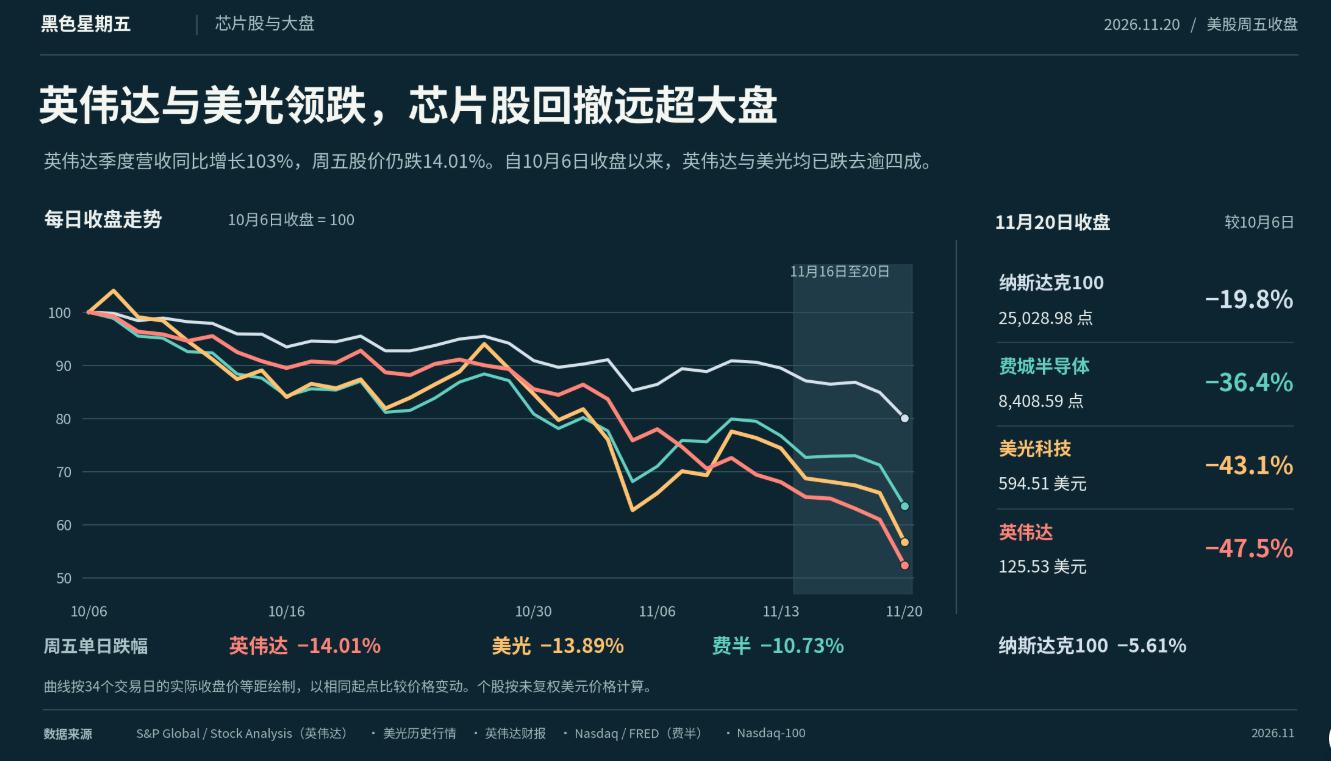
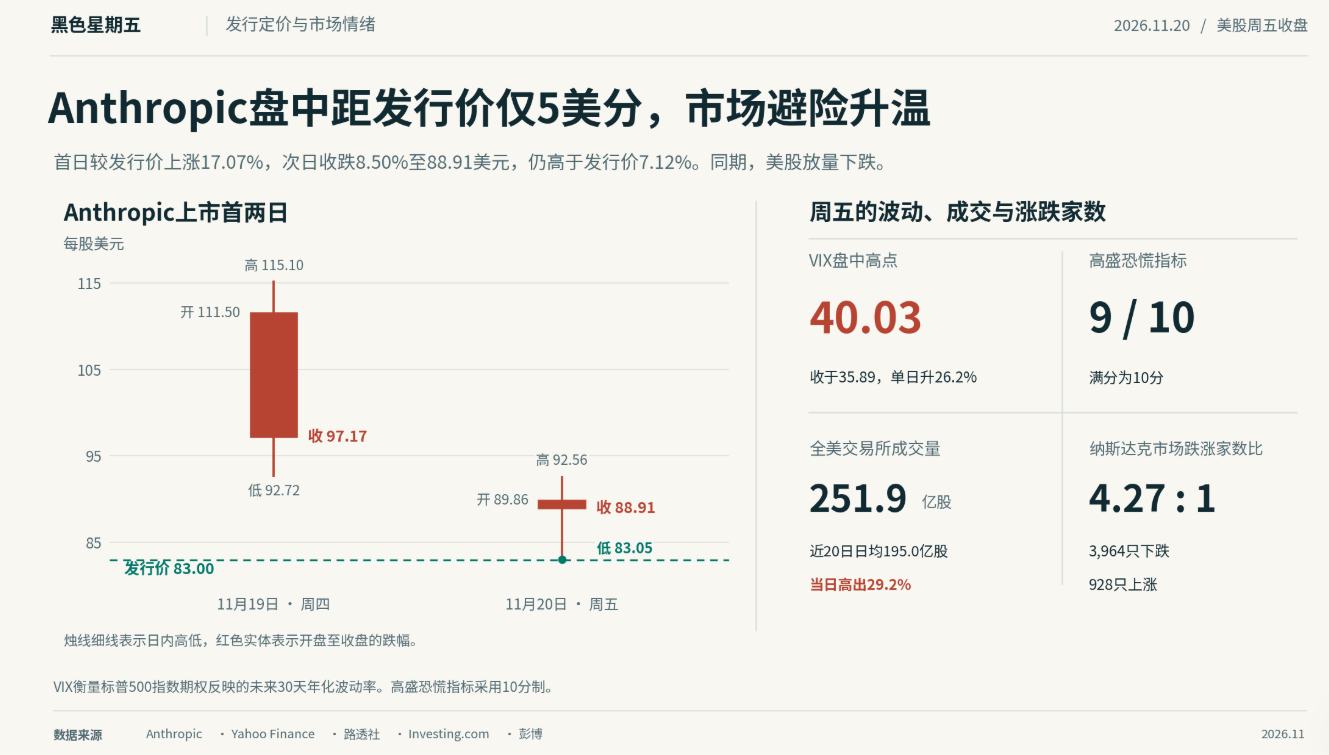
The two companies originally expected to reverse AI trading sentiment were simultaneously sold off: Anthropic hit a low of $83.05 the day after listing, only about 5 cents from the issue price, closing at $88.91, down 8.50%; Nvidia plummeted 14.01% after handing over earnings reports that doubled its revenue. The VIX Panic Index soared to 40.03 intraday on Friday — meaning that the intraday panic index once hit the highest level since the April 2025 tariff crisis, and the Goldman Sachs trading department's panic index also surged to 9 points on Friday — out of 10 on Goldman Sachs's benchmark panic index.
The core logic of this round of global technology stock sell-offs, including “Black Friday,” can be described as global investors starting to differentiate between sales revenue already realized by chip manufacturers and the return on investment that large AI computing power buyers such as AI Xinyun and cloud computing giants have yet to be realized. For data center operators, GPU delivery is only the beginning of capital investment. Only when clusters are put into operation on schedule, paid utilization rates, and rents meet expectations can the project have sufficient cash flow to cover electricity costs, pay debts, and recover equipment investment.
The anticipated pricing of the 25 basis point rate increase by the Federal Reserve in December in the futures market is still close to 100%, and expectations for the Fed to raise interest rates by 50 basis points in December and to continue to raise interest rates at the beginning of next year continue to heat up, further raising the return threshold for new projects and reducing the valuation premium investors are willing to pay for forward profits. Furthermore, with regard to global capital flow trends, as leveraged AI bulls continue to be congested, drastically cut their exposure, and trend strategy “fast money” quantitative forces (represented by CTA quantitative strategies) followed price weakening and large-scale mechanical position reduction, concerns about return on capital were transmitted from model companies and chip manufacturers to the cloud computing power leasing and data center power equipment chain, rapidly amplifying the sharp sell-off and decline of capital on the entire AI industry chain.
As the market became too fearful this week, especially the leaders in the AI computing power industry chain and a broad range of technology stocks, many institutions are expecting a sudden sharp rebound. Many of Wall Street's top strategists are clearly optimistic that US stocks and even global technology stocks will rebound during Thanksgiving week (November 23-27, next week).
From falling out on Thursday to a stomping crash on Friday, the “AI computing power weather vane” Philadelphia Semiconductor Index fell 17% in a week
To measure the depth of this round of stock market adjustments, the US stock Philadelphia Semiconductor Index, which has the title of “AI computing power weather vane,” is more representative than the NASDAQ index in recent years.
Fee Half fell 10.73% to 8,408.59 points on Friday, down 42.54% from its all-time closing high on June 22. The weekly decline reached 17.13%, the worst week since September 2001. The total loss of the constituent companies was about 2.3 trillion US dollars in market value. Micron Technology, a leader in memory chips headquartered in the US, plummeted 13.89% to 594.51 US dollars in a single day, a crazy drop of 51.01% from the highest closing price in history set in June. It can be said that it has experienced a sharp drop in the back.
In the same week, the S&P 500, Dow, and NASDAQ (NASDAQ Composite Index) fell by about 8.6%, 8.0%, and 10.0%, respectively, and the NASDAQ recorded the biggest weekly decline since March 2020. US stocks traded 25.19 billion shares on Friday, about 29% higher than the average daily level for the past 20 trading days. The number of companies that fell in the NASDAQ market was 4.27 times the number of companies that rose. Selling pressure has spread frantically from a few AI superleaders to the entire stock market, and panic has spread to every corner.
The Asian stock market, on the other hand, had already gone through a round of revaluation before trading officially opened in New York on Friday. The Taiwan Weighted Index, which has taken up the dividends of the AI infrastructure frenzy in recent years, fell 6.2% on the same day and 17.5% for the whole week. The Korea Stock Market Composite Index and the Nikkei 225 Index fell about 5.2% and 5.1% respectively on the same day. Afterwards, the European Stoxx 600 Index fell 2%, and the MSCI Global Stock Index fell 8.1% throughout the week, the biggest weekly decline since the beginning of 2020.
Taiwan's foundry and server manufacturing chains, South Korea's memory chips, and Japan's huge semiconductor equipment chain all have different revenue confirmation processes, but they are all exposed to the same variable — whether the next batch of large-scale AI data center construction processes in North America can be heavily funded, energized, and continue to frantically procure core equipment related to AI infrastructure on schedule after the Democratic Party controls the Senate and House of Representatives.
As mentioned above, the core of this round of crazy market sell-off and the “Black Friday” sharp decline is that investors are beginning to differentiate between the revenue data that chip manufacturers have already realized and the return on investment that AI computing power buyers have yet to realize. For data center operators, GPU delivery is only the beginning of capital investment. Only when important revenue generation data, payment utilization rates, and rent data related to AI applications such as cluster operation and downstream model vendors meet expectations can large-scale AI infrastructure projects have sufficient cash flow to cover electricity costs, pay debts, and recover equipment investments.
The core of the market's concerns about the return on AI capital expenditure is whether companies' demand for AI applications can continue to significantly exceed expectations. For model and application vendors, if subscription and API revenue can continue to grow faster than the computing power costs required to provide services, the renewal and purchase of GPUs will have a more solid commercial foundation. For data center operators, only if the cluster is put into operation on schedule, the customer pays the rent as agreed, and the existing contract is renewed with sufficient rent or taken over by a new customer after the expiration of the existing contract can the project be expected to cover electricity and operation and maintenance costs, pay debts on time, and recover the investment over the economic life of the equipment.
Nvidia's revenue is doubling, why is the entire AI infrastructure industry chain from GPUs to backup power supplies plummeting?
Nvidia's revenue for the third fiscal quarter was US$115.8 billion, up 103% year over year, higher than Wall Street's forecast of about US$109 billion. Data center revenue increased 110% year over year to US$107.6 billion, and surpassed expectations and raised growth forecasts for the next fiscal year sharply. Financial reports confirm how popular the delivered computing power is, yet the stock price is re-evaluating how high returns customers can continue to expand.
On Friday, AMD fell about 13.3%, Broadcom fell 12.2%, cloud computing power operators CoreWeave and Nebius fell about 12% and 16% respectively, and even Caterpillar, which sells power generation and backup power equipment, fell about 5%. For chip manufacturers, the risk is that customers delay the next round of procurement; for operators that have already borrowed money to build computer rooms, the same delay means that rental income is being delayed, but interest and equipment costs have begun to accumulate.
Nvidia's share price is also under pressure independent of the industry cycle. After Huang Renxun left office, the management handover is still ongoing. On Friday, Reuters quoted two people familiar with the matter as saying that US Securities and Exchange law enforcement officials are examining Nvidia's potential accounting issues; before the report was released, the stock price had already fallen by more than 6%, and the decline widened after the news broke.
The details of the review have not been disclosed. Investors' continued concern about regional revenue ownership and customer financing arrangements cannot be understood as major issues identified by US regulators. Chuck Carlson, CEO of Horizon Investment Services, originally anticipated that Nvidia's earnings report and Anthropic listing would allow the market to absorb the backlog. Friday's closing showed that neither of these benefits could resolve investors' concerns about the next round of capital returns.
Gene Goldman, Cetera's chief investment officer, believes that the two test different issues: top chip companies' financial reports have proven strong current profits, while Anthropic's listing tests how high an estimate investors are willing to pay for future growth. When the 10-year US Treasury yield is still close to 5% and the market expects the Fed to continue to raise interest rates, even if AI demand remains strong, investors will ask how much of the growth over the next few years has actually been factored into the stock price.
Anthony Saglimbene, chief market strategist at Ameriprise Financial, pointed out in Friday's closing report that investors are re-evaluating the financing capacity of computing power buyers: borrowing costs are high, and there are still questions about whether credit funds can continue to be in place. Nvidia's management changes have added another variable, that is, the company is willing to provide strong financing support to small and medium-sized customers in the future.
Richard Saperstein, chief investment officer of Treasury Partners, pointed out that the same round of data center investment slowed, and the impact on profits of all links in the industrial chain was not the same. The tightening of financing for new projects will depress the profit growth expectations of technology companies, but hyperscale cloud service providers that already have a large number of operating data centers can still rely on existing facilities to serve customers; if additional capital expenses slow down, their free cash flow is expected to improve.
US debt is rising and the Federal Reserve is still hawkish. Who does the next round of “selling storm” depend on?
Bill Northey, senior investment director of U.S. Bank Wealth Management (U.S. Bank Wealth Management), said that selling pressure was still accelerating as the market closed on Friday, short-term prices were more dominated by sentiment, and it would take longer for economic resilience and corporate profits to support stock prices.
Goldman Sachs's trading department's position model further explains why even if the index stabilizes, selling pressure may continue: under the scenario where the stock market is trading sideways in the coming week, trend tracking strategies such as commodity trading advisors (CTAs) may still net about 65.8 billion US dollars of stocks. If the decline continues, potential sales can reach 80.6 billion US dollars. This means that even if corporate profit expectations do not deteriorate at the same time, a systematic reduction in positions triggered by an earlier decline may still amplify short-term price fluctuations.
On Friday, safe-haven funds bought US bonds. The 10-year yield fell by about 10.4 basis points to 4.948%, while gold and silver fell by 2.81% and 4.22%, respectively. Bitcoin once fell below 60,000 US dollars. Although Brent crude oil fell about 4% throughout the week, it was still not enough to change near-end interest rate pricing.
Federal Reserve Governor Cook believes that previous interest rate hikes were not strong enough. Philadelphia Federal Reserve Chairman Paulson advocated prudent progress, while remaining open to two consecutive meetings to raise interest rates. Federal funds futures are still offering the December rate hike of 25 basis points close to a definitive price. The decline in long-term bond yields reflects investors buying safe-haven assets, and the actual financing costs of AI projects also depend on credit spreads. The US October PCE data released at 21:30 Beijing time on November 25 will test whether the market has reason to lower interest rate hikes after the sell-off.
Goldman Sachs's estimates explain why sales may continue even if the market stabilizes. The bank estimates that the trend tracking strategy has sold about 57 billion US dollars of stock positions in the past month, and the US stock position turned into a net short of 19 billion US dollars. In the coming week, if the stock market rises, the model still predicts that trend strategies such as commodity trading advisors (CTAs) may sell $28.6 billion in stock positions; in a sideways scenario, it is 65.8 billion US dollars, and the buying forecast under a continued decline scenario is about US$80.6 billion. The Goldman Sachs research team said that the core reason behind this is that the downward trend accumulated over many weeks will not be immediately reversed due to a one-day rebound. Investors should note that $80.6 billion is a quantitative model estimate under a declining scenario, and public disclosure does not limit all of it to US stock sales.
Five trading trends to watch - how to distinguish between a sharp decline and a real stabilization of AI valuations?
On Friday, Anthropic's intraday price was only 5 cents away from the $83 issue price, and the Philadelphia Semiconductor Index fell 10.73%. Experiencing such a sharp decline, bears' recovery, or trend capital slowing down positions may all bring about a round of rebound. The answer to the following five trading observations is that if this round of the AI industry chain and a broad rebound in technology stocks occurs — most institutional investors begin to expect global technology stocks to rebound from a sharp decline next week after experiencing a sharp collapse, and whether there is sufficient buying and profit base to support it to continue.
Nathan Peterson, director of derivatives research and strategy at Carson Financial Research Center, is clearly bullish on next week's US stocks in the trading outlook released on Friday. He pointed out that at the time of writing, the S&P 500 and Nasdaq Composite Index's Relative Strength Index (RSI) had both dropped to 26, while the VIX had risen above 30, indicating that short-term sell-off was close to extreme, and the probability of a technical rebound was higher than usual. He is particularly concerned about acceptance after the opening of the market next Monday: if the stock index opens low and then closes higher, or continues to be under pressure on Monday and quickly recovers losses on Tuesday, it will be more indicative that buying is willing to catch up with sales than simply opening higher.
TheStreet Pro technical analyst Helene Meisler also pointed to the rebound window next week. She said that even if the NASDAQ continues to close slightly lower, the momentum indicators she is tracking may rise in the middle of next week. According to her experience, when downward momentum declines and investor sentiment has clearly turned pessimistic, a tradable rebound is more likely to occur. Chris Versace, the agency's portfolio manager, pointed out after closing on Friday that next Wednesday's US personal consumption expenditure (PCE) inflation data may be a catalyst: if inflation is weaker than expected, market concerns about further interest rate hikes by the Federal Reserve are expected to ease, providing rebound conditions for technology stocks that have already entered the oversold range.
In the short term, as underwriters complete overallotment reimbursement, who is willing to accept with real money close to the issue price, and whether systemic selling pressure can be relieved after volatility falls back down will determine whether the market can stabilize prices first. Further, the Nvidia CEO turmoil gradually subsided, and the new management lineup and product line outlook were recognized by the market; how much revenue could be generated by enterprise customers; whether gross profit per unit of computing power could be improved; and whether computing power operators could finance the next batch of GPUs at an affordable interest rate only determined whether investors had a reason to raise the AI industry chain's valuation again.
① Anthropic's $83, revealing the price differences between the two categories of buyers. Investors allotted at the issue price were still making a profit of 7.12% by Friday's close; investors who bought and held at the opening price of $111.50 on the first day had a loss of 20.26% over the two trading days. What Forte Securities refers to as a “buyers' strike” means that some institutions that have not been allocated and have no pressure to track the index are willing to wait for lower offers. Vega IS has even made it clear that it will only consider buying when it is close to or below the issue price. Demand is still there, but the premium that buyers are willing to pay has narrowed drastically.
② The record amount of financing did not leave a tray of the same size for the secondary market. After the underwriter fully exercised 147 million shares of Green Shoe, the total gross transaction volume of the IPO and simultaneous private placement was US$119.5 billion, including the sale of old shares, and the company's own gross income was approximately US$117.6 billion. The underwriter acquired additional shares at the issue price, which covered the overallotted position. If the stock price approaches $83 again, the previous purchases that may have been made to make up this position through the open market will no longer exist. Whether the issue price can be maintained depends more on the real quotes of new investors.
③ The increase in model calls can only be converted into sufficient revenue per unit of computing power to support the next round of chip orders. Anthropic revealed that by the end of October, the annualized revenue operating rate had reached 81 billion US dollars, but the company usually purchases computing power 12 to 18 months ahead of schedule, and short-term costs are relatively fixed. If the number of new calls brought about by the model price reduction is sufficient to increase utilization, more paid tasks can dilute idle costs; if each task consumes more inference resources, or if the call unit price drops faster than the unit inference cost, revenue expansion may also be under pressure on profit margins. This is the reason why the market went from Claude's corporate requirements to GPU and high-bandwidth memory orders.
④ The credit market has begun to offer different prices for different AI projects. CoreWeave is a bond issued with a yield of 9.625% in June. The yield in the secondary market was close to 15% in mid-November, which directly affects the pricing of new financing and refinancing. Meanwhile, Apollo and Goldman Sachs still finalized GPU financing of about $44 billion for SpaceX on Friday. The yield of one priority guarantee note due in 2033 was 8.259%. The relevant lease is expected to start when the equipment is delivered. The guarantees and terms of the two financings are different, but the transaction results reveal what the funds are still willing to support: when the equipment is delivered, who bears the rent, and what recourse the creditor has over assets and cash flow will directly affect the financing conditions.
⑤ VIX hit 40, which can explain why the rebound may be fierce, but the bottom cannot be judged alone. VIX finally closed at 35.89 on Friday, up 26.20%, the highest closing since the April 2025 tariff crisis. Mandy Xu of the Chicago Board Options Exchange estimates that more than 80% of this increase can be explained by the fall in S&P and its knock-on effect on options pricing. Under high volatility, a slight weakening in sales may bring about a sharp rebound. What can better test the quality of the rebound is whether stocks that hit a 52-week low when the index rebounded were significantly reduced from Friday's high, whether credit spreads for computing power operators narrowed at the same time, and whether the new computer rooms can be delivered on schedule and begin rent collection. The three measure the breadth of purchases, financing capacity, and cash flow disbursement, respectively.