


As the dynamic adjustment window of the Hong Kong Stock Exchange Standard approaches, the “Baotong” prospects of Tong Ren Tang Sinopharm (03613) seem to be increasingly overshadowed. The latest estimates of the Zhitong Finance App “Hong Kong Stock Connect Withdrawal” have included the company in the next phase of the potential withdrawal list. It is expected that the applicable withdrawal threshold will be lowered to HK$5.854 billion.
According to the author's calculation, as of November 19, Tong Ren Tang Sinopharm (total share capital of 837 million shares) had an average daily market value of HK$5.909 billion during the year, and was still barely above the red line with a weak margin of about HK$55 million, forming a safety cushion. However, the thickness of this buffer has clearly deviated from current stock prices. Based on the reverse calculation of the remaining trading days, if the average daily market value is to maintain the threshold for the whole year, the stock price would need to continue to run above HK$6.44, while the closing price on November 19 was only HK$5.425. The gap between the two over HK$1 means that existing safety pads can easily be broken down by further price pullbacks.
It is inferred from this that if the company fails to effectively repair its stock price within the remaining assessment window, the current fragile pattern of “meeting the standards ahead of schedule” will be like a “building collapse.”
HK$0.55 safety mat?
From the beginning of November to 19, judging from the market, the total number of shares in the range was 142.11 million shares, of which the negative volume was as high as 10.739 million shares (accounting for over 75%), and the positive volume was only 3.472 million shares. The sales market showed an overwhelming advantage. Furthermore, the ranged turnover rate was only 1.697% * in a market with a total share capital of 837 million shares, and the average daily turnover was only at the level of one million shares. This extremely low liquidity means that the market is extremely light. If the main players want to increase market value, they need to spend huge sums of money to clean up the goods; and once an institution throws out due to the failure of “safe keeping” expectations, even if it is just a million-level sale, it will directly break through the “safety cushion.”
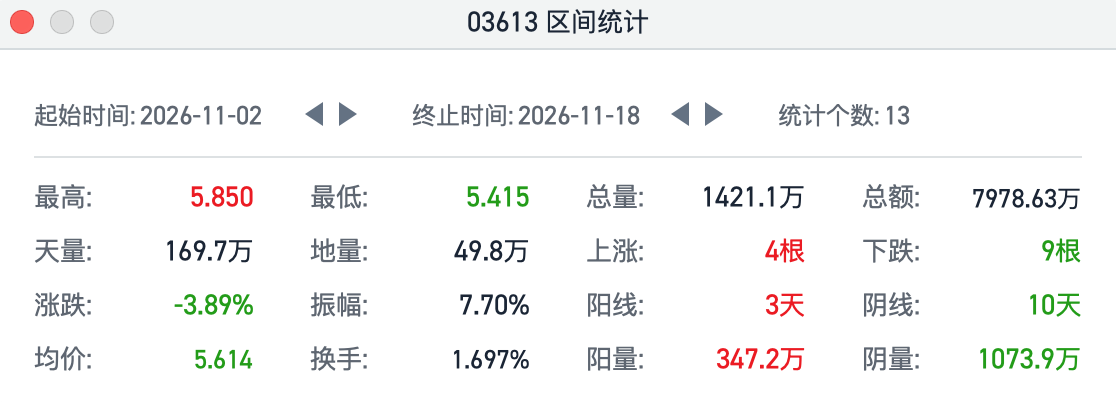
Specifically, from November 2 to November 11, the trading volume remained between 498,000 and 1,586,000. The stock price fluctuated in a narrow range between 5.625 and 5.775 yuan. This is a typical main low cost stabilization strategy. The main players know that in order to raise the market value to the threshold (the stock price must be above HK$6.44), the amount of capital required is huge. Therefore, the main players chose to maintain an illusion of “no decline” by matching or passively taking over with very few chips above 5.6 yuan, in an attempt to delay time and loosen the game policy window. However, the “positive volume” is extremely low, which indicates that the bulls have no intention of attacking and do not want to take the initiative to raise market value at all.
On November 12, it was revealed that the daily volume of 1.697 million shares was revealed. The stock price directly fell below the previous platform and plummeted to 5.485 yuan. That day's decline and energy levels were a turning point for the whole of November. Under market conditions with an extremely low turnover rate, the sudden sale of more than 1.5 million shares was not just an act of retail investors.
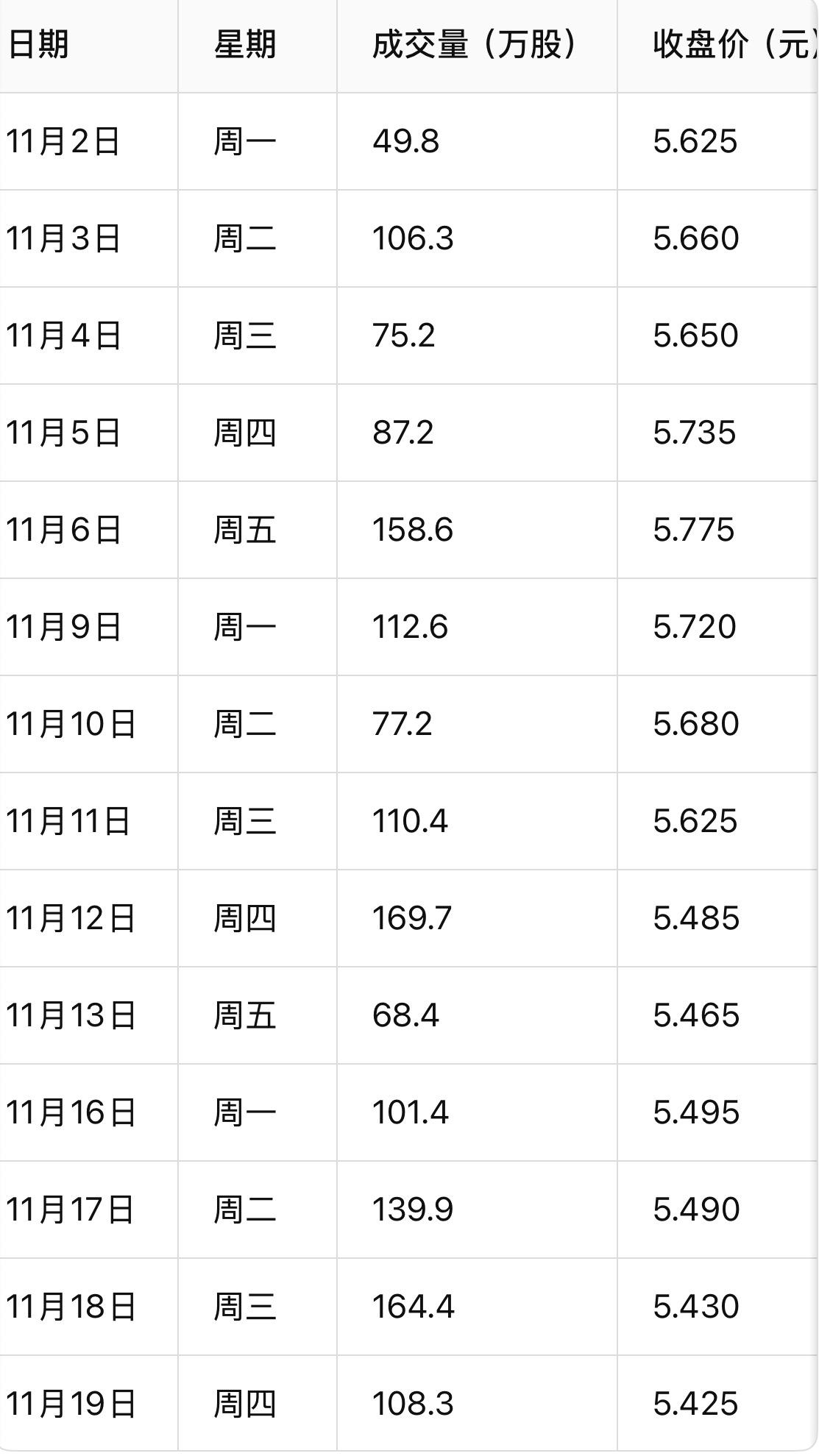
From November 13 to November 19, stock prices continued to fall. Volume declined again on November 17 (1.399 million shares, closing 5.490) and November 18 (1.644,000 shares, closing 5.430), and continued to bottom to 5.425 yuan on November 19, setting a new low in the range. The continuous amount of negative lines indicates that the chips are loosening at an accelerated pace. The main capital may have been completely abandoned. Not only is there no market protection, but it may instead use the window before the Hong Kong Stock Connect adjustment to follow the trend or be finally distributed.
It is inferred from this that the HK$55 million safety mat seems to be extinct, because the daily sell-off pressure of several million shares is like toppling the dominoes on this target of exhaustion of liquidity.
Can't fundamentals quench Baotong's “thirst”?
Although Tongrentang Sinopharm has had a deep moat for a long time, the performance flaws of increasing profits without increasing revenue in the short term are quite remarkable. This also explains why Tongrentang Sinopharm is unable to act as a “booster” for Baotong at around HK$5.
Financial reports show that in mid-2026, the company achieved revenue of about HK$602 million, a year-on-year decrease of 21%; profit attributable to company owners was approximately HK$198 million, a decrease of 15.6% year-on-year. According to the announcement, gross margin rose from 60.8% in the same period last year to 63.9% in the current period, up 3.1% year on year. At the same time, the decline in profit was less than the decline in revenue, indicating that the company's efforts in cost control and product structure optimization continued to bear fruit.
The sales product segment, which is the absolute core basic market, recorded a sharp drop of 21.79% over the previous year, of HK$578.6 million, and was the absolute main driver of overall revenue. This data accurately confirms the market's previous speculation that it would cut wholesale shipments and squeeze channel inventory. In the context of extremely low turnover rates, the company took the initiative to stop extensive wholesale of high-margin single products in Hong Kong and the mainland, with the aim of cracking down on cross-regional trading and repairing the terminal price system. Although this practice has led to a sharp contraction in revenue books, combined with the previous gross margin that bucked the trend and climbed to 63.9%, it shows that this contraction is of high quality, that is, it removes the distribution part that is inefficient or disrupts prices, and preserves the profit depth of core products.
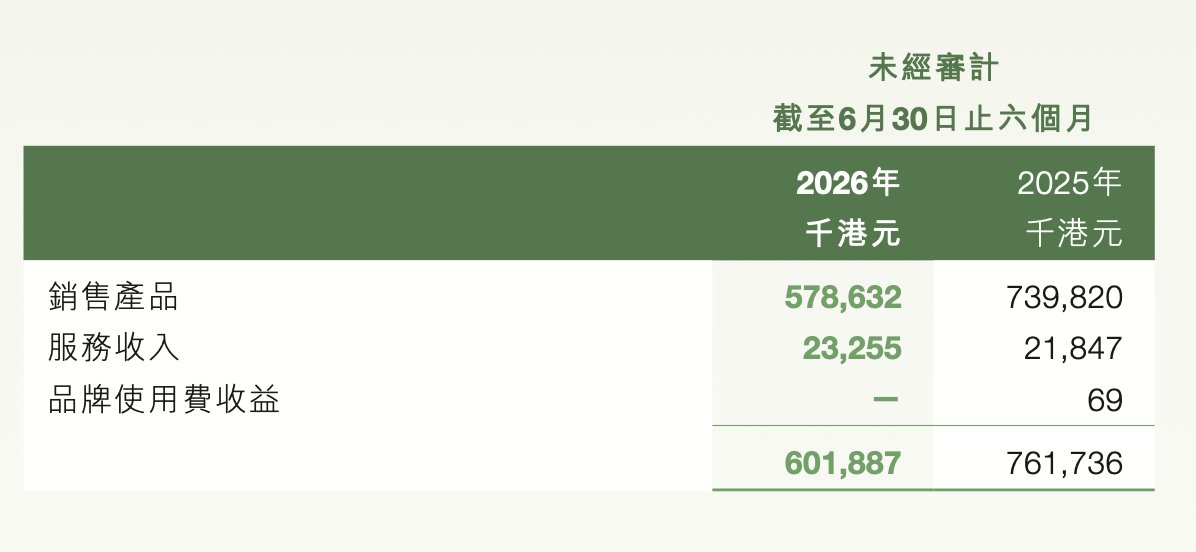
In stark contrast to the cliff-style decline on the product side, service revenue recorded HK$23.255 million, which bucked the trend and increased slightly by 6.44%. In a headwind situation where the overall market fell by more than 20%, the service sector showed strong defensive performance. This revenue mainly comes from its own terminals and traditional Chinese medicine clinics, which have high customer stickiness and immediate cash flow attributes. Its positive growth shows that while the company is shrinking its wholesale network, strategic fine-tuning from batch to zero and enhancing the terminal experience is being implemented, and the service sector is acting as a valuable performance buffer at this point. As for brand royalties, revenue was directly eliminated at HK$69,000 in the same period last year.
Short-term results have been hampered, but in the long run, Tongrentang Sinopharm's business logic is still strong — the quasi-monopoly position of Angong Niuhuang Pills (Double Natural). Only 5 companies in the country have been approved to use natural musk to produce Angong beef yellow pills. The Tongrentang system absolutely dominates. This product contributes more than half of the sales of its own products, and has a strong history of price increases. This is the structural foundation for maintaining the company's gross margin above 60% for a long time, and it is also a moat that cannot be eroded by any short-term performance fluctuations.
However, the growth ceiling for monopoly varieties is approaching. The core consumption scenario of Yasumiya beef yellow pills (stroke first aid and cardiovascular and cerebrovascular care) corresponds to a mature stock market with a high penetration rate. Its incremental space is highly dependent on price increases rather than volume. Against the backdrop of the continuing rise in the cost of raw materials (natural musk, beeswax), some of the effects of price increases have been eroded by costs. This is the underlying reason why gross margin has slipped from 66% to 61%.
High expectations are placed on Ganoderma lucidum spore powder capsules, which break the second growth curve, but the competitive pattern is far less stable than that of Yasumiya beef yellow pills. This product is exclusively produced by Sinopharm, and there has been growth in the mainland market (revenue growth in mainland China by 18.3% in 2025, mainly driven by sales of Ganoderma lucidum spore powder), but the competitive environment it faces is not the same as Angu's “5 approved” monopoly pattern.
What really has room for long-term imagination is the internationalization of traditional Chinese medicine. As the only overseas platform of the Tongrentang Group, the company had 76 retail terminals (48 overseas) by the end of 2025. Angong gyujang pills have obtained a registration license for traditional Cambodian drugs, deer products have landed in New Zealand, and the Shenzhen Global Purchase and Operation Center has also signed a contract.
However, the pace of implementation of this growth logic is the key to understanding the plight of Baotong.
In summary, the hard constraint required by Baotong is that the stock price will continue to run above HK$6.44 during the remaining assessment and trading days to bring the annual average daily market value back above the HK$5.854 billion threshold. Meanwhile, the closing price on November 19 was HK$5.425, with a gap of over HK$1, corresponding to an increase of nearly 19%. More importantly, the current state of fundamentals itself does not support short-term strong catalysis.