


- Chevron reported sharply higher Q3 2026 earnings and free cash flow, while management reiterated that growing the dividend remains the top cash priority alongside capital efficient production and refinery projects.
- At the same time, Chevron is pushing into Venezuela and the southern Ionian Sea, using joint ventures and debottlenecking to pursue low cost volume growth without relying solely on new megaprojects.
- We will now look at how Chevron's strong free cash flow and dividend focus might reshape the existing investment narrative around capital discipline.
Chevron Investment Narrative Recap
To own Chevron, an investor needs to be comfortable with a large hydrocarbon producer that relies on low cost barrels, cost efficiencies and disciplined project spending to keep free cash flow robust enough to cover and grow dividends. The analyst consensus narrative on Simply Wall St assumes that execution in areas like Venezuela, the Permian and long term power contracts offsets forecast earnings and revenue declines.
The latest jump in free cash flow and the reaffirmed dividend priority make near term cash returns look well supported, so they reinforce rather than change that storyline. The more immediate swing factor still appears to be refining margins and commodity prices, while the biggest risk remains faster shifts in energy demand away from hydrocarbons than Chevron’s portfolio can currently absorb.
The recent update around roughly doubling Venezuela production capacity over time is one of the most relevant announcements for this narrative. Management has already committed about US$7b to a growth phase in those joint ventures, with current fiscal terms reported as immediately positive for free cash flow. That fits with the focus on capital efficient expansion instead of only new megaprojects.
For you as a shareholder, Venezuela sits alongside the southern Ionian Sea exploration as a tangible test of Chevron’s ability to add resilient, low cost barrels without overstretching the balance sheet. Success would support dividend coverage and help counter the earnings declines analysts forecast. Execution setbacks, political disruption or higher long term decarbonisation pressure could weaken that role and weigh on the operating outlook.
Analysts currently frame Chevron's outlook around revenues of US$218.7b and earnings of US$25.4b by 2029, based on an assumed 1.1% yearly decline in revenue and an earnings decrease of US$1.6b from current earnings of US$27.0b.
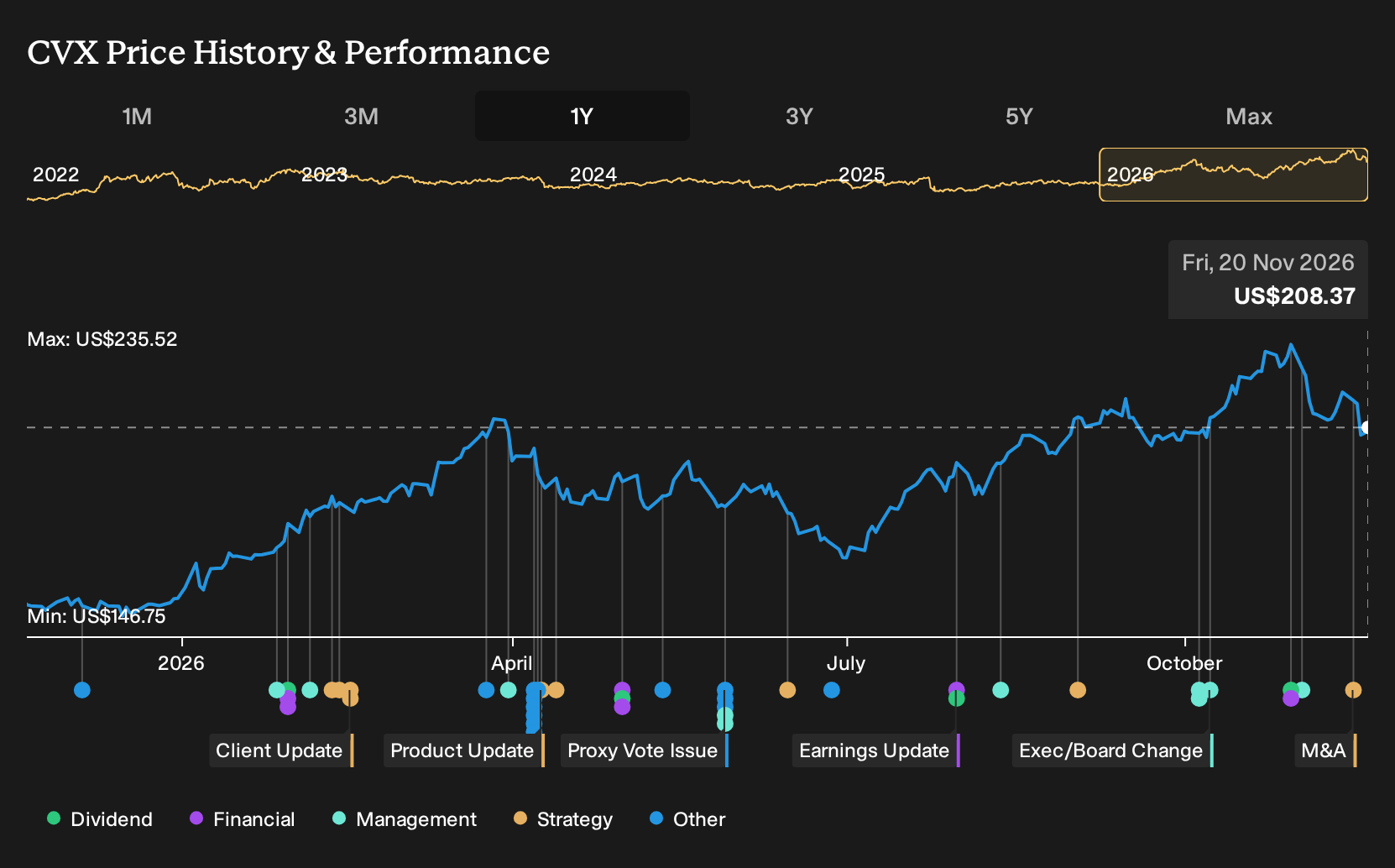
Uncover why Chevron's fair value indicates a 17% potential upside to its current price, which could narrow quickly.
Exploring Other Perspectives
Two fair value estimates from the Simply Wall St Community span roughly US$243 to US$369, so private investors already bracket Chevron with a wide valuation gap. Those views now sit beside fresh catalysts, including Venezuelan expansion and Hess integration, as well as demand and energy transition risks. Opinions clearly diverge, so explore several viewpoints before deciding where Chevron fits in your portfolio.
Explore another Chevron fair value estimate, including one that suggests as much as 77% upside from the current price.
The Verdict Is Yours
Don't just follow the ticker. Dig into the data and build a conviction that's truly your own.
- A great starting point for your Chevron research is our analysis highlighting 3 key rewards and 1 important warning sign that could impact your investment decision.
- See our latest analysis for Chevron. The report includes a comprehensive fundamental analysis summarized in a single visual, the Snowflake, making it easy to evaluate Chevron's overall financial health at a glance.
Looking For More Ideas Beyond Chevron?
Once you have a view on Chevron, it can help to benchmark that thinking against a wider watchlist. The Simply Wall St Screener lets you filter for cash flow strength, balance sheet resilience and income potential so you can build a line up of candidates that match your own return and risk preferences.
- If resilience matters most to you, start with companies that pair lower risk profiles with defensive fundamentals by screening for 32 resilient stocks with low risk scores.
- If value is your priority, focus on businesses that combine solid quality metrics with pricing that looks undemanding through the 40 high quality undervalued stocks.
- If you want yield to do more of the heavy lifting in your portfolio, search for income focused opportunities that match your comfort level using the 8 dividend fortresses.
Have feedback on this article? Concerned about the content? Get in touch with us directly. Alternatively, email editorial-team@simplywallst.com