


Kenya Power and Lighting has seen its share price climb sharply in recent years, which puts a spotlight on whether the current valuation still lines up with what the business is earning. With that kind of share price history in the rear-view mirror, the key issue for you is how much of those earnings are already reflected in today's price.
- Over the past 3 years the stock has delivered a very large gain, which raises the question of how much future earnings strength the market is already assuming.
- The company relies on regulated electricity distribution and billing, so profitability can depend heavily on how efficiently it converts revenue into cash and manages network investment needs.
- Before you settle on a price for Kenya Power and Lighting, see what its peers cost. See how Kenya Power and Lighting's 1.7x P/E compares with its peers.
The stock's next move may depend on whether Kenya Power and Lighting's current share price is adequately supported by its earnings profile relative to the industry average.
If you want a broader earnings-led watchlist alongside Kenya Power and Lighting, consider using a focused screener built around solid balance sheet and fundamentals stocks screener (187 results).
Is Kenya Power and Lighting a Bargain on Earnings?
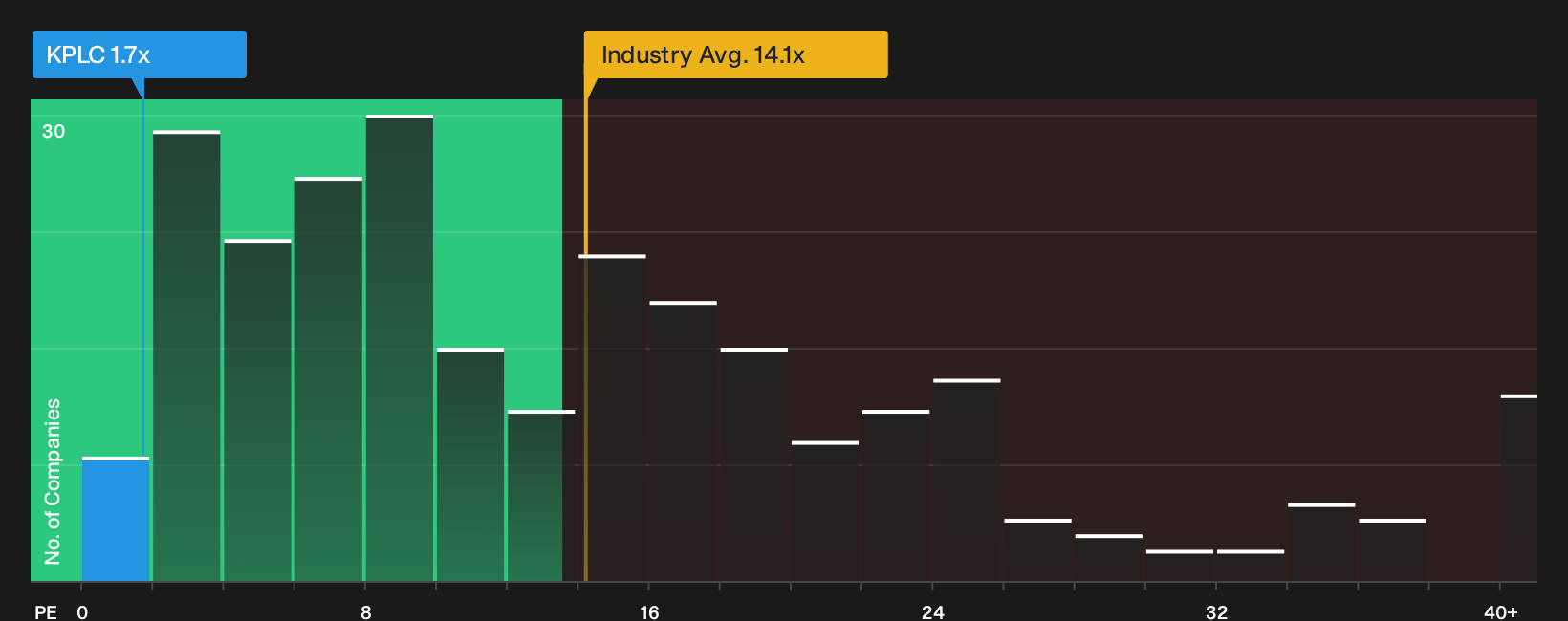
The P/E ratio lines up neatly with how investors think about earnings power for a regulated utility like Kenya Power and Lighting. On this lens, the shares trade on a P/E of about 1.7x, which is far below the broader Electric Utilities sector on roughly 14.1x. Even against a narrower peer set on around 8.5x, Kenya Power and Lighting still changes hands at a steep discount.
Such a low earnings multiple can reflect several things at once, including perceptions of regulatory risk, balance sheet pressure or doubts about how durable current profits might be. For you as a shareholder or potential investor, the gap between Kenya Power and Lighting's 1.7x P/E and the sector norm suggests the market is pricing in a lot of caution and is not paying up for its recent profitability. Explore the numbers behind Kenya Power and Lighting's P/E valuation.
The Kenya Power and Lighting Narrative: What Would Justify Today's Price?
Kenya Power and Lighting's valuation raises clear questions about what the market expects next, and Narratives on Simply Wall St's Community page are designed to spell out which future paths for earnings, margins and growth would need to play out for the stock to be worth materially more or less than today's price. Where a single ratio or model gives you one headline figure, Narratives unpack the future business conditions that figure depends on, so you can watch whether those assumptions actually play out over time.
A clear, number-driven narrative on Kenya Power and Lighting's valuation and earnings now gives you a concrete yardstick for where its growth, margins and execution would need to head for the current P/E gap to make sense. It also turns those assumptions into a checklist that can be revisited as future financial results and regulatory decisions come through.
Share your own Narrative for Kenya Power and Lighting and set out the assumptions behind your valuation.
Kenya Power and Lighting’s valuation still leaves one big unknown on the table
Everything so far has focused on what the current numbers say about Kenya Power and Lighting, but professional forecasts for revenue and earnings several years out offer a separate lens to compare with today’s pricing. Explore where analysts expect Kenya Power and Lighting to be in a few years.
Have feedback on this article? Concerned about the content? Get in touch with us directly. Alternatively, email editorial-team@simplywallst.com