


The Zhitong Finance App learned that industry executives said that an action to ensure that key digital services can operate under European control is gaining momentum, and governments and regulated industries are beginning to take “sovereignty” into consideration when awarding cloud service contracts.
While digital sovereignty has been a political goal for years, procurement standards and contract awards are now beginning to reflect these priorities.
The change came in a year when European policymakers and businesses became more sensitive to their reliance on American technology. US President Donald Trump's return to the White House and restrictions on access to some technologies have heightened concerns about strategic dependency; while cloud service disruptions have highlighted the risk of concentrating critical services on a few vendors.
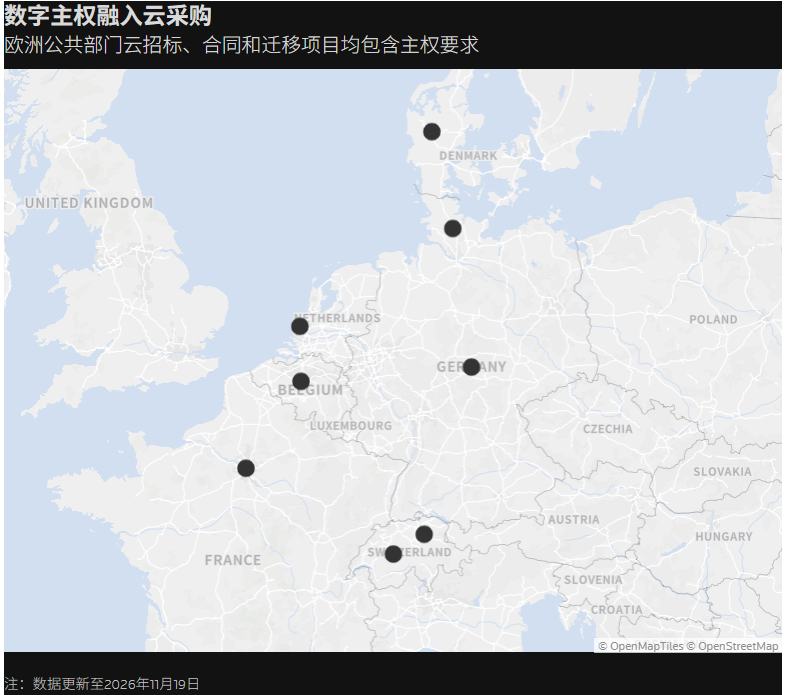
In April, the European Commission awarded four sovereign cloud contracts to consortia led by Luxembourg Post Telecom and Telekom Belgium, as well as Germany's StackIT and France's ScaleWay, for a total of up to 180 million euros (about 198 million US dollars) over six years.
The Dutch government also signed a framework agreement with StackIT, saying the move will reduce reliance on non-European suppliers and enhance digital resilience.
Recently, the Danish state-owned railway operator DSB, the Swiss federal agency, and the German public broadcaster have all included digital sovereignty requirements to reduce reliance on a single supplier and foreign jurisdictions.
Markus Noga, chief technology officer at IONOS, Germany's largest hosting and cloud service provider, said: “Sovereignty standards are increasingly being put at the forefront of the public sector and leading regulated industries.”
This shift has not always been a matter of choice between European suppliers and US suppliers. Google Cloud's S3NS joint venture (in partnership with Thales) has been certified by France's SecnumCloud to handle sensitive government and regulated industry workloads, and was selected to participate in the European Commission's €180 million project.
Google Cloud said public sector tenders are increasingly evaluating vendors based on operational autonomy, cryptographic key control, and “cloud exit” clauses (that is, allowing customers to migrate apps and data to another vendor when needed) rather than just looking at where the data is stored.
“The real value is that it can continue to operate indefinitely without being governed by a 'one-click kill switch',” Noga said.
Christina Knackfuss-Nikolić, chief sovereign of T-Systems, IT services division of Deutsche Telekom, said that during 2025, digital sovereignty has changed from a topic of discussion to a procurement consideration.
She mentioned concerns about strategic dependency and operational resilience, including incidents such as the International Criminal Court temporarily losing access to Microsoft services and restrictions on the export of some AI models.
A series of recent European Commission initiatives, including the proposed Cloud and AI Development Act, which aims to boost European cloud and AI infrastructure, have further strengthened this trend.
Google said regulations such as the European Union's Digital Operations Resilience Act (which sets technical risk standards for financial institutions) and NIS2 cybersecurity rules are prompting customers to more closely examine who controls their data, cloud operations, and critical technical infrastructure.
Nextcloud, which develops self-hosted alternatives to Microsoft 365, said demand for its software has increased about fivefold since the beginning of Trump's second term; T-Systems said demand for its sovereign cloud products has more than quadrupled since mid-2025.
However, interest in sovereignty has so far translated into few large-scale migrations.
According to the European Commission's draft “Cloud and AI Development Act” in June, the market share of EU cloud providers has declined from 29% in 2017 to 15% in 2022, and has remained stagnant since then, while Amazon Cloud Services (AWS), Microsoft Azure, and Google Cloud control more than 70% of the European cloud market.
Lock down the puzzle
Despite growing demand, vendors say migration from existing platforms is still slow.
IONOS public sector strategist Mark Neuvert said, “The business is still lagging behind.” He said that currently only a single-digit percentage of discussions with public sector customers can eventually be converted into contracts, and procurement reviews and migration concerns often delay projects for 12 to 24 months.
Many organizations are still deeply tied to Microsoft Office, Microsoft 365, and existing cloud infrastructure.
Google said customers are increasingly seeking an “exit from the cloud” strategy and open standards to reduce reliance on a single vendor.
“The problem is that a lot of people don't like change and are afraid of migration projects,” said Frank Kalicek, CEO of Nextcloud.
Amazon Web Services, Microsoft, and Google all responded with their own sovereign cloud products. AWS said a test it conducted in October showed that its European sovereign cloud can operate independently without relying on infrastructure outside the EU.
Microsoft, on the other hand, mentioned projects operated by partners, including Bleu in France and Delos Cloud in Germany.
Even companies benefiting from this trend acknowledge that it is unrealistic to completely decouple from US platforms in the short term.
“For example, for large enterprises, migrating all workloads doesn't make sense; you only need to migrate the sensitive ones,” said Knackfuss-Nikolić.
Swiss banking software company Temenos said that for many large banks that do international business, sovereign data and cloud plans are not mature enough.
Sami Pienimaki, CEO of Finnish software and equipment manufacturer Jolla, said: “We have almost all the pieces of the European puzzle. But it's really hard for an average European, or even an educated policymaker, to lay all the pieces on the table and see the full picture.”