


After the US tightening of computing power controls triggered a sharp decline in chip stocks, Morgan Stanley and J.P. Morgan Chase proposed two different coping ideas: Damo believes that computer rooms that are already powered and can immediately serve compliant customers will be even scarce; Xiaomo believes that Asian AI hardware stock prices have implied a 25% to 30% reduction in earnings expectations per share over the next three to four months, far exceeding their expectations of 5% to 10%, with room for a rebound of more than 20%. The difference between the two investment banks is how quickly the computing power can be put into use in another location after the restricted order is delayed.
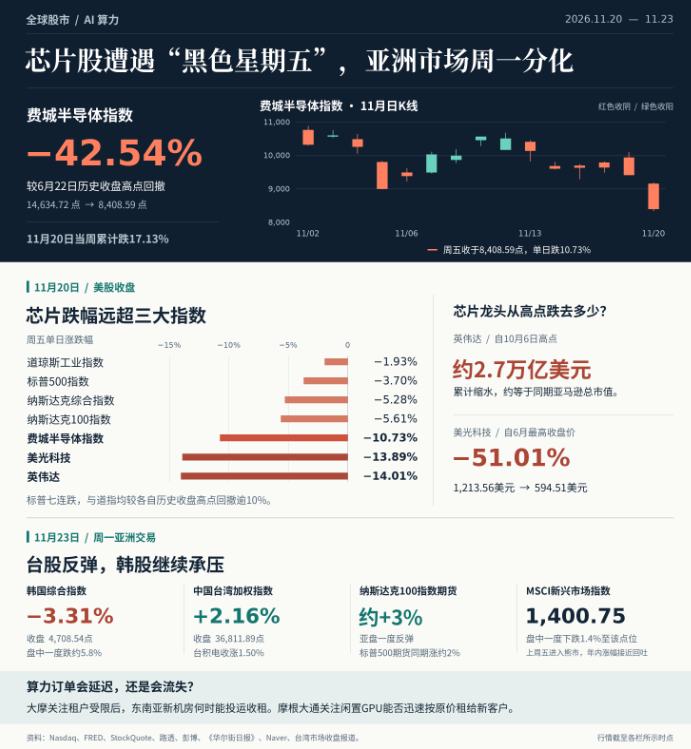
The background to this discussion was the sharp sell-off last Friday. As of the close of trading on November 20, EST, the tech stock sell-off on Thursday evolved into “Black Friday,” where chip stocks led the decline. The Dow fell 1.93%, and the S&P 500 index fell 3.70%, closing lower for seven consecutive trading days. Both retreated more than 10% from their historical closing highs. The Nasdaq Composite Index fell 5.28% on Friday, while the Nasdaq 100 Index fell 5.61%. The Philadelphia Semiconductor Index fell sharply by 10.73% to 8,408.59 points in a single day, retreating 42.54% from its historical closing high on June 22 and falling deep into a bear market.
AI trading leader Nvidia, the “AI chip hegemon”, fell by about 14% on Friday and has evaporated a cumulative market value of about 2.7 trillion US dollars since the high on October 6, which is equivalent to the total market value of Amazon, an American e-commerce and cloud computing giant during the same period. Micron Technology, headquartered in the US, plummeted 13.89% to $594.51, a “lumbar cut” of 51.01% from the highest closing price in June. According to Wall Street financial giants Damo and Xiaomo, there are two major issues behind this round of the market that revolves around the AI computing power theme and the sharp sell-off of global technology stocks in the semiconductor sector that require separate pricing: After US policies are tightened, exactly what types of computing power orders will be delayed in delivery? How many of these AI computing power infrastructure delays will eventually become permanently lost AI orders and demands?
The Zhitong Finance App observed that the trend of Asian technology stocks diverged on Monday: the Korea Composite Index fell about 5.8% intraday, closing down 3.31% to 4,708.54 points; the Taiwan Weighted Index rebounded 2.16% to close at 36,811.89 points, driven by TSMC's 1.50% increase. In the same period, NASDAQ 100 futures rebounded about 3% in the Asian market, but the MSCI Emerging Markets Stock Index, which had already fallen into a bear market last Friday, fell 1,400.75 points during the intraday session on Monday, and is close to recovering its annual gains. Whether Asian AI hardware stocks can continue to recover after the split still depends on the extent of delays and the final destination of affected orders after the US tightens computing power controls.
Damo is concerned about government-led delivery risks — for example, even if power is promised for some overseas computer rooms, they may be delayed due to tenant restrictions, and how long it will take for ASEAN's announced AI infrastructure projects and promised power capacity to be converted into computing power capacity already put into operation and used by existing customers. What Xiaomo is concerned about is how long cloud service providers will have to wait to find new compliant tenants and how much rent they are willing to pay after the original tenant withdraws due to export controls; if the vacancy period is short and the rent can be maintained, the loss of individual customers will have less impact on operators' revenue and subsequent GPU purchases; if the equipment is idle for a long time, or the price must be drastically reduced before it can be leased, the next round of AI infrastructure-related orders will face greater downward pressure.
Damo has sorted out four paths where the US AI policy may be further tightened, including expanding the scope of licensing for the export of advanced chips and the use of remote computing power, strengthening export controls through the National Defense Authorization Act, taxing overseas data centers, and restricting the use of China's open weight model. Among them, chip exports and remote access restrictions have the most direct impact on recent computing power deployment. If target tenants require additional permits to use controlled computing power, data center projects announced or even promised to supply electricity in Southeast Asia may take longer to be put into operation and receive rental income. At the same time, new computer rooms in the US are limited by electricity access, construction manpower, and local approval, making it difficult to quickly fill the gap left by delays in overseas projects. All of this makes computer rooms that are already electrified and can immediately service compliant customers even more scarce value.
Komo saw a major rebound in AI computing power and semiconductors in terms of GPU rents and profit expectations — some expired contracts can still be renewed at higher prices, and the prices of hardware stocks linked to AI computing power infrastructure in the Asian market have implied a 25% to 30% reduction in earnings per share over the next three to four months, far exceeding the bank's expectations of 5% to 10%. If compliant customers are still willing to accept the computing power released by restricted orders at the original price or higher, the profit decline may be milder than the implied share price. As a result, hardware stocks linked to AI computing power infrastructure in Asia have room for a rebound of more than 20%.
From where to ship chips to who uses computing power: Damo dismantles four policy variables
The change that has already been implemented is that the US extends export licenses to the final computing power users of overseas computer rooms. The new regulations of the US Department of Commerce's Bureau of Industry and Security (BIS), which came into effect on November 19, include Singapore, Malaysia, Thailand, Indonesia, and Brazil in the scope of new licenses for advanced chips. An exception can be applied to US headquarters companies that meet the application conditions.
Overseas computer rooms provide more than 12 million total processing performance (TPP) computing power to restricted destination companies, including China, or related entities controlled by them, triggering licensing requirements; Damo estimates that this is approximately equivalent to a cabinet of 72 Vera Rubin GPUs. The rules cover deployed equipment and new leases. Existing related services have a 90-day forensic window, and the commercial recommendation system is exempted. Customer scrutiny has also been tightened in the wafer foundry and packaging process, and some of the paths for Chinese chip designers to commission production from advanced manufacturers such as TSMC and Samsung have narrowed.
① Can the US administration extend the restrictions to computer rooms within the US? Former White House official Chris McGuire proposed restricting Chinese companies from purchasing AI chips in the US, using regulatory powers targeting “Americans” to cover computer rooms in the US, licensing large global chip orders, making exceptions for companies that have already passed the review, and requiring overseas website builders to retain a certain percentage of computing power in the US.
Damo believes that the Ministry of Commerce has room to enact further regulations, but in 2009 and 2014, BIS determined that cloud computing capacity itself is not subject to the Export Administration Regulations, and that global licensing also requires cooperation from partner countries. The company has taken the lead in legislative action, and Oracle has reportedly cancelled the five-year lease to provide Tencent with computing power in Southeast Asia. Although the US Senate has passed the BAAJA bill aimed at speeding up infrastructure approval, power grid access, construction workers, and local resistance still determine when the replacement computer room can be put into operation.
② Can Congress write temporary restrictions into laws that are more difficult to reverse? Damo believes that the policies of the two parties towards China are getting stricter, and that the “National Defense Authorization Act” (NDAA) over the next few weeks is an important window. Each of the four proposals has strong points: RASA targets remote computing power access, MATCH pushes allies to simultaneously tighten restrictions on semiconductor equipment in China, AI Overwatch strengthens congressional scrutiny of advanced chip exports, and Chip Security requires verifying chip locations and tracking transfers.
Damo said that the difficulty of MATCH is international coordination, and RASA may reduce the White House's space for flexible licensing. If restrictions are further solidified, the time from announcement and receipt of electricity to rental of ASEAN computer rooms will be lengthened, the cutting-edge computing power that Chinese laboratories can obtain under the same budget will also be reduced, and the cost and model capability advantages of US laboratories may expand.
③ How much computing power can be brought back to the US by taxing overseas data centers? Trump proposed a tax on overseas website builders. There is no congressional push, and the probability of implementation is limited in the near future, but support from both parties for data center taxation is still likely to rise.
Daimo's European Strategy Team predicts that by the end of this decade, there may be about 20 gigawatts of surplus capacity overseas to help fill the US gap. Canada is also facing electricity, licensing, and community resistance, and Middle East projects are also affected by relations with the US. For US cloud vendors that are in urgent need of computing power, what really needs to be compared is the overseas tax burden and the revenue lost while waiting for the US computer room to be electrified. If the latter is higher, businesses might rather pay taxes and continue to use overseas capacity.
④ Will restrictions on China be extended from chips to open weighted AI models? Damo classified it as a scenario with low probability and high impact. The recent benchmark judgment is that the new actions are still mainly aimed at the closed weight model. Open weights can be downloaded, modified, and redistributed, and it is difficult for regulation to cover all uses by an API, a single enterprise, or a publishing process alone. About 60% of the companies surveyed use a mix of open and closed weighting models, and the voluntary framework of the US June Executive Order did not include the open weighting model.
Damo said that if friction between China and the US continues to escalate, the US may still use entity lists, the International Emergency Economic Powers Act, or Treasury sanctions to restrict software licensing, cloud services, and platform launches. At that time, American model makers may increase their share and revenue per customer, but a reduction in low-cost options will also increase corporate reasoning costs and slow down application promotion. Damo warned that the Busan truce may expire on January 11, 2027, and whether Frontier Laboratories can reduce product expansion costs by improving computing power efficiency in 2027.
Will AI infrastructure peak in 2027? Komo chases from GPU rent to next AI chip order
The rebound logic given by Komo first comes from the implied decline in profit in stock prices. The Komo analyst team led by Gokul Hariharan estimates that since the beginning of September, Asian technology stocks have fallen by more than 30%, and the MSCI Asia Pacific Index fell about 15% to 20% during the same period. According to its valuation estimates, Asian technology hardware stocks have included a 25% to 30% reduction in earnings per share over the next three to four months, and the team itself expects a 5% to 10% reduction.
If only moderate downgrades are realized in the next few quarters, the AI infrastructure sector in the region is expected to rebound by more than 20%. The basis is that short-term export restrictions may affect 15% to 20% of GPU demand, equivalent to about 10% to 12% of overall AI computing power requirements, but the computing power freed up by some new cloud service providers has already been accepted by customers, and the price per GPU when some old contracts are renewed is even higher. Being able to find the next customer for a similar or higher rent is more indicative of the strength or weakness of global computing power demand than the cancellation of a restricted order.
The real difference between the two investment banks is how quickly the computing power can be put into use in another location. The Xiaomo US team predicts that the capital expenditure of hyperscale cloud vendors will increase by 87% in 2027 and 19% in 2028; even if some projects are delayed for one year, the total investment will continue to grow. According to TSMC Advanced Package (CoOS) shipments, the world's new AI chips in 2027 correspond to a power load of about 34 to 36 gigawatts, which is at the same level as the expected additional 40 gigawatts of data center capacity in the US.
However, global chip power consumption and US planned capacity use different regions and statistical calibers. For a batch of GPUs that have actually been delivered, equipment investment can only generate cash flow for debt repayment if the local substation transmits power on schedule, the computer room completes inspection, and compliant tenants begin to pay. This also explains why Damo can be optimistic about the installed power plant, while Xiaomo is also optimistic about some of the core hardware stocks in the computing power industry chain linked to Asian AI infrastructure that were mistakenly killed.
Whether the sharp decline and rebound can continue depends ultimately on whether the investment in training can be exchanged for the next batch of app customers willing to pay. Xiaomo observed that Head Laboratory has increased its share of training computing power in recent months. The company's current subscription revenue can only reflect commercialized demand, and it is impossible to fully measure how much computing power model development consumes. However, in order for training budgets to continue to be converted into GPUs, high-bandwidth memory, and advanced package orders, new applications similar to Claude Code still need to appear, making companies willing to expand paid usage.
According to the Xiaomo analyst team, what is most worth tracking next is whether training regulations will be tightened, whether GPU renewal prices can be maintained when new cloud financing costs rise, whether cloud vendors will delay procurement due to insufficient revenue from new applications, and whether chip and server inventories will rise at the same time. If rents are stable and inventories are not accumulated, only a moderate decline in profits may support valuation restoration; if rents and utilization rates fall together and inventories rise, “peaking in 2027” will only begin to be supported by industry data.