



As the craze of earnings season draws to a close, here’s a look back at some of the most exciting (and some less so) results from Q3. Today, we are looking at regional banks stocks, starting with First Hawaiian Bank NASDAQ:FHB.
Regional banks, financial institutions operating within specific geographic areas, serve as intermediaries between local depositors and borrowers. They benefit from rising interest rates that improve net interest margins (the difference between loan yields and deposit costs), digital transformation reducing operational expenses, and local economic growth driving loan demand. However, these banks face headwinds from fintech competition, deposit outflows to higher-yielding alternatives, credit deterioration (increasing loan defaults) during economic slowdowns, and regulatory compliance costs. Recent concerns about regional bank stability following high-profile failures and significant commercial real estate exposure present additional challenges.
The 86 regional banks stocks we track reported a softer Q3. As a group, revenues were in line with analysts’ consensus estimates.
While some regional banks stocks have fared somewhat better than others, they have collectively declined. On average, share prices are down 4.2% since the latest earnings results.
First Hawaiian Bank NASDAQ:FHB
Dating back to 1858 as Hawaii's oldest bank with deep roots in the Pacific island communities, First Hawaiian (NASDAQ:FHB) operates a full-service community bank providing deposit accounts, commercial and consumer loans, credit cards, and wealth management services across Hawaii, Guam, and Saipan.
First Hawaiian Bank reported revenues of $230.2 million, up 1.7% year on year. This print exceeded analysts’ expectations by 0.7%. Despite the top-line beat, it was still a softer quarter for the company with a significant miss of analysts’ EPS estimates and a miss of analysts’ tangible book value per share estimates.
“I’m pleased with the solid earnings we delivered this quarter and the continued trust our customers place in us,” said Bob Harrison, Chairman, President and Chief Executive Officer. “Our deposit growth in a competitive market reflects the strength of those relationships, and our balance sheet is well positioned to benefit from rising interest rates. As we prepare for the Tri Counties Bank acquisition, we’re focused on building on that foundation and the growth opportunities ahead.”
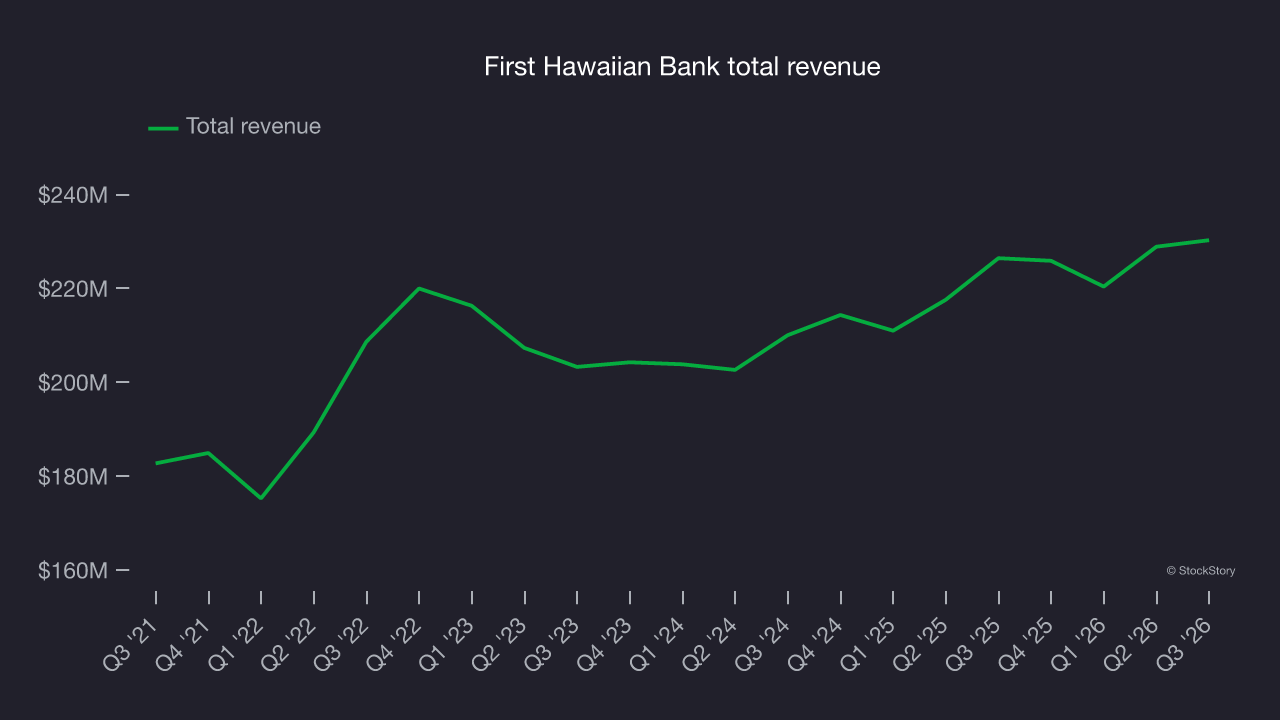
The market seems disappointed with the results as the stock is down 11.6% since reporting and currently trades at $23.11.
Read our full report on First Hawaiian Bank here, it’s free.
Best Q3: Merchants Bancorp (NASDAQ:MBIN)
With a strategic focus on low-risk, government-backed lending programs, Merchants Bancorp (NASDAQCM:MBIN) is an Indiana-based bank holding company specializing in multi-family mortgage banking, mortgage warehousing, and traditional banking services.
Merchants Bancorp reported revenues of $224.9 million, up 31.5% year on year, outperforming analysts’ expectations by 22.3%. The business had a favorable quarter with a beat of analysts’ EPS estimates and a narrow beat of analysts’ tangible book value per share estimates.
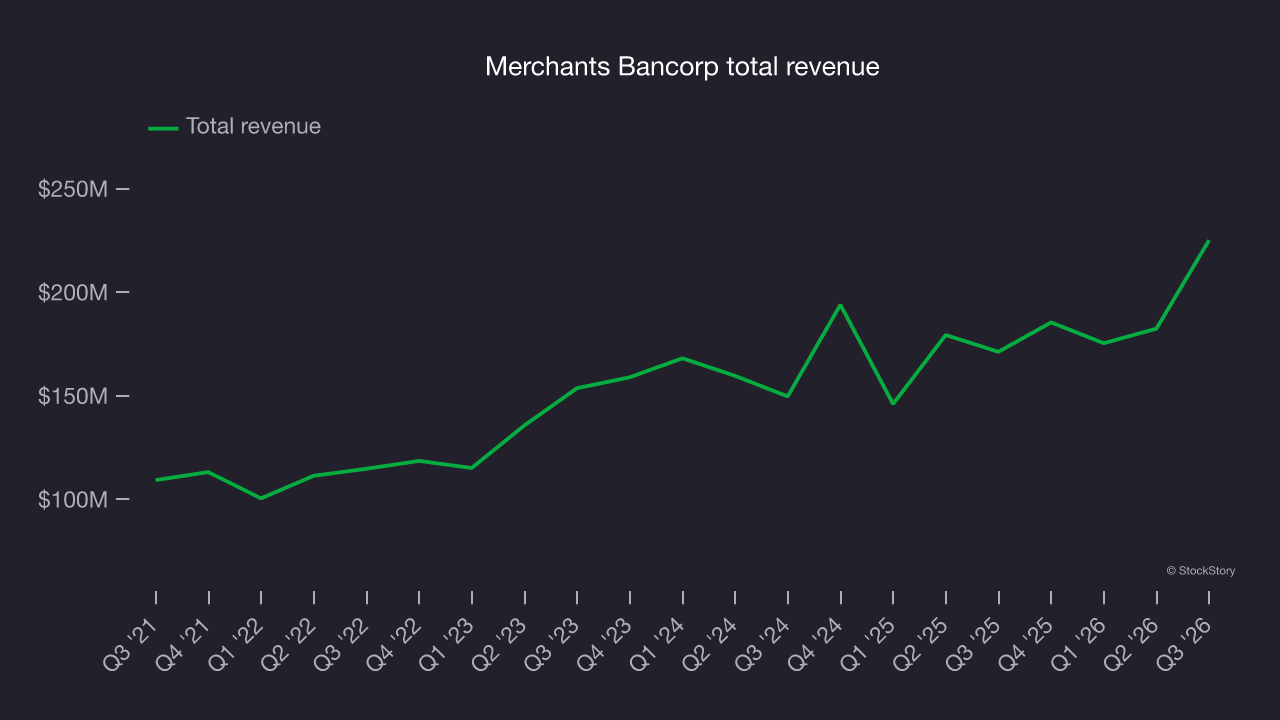
Merchants Bancorp delivered the biggest analyst estimate beat among its peers. However, the results were likely priced into the stock as it’s traded sideways since reporting. Shares currently sit at $49.11.
Is now the time to buy Merchants Bancorp? Access our full analysis of the earnings results here, it’s free.
Weakest Q3: National Bank Holdings (NYSE:NBHC)
Operating under familiar local brands like Community Banks of Colorado, Bank Midwest, and Bank of Jackson Hole, National Bank Holdings (NYSE:NBHC) operates regional banks across Colorado, Kansas, Missouri, Wyoming, Texas, and other western states, offering commercial, business, and consumer banking services.
National Bank Holdings reported revenues of $128.5 million, up 21.8% year on year, falling short of analysts’ expectations by 2.1%. It was an underwhelming quarter as it posted a significant miss of analysts’ net interest income estimates and a significant miss of analysts’ EPS estimates.
As expected, the stock is down 8% since the results and currently trades at $35.85.
Read our full analysis of National Bank Holdings’s results here.
Eastern Bank (NASDAQ:EBC)
Founded in 1818 as one of America's oldest mutual banks before converting to a public company in 2020, Eastern Bankshares (NASDAQ:EBC) operates as a bank holding company providing commercial and retail banking services primarily in Massachusetts, New Hampshire, and Rhode Island.
Eastern Bank reported revenues of $306.6 million, up 25.1% year on year. This print missed analysts’ expectations by 1.6%. It was a softer quarter as it also logged a slight miss of analysts’ net interest income estimates and a narrow beat of analysts’ EPS estimates.
The stock is down 3.3% since reporting and currently trades at $21.39.
Read our full, actionable report on Eastern Bank here, it’s free.
Pinnacle Financial Partners (NYSE:PNFP)
Founded in 2000 with a focus on delivering big-bank capabilities with community bank personalization, Pinnacle Financial Partners (NASDAQ:PNFP) is a Tennessee-based financial holding company that provides banking, investment, trust, mortgage, and insurance services to businesses and individuals.
Pinnacle Financial Partners reported revenues of $1.32 billion, up 135% year on year. This result surpassed analysts’ expectations by 2.6%. However, it was a softer quarter as it produced a miss of analysts’ tangible book value per share estimates and a narrow beat of analysts’ EPS estimates.
Pinnacle Financial Partners delivered the fastest revenue growth in the group. The stock is down 5% since reporting and currently trades at $93.28.
Read our full, actionable report on Pinnacle Financial Partners here, it’s free.
Market update
Over the past year, investors have been forced to repeatedly answer the same question: What is the market’s biggest risk? The answer has changed several times, and each shift has reshaped market leadership.
Late in 2025 and early 2026, artificial intelligence became the market’s primary uncertainty. Investors questioned whether AI would erode software pricing power and weaken competitive moats as AI made it easier to replicate once-differentiated products.
By the spring, technology took a back seat to geopolitics. The U.S. conflict with Iran briefly became the market’s dominant narrative, raising concerns about oil prices, inflation, and global growth. But as energy markets remained orderly and fears of a prolonged supply disruption faded, investors quickly turned their focus back to fundamentals.
Want to invest in winners with rock-solid fundamentals? Check out our Top 5 Growth Stocks and add them to your watchlist. These companies are poised for growth regardless of the political or macroeconomic climate.