


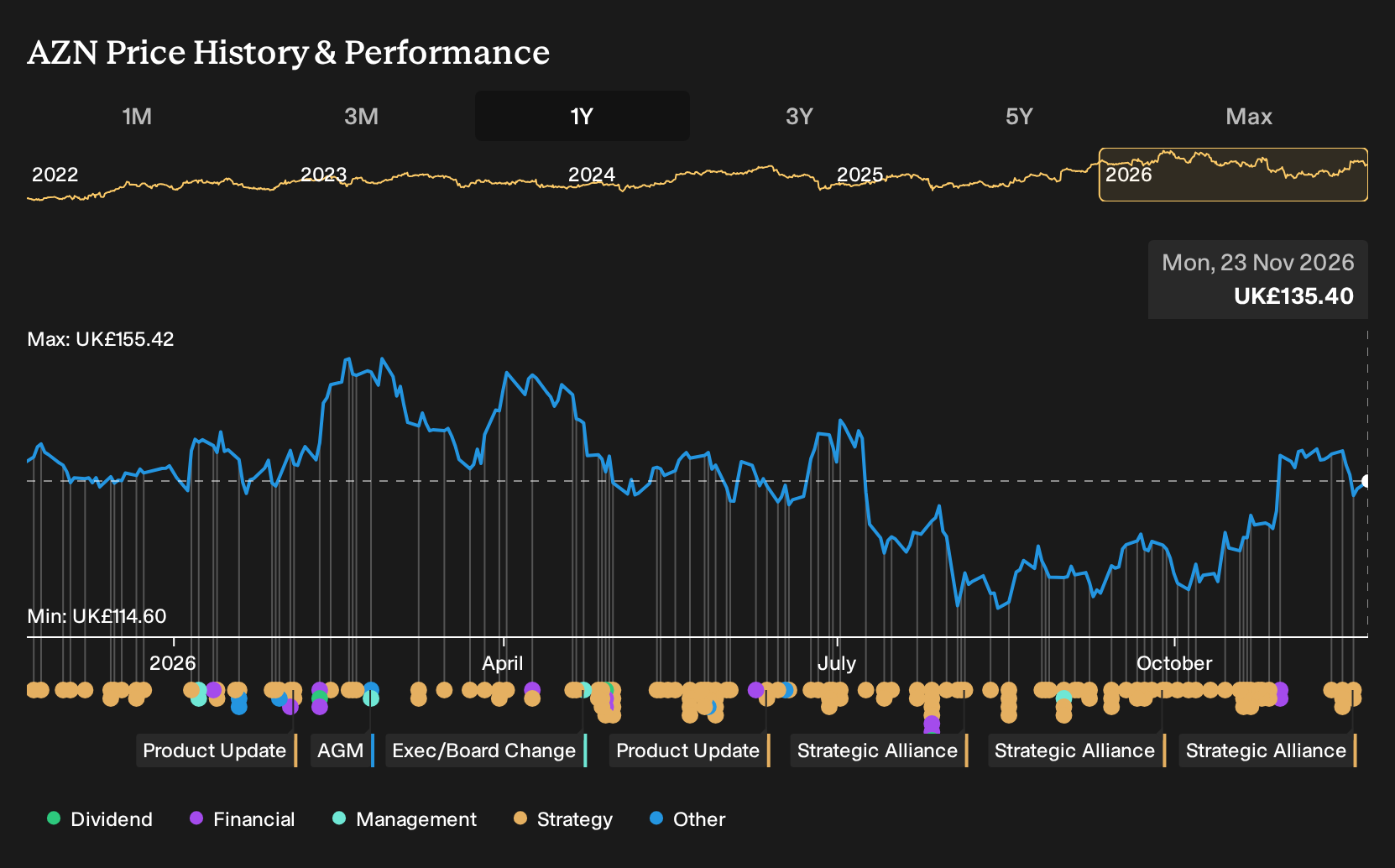
- AstraZeneca has secured a run of high impact product events, including US Priority Review for gastric cancer therapy Sone Ve, EU approval for rare disease drug Klygefa, an EU recommendation for hypertension treatment Baxfendy and expanded US approval for Imfinzi in muscle invasive bladder cancer, all announced in mid November 2026.
- This cluster of regulatory milestones deepens AstraZeneca’s exposure to oncology, rare disease and cardiometabolic markets at once. It may reshape how its late stage pipeline supports future revenue mix and operating efficiency as older products face competition.
- The focus now turns to how AstraZeneca’s late stage earnings story may be influenced by Priority Review for Sone Ve in gastric cancer.
Scan how AstraZeneca’s late stage wins compare with other potential breakout healthcare opportunities by running through the hand picked 8 healthcare AI stocks list while you read this story.
AstraZeneca Investment Narrative Recap
To own AstraZeneca, you need to be comfortable with a story built on a deep late stage pipeline and disciplined execution rather than rapid headline growth. The analyst consensus Narrative on Simply Wall St leans on oncology, rare disease and cardiometabolic assets to support earnings and cash flow as older therapies meet tougher competition. The recent cluster of approvals and reviews fits that picture but does not remove the core uncertainty around future trial readouts and uptake.
In the near term, the most important catalyst remains how efficiently AstraZeneca converts late stage programs into launches that support margins after heavy R&D and capital spending. The biggest risk is that more high profile programs repeat the missed endpoints seen with Wainua and Ultomiris while debt stays elevated and capital expenditure stays high, which could weigh on returns if newer assets underperform expectations.
The Priority Review for sonesitatug vedotin, branded as Sone Ve, looks most relevant to the current oncology focused news flow. It concentrates AstraZeneca’s near term execution risk in a hard to treat gastric cancer segment where treatment options are limited. The CLARITY Gastric01 data underpin the filing and now the timetable shifts to an FDA decision expected in the second quarter of 2027.
For investors tracking catalysts, Sone Ve sits alongside Imfinzi bladder cancer approvals and cardiometabolic moves like Baxfendy as part of a broader effort to turn a large late stage portfolio into durable revenue sources. The key issues to watch are how quickly testing for CLDN18.2 is adopted, how smoothly AstraZeneca scales commercial access if approvals follow, and whether safety and tolerability in broader use remain consistent with the trial profile.
AstraZeneca Forecasts and Implied Earnings Lift
AstraZeneca's narrative projects US$75.0b revenue and US$17.9b earnings by 2029. This aligns with analyst assumptions of 6.3% yearly revenue growth and implies an earnings increase of about US$6.9b from US$11.0b today.
Uncover why AstraZeneca's fair value indicates a 22% potential upside to its current price, which could narrow quickly.
Exploring Other Perspectives
The lupus collaboration offers a different twist for AstraZeneca. Bearish analysts worried more about cardio metabolic setbacks and expected 2029 earnings of about US$14.2b on revenue of roughly US$70.9b. You can read that as a cooler view on immunology upside. This new partnership may affect how those forecasts develop.
Explore 3 other AstraZeneca fair value estimates, including one that suggests it could be worth just £164.59!
Decide For Yourself
Don't just follow the ticker. Dig into the data and build a conviction that's truly your own.
- A great starting point for your AstraZeneca research is our analysis highlighting 4 key rewards and 1 important warning sign that could impact your investment decision.
- See our latest analysis for AstraZeneca. The report includes a comprehensive fundamental analysis summarized in a single visual, the Snowflake, making it easy to evaluate AstraZeneca's overall financial health at a glance.
Looking for more AstraZeneca style investment ideas?
If AstraZeneca has sharpened your focus on quality, it can help to widen the lens and compare it with other potential opportunities using the Simply Wall St Screener. Pick a few angles that fit your approach and stress test your AstraZeneca thesis against what else is out there.
- For investors who care about quality at a reasonable entry point, scan a curated set of companies that screen as both high quality and potentially mispriced through the 15 high quality undervalued stocks.
- If capital preservation sits high on your priority list, focus on businesses that combine resilience with lower overall risk scores by running through the 7 resilient stocks with low risk scores.
- When you want to back stronger balance sheets rather than stretch for story stocks, compare AstraZeneca with a list of solid balance sheet and fundamentals (7 results) that can handle shocks and still fund their own growth.
Have feedback on this article? Concerned about the content? Get in touch with us directly. Alternatively, email editorial-team@simplywallst.com