


UnitedHealth Group has seen its share price fall sharply in recent weeks, and the stock last closed at US$339.85. After a three year stretch where holders have seen a loss on paper, the key issue for investors is whether that current price is still in line with what UnitedHealth’s earnings can support.
- Over the past three years the stock has declined 33.4%, which puts fresh focus on whether the underlying earnings justify even the reduced valuation that the market is now assigning.
- Regulatory pressure on Medicare Advantage plans, including proposed anti fraud rules and renewed debate over Medicare for All, can influence expectations for UnitedHealth’s future profitability and the timing of its cash flows from this important line of business.
- There is a second opinion on UnitedHealth Group worth weighing. See what analysts think UnitedHealth Group's shares could be worth.
The issue now is whether UnitedHealth Group’s current share price is adequately supported by the earnings it is generating today and what analysts expect it to produce in the years ahead.
If you are reassessing UnitedHealth Group after this drop and want a broader watchlist, a focused stock screen built around 31 resilient stocks with low risk scores can be a useful second starting point for research.
Does UnitedHealth Group Look Undervalued on Earnings?
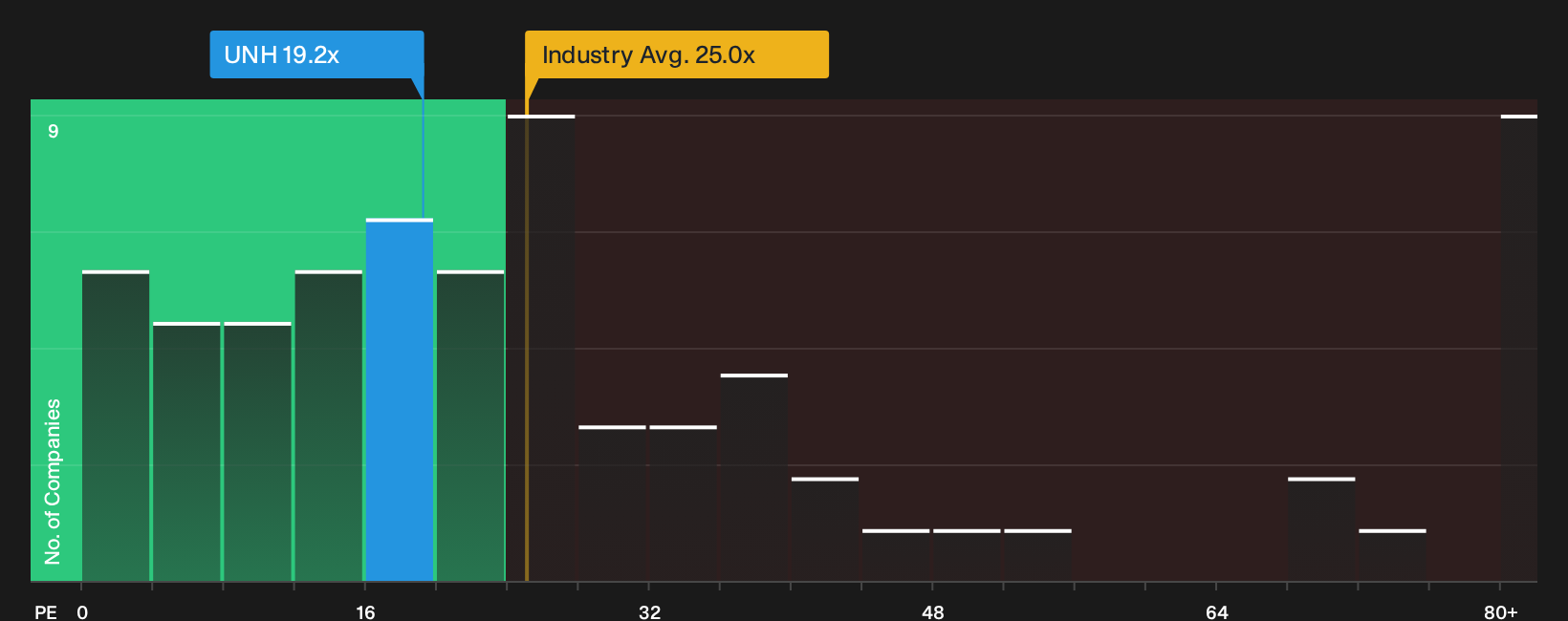
The P/E ratio suits UnitedHealth Group because earnings remain a primary anchor for how investors judge large insurers. On this yardstick, the stock trades on about 19.2x, which is below both the broader Healthcare sector average of roughly 25.0x and the closer peer group at about 27.2x. For a mature, diversified healthcare group, that is a meaningful step down from what similar businesses currently command.
The Fair Ratio framework blends factors like profitability, scale and sector risk. Its output points to a higher P/E than where UnitedHealth Group trades today, which implies the shares screen as undervalued on this measure. Despite the CRUSH rule proposals and renewed Medicare for All debate weighing on sentiment, the current multiple still prices the stock at a discount to these benchmarks. That leaves room for readers to judge whether the regulatory risk justifies that gap. Explore the numbers behind UnitedHealth Group's P/E valuation.
The UnitedHealth Group Narrative: What Would Justify Today's Price?
Simply Wall St Narratives for UnitedHealth Group pick up where the valuation work leaves off and explain which paths for earnings, margins and growth would need to occur for today’s share price to appear materially high or low. Each scenario links its figures to a clear view on how profitability, expansion and key risks might change over time, which gives you something specific to compare against as new information on UnitedHealth Group becomes available.
Bulls and bears are looking at the same UnitedHealth Group playbook and drawing very different conclusions about what the current price reflects.
Bull case: 29% undervalued
According to the analyst consensus Narrative on Simply Wall St, the positive view rests heavily on execution and technology.
"The main thing that has to go right is execution on margin recovery in Medicare, Medicaid and commercial lines, along with delivering the OptumHealth turnaround and AI-enabled cost savings…"
Discover why this Narrative puts UnitedHealth Group at 29% undervalued.
Bear case: 10% overvalued
According to yiannisz, an investor in the Simply Wall St Community, the concern is what regulators and policymakers might do with that integrated model.
"Regulators and policymakers increasingly question whether vertically integrated insurers reduce competition or steer patients in ways that limit choice…"
Explore why this Narrative puts UnitedHealth Group at 10% overvalued.
UnitedHealth Group's valuation still leaves one crucial angle unresolved
Price and earnings only tell part of the UnitedHealth Group story, because our broader checks have flagged potential pressure points that deserve a closer look before you decide how to weigh this insurer. Take a closer look at 1 warning sign before settling on a valuation.
Have feedback on this article? Concerned about the content? Get in touch with us directly. Alternatively, email editorial-team@simplywallst.com