


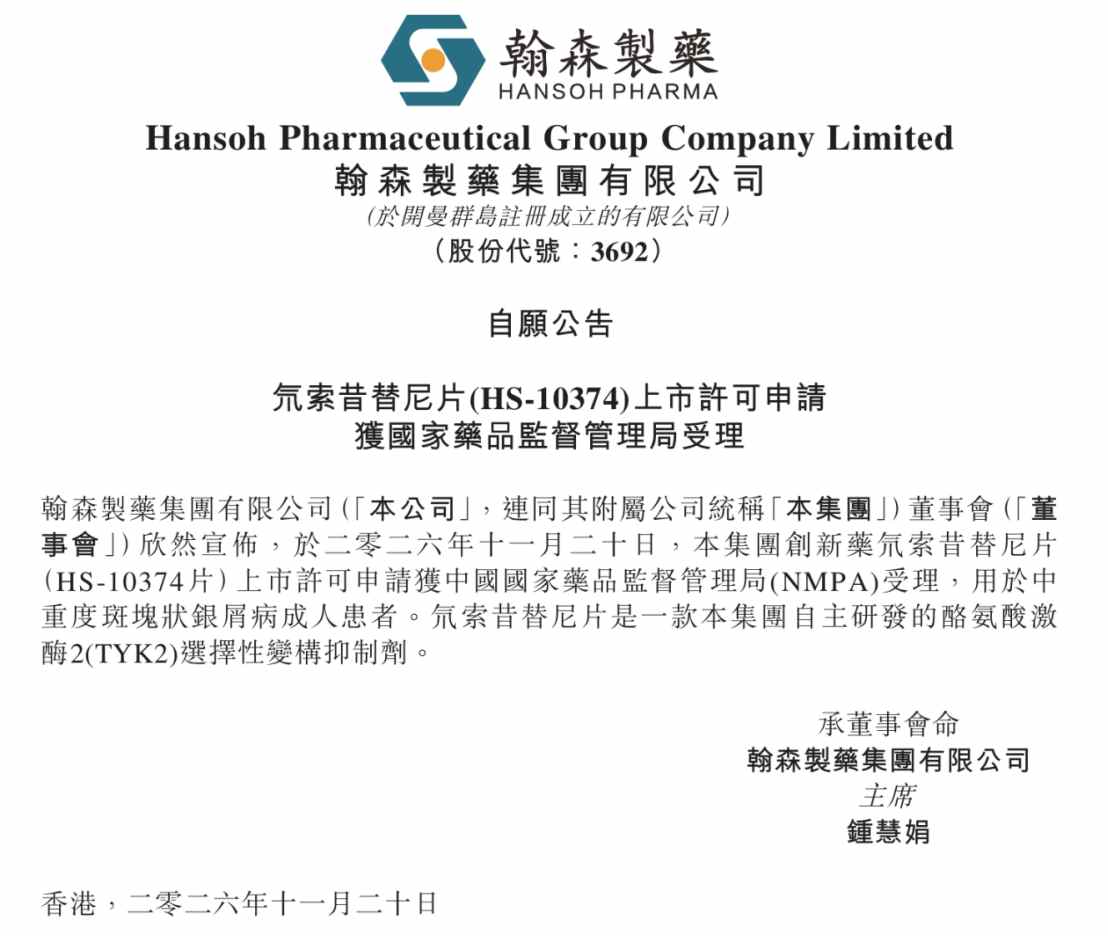
After the market on November 20, deuterosoxitinib (HS-10374), an innovative drug under Hanson Pharmaceuticals (03692), officially submitted a marketing application to treat moderate to severe plaque psoriasis in adults. This means that this oral TYK2 variant inhibitor, the first domestically produced and the second to be declared for marketing in China, has entered the final countdown stage for commercialization. The news has also become one of the important variables affecting the recent stock price of Hanson Pharmaceuticals.
Oversold indicators resonated intensively, and signs of a steady rebound have appeared?
Looking at the market, from November 16 to 20, Hanson Pharmaceuticals's stock price broke out of a downward trend, with a cumulative decline of 10.69% in the range. However, the beta factor in the AH sector is an important factor causing the company's stock price to fall.
The Zhitong Finance App observed that from November 16 to 20, the A-share pharmaceutical and biological sector fell 7.04%, clearly outperforming the market. Among them, chemical pharmaceuticals and biological products led the decline by 8.62% and 8.77% respectively; in the Hong Kong stock market, the Hang Seng Healthcare Index had a cumulative decline of 9.65% during the same period, while the Hang Seng Biotech Index, which represents the performance of innovative drugs, reached 10.19%. Both outperformed the Hang Seng Biotech Index during the same period.
In fact, CDE's official website updated the marketing application information for deuterosoxitinib during the intraday period on November 20, but against the backdrop of continued adjustments in the pharmaceutical sector in AH, it is difficult to reverse market sentiment even when the R&D milestones for major innovative varieties are difficult to reverse market sentiment.
It is easy to see that this round of Hanson Pharmaceuticals' stock price adjustments began on November 11. After the previous round of market increases, the company's stock price began to shrink and recover on the same day and continued until November 19. During this period, technical stock price information showed that its moving average gradually became bearish, OBV continued to decline, and the MACD red bar shrank to the zero axis. In particular, the short-term EMA acceleration downward showed an EMA suppression performance, which established a bearish signal in this range.
Continued bearish technology combined with a systematic sharp decline in the sector contributed to a certain extent that investors chose to make short-term profits when Hanson Pharmaceuticals successfully landed on November 20. On the same day, the company's stock price closed down 5.18% in a single day, with a volume of 1.3536 million shares. The closing price of HK$30.74 almost hit the BOLL offline trend of HK$30.72 on the same day.
Judging from quantitative energy performance, Hanson Pharmaceuticals' OBV index fell from the starting point of the range of 74.6 million to the end of the range, with a net outflow of 24 million shares, and hit a new low OBV of 45 million on November 20. In sync with the new low in the company's range stock price, the sharp decline in volume and price showed a classic bearish confirmation structure.
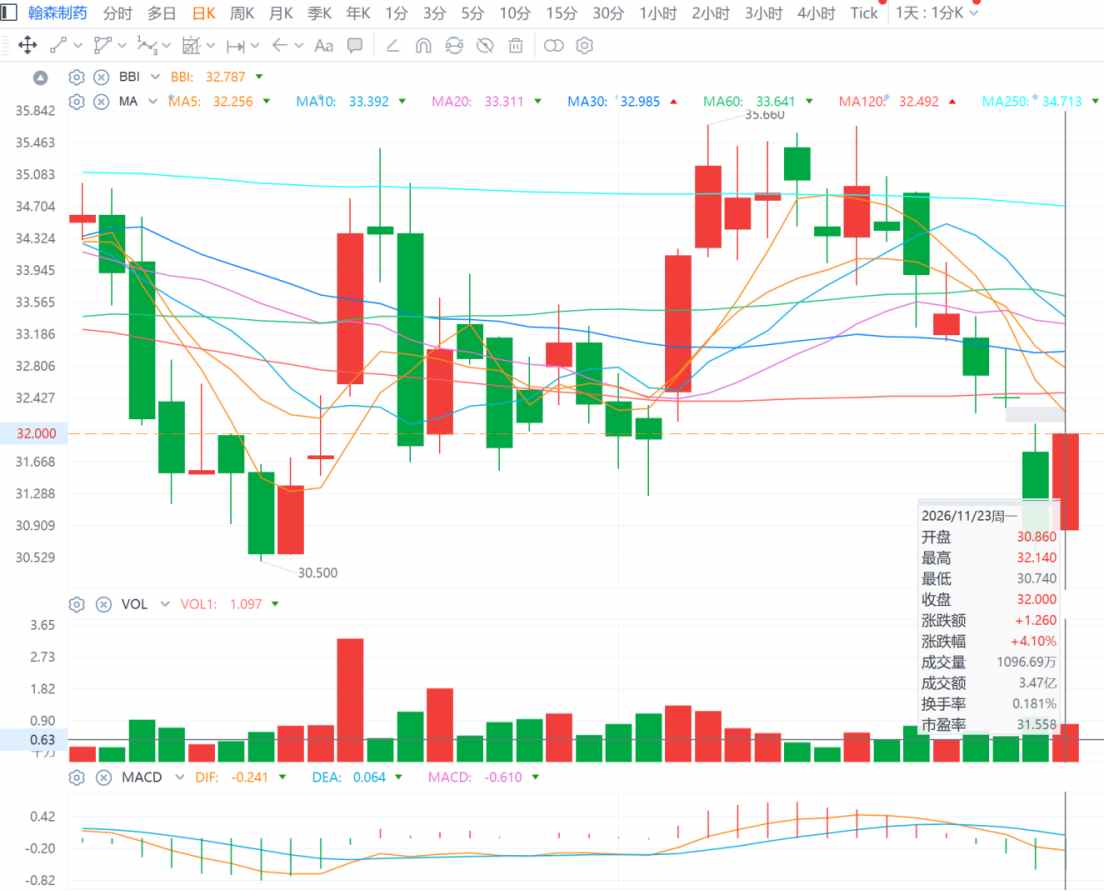
However, the rise on November 23 added quite a few variables to the next technical trend of Hanson Pharmaceuticals' stock price.
According to the Zhitong Finance App's observation, technical indicators show that on November 20, its KDJ-J value fell to -17.35 and entered the extreme oversold zone during a sharp drop in volume, while the KDJ-K value fell below the 20 indicator line and reached 18.31; however, on November 23, the KDJ-J value of Hanson Pharmaceuticals stock price rebounded sharply to 2.21 along with the rising market, and the corresponding KDJ-K value returned to 21.60. Although its KDJ-D value was still suppressed at a high level of 31.29 and there was no gold fork at this point, the rapid recovery of the J value from the deep negative value range and the K-line turned upward is already technically a leading sign of a rebound over the fall.
Meanwhile, Hanson Pharmaceuticals' RSI indicator shows that its RSI6 has recovered from the 17.87 oversold area on November 20 to 39.18 on the 23rd. Although currently the RSI6 indicator is still below the 50-point index on the central axis and has not yet entered the bullish range, the single-day rebound has exceeded 20 points, indicating that the market is undergoing rapid momentum restoration and has moved away from the extreme oversold region.
Southbound capital bucked the trend and increased its holdings, or provided important support for subsequent reversals
Recently, along with the Federal Reserve's interest rate hike, long-term US bond yields have risen markedly, and the global high-valued assets, especially the AI-related technology sector, have clearly fluctuated.
Meanwhile, in the Hong Kong stock market, according to statistics from Guojin Securities's Hong Kong Stock Fund's three-quarter report, it showed the characteristics of “index fluctuations and structural differentiation” in the 26Q3 quarter. The “high and low cut” of capital was obvious: the Hong Kong Stock Fund Allocation Technology sector declined sharply by 4.99 percentage points from month to month, and the China Securities Hong Kong Stock Connect Innovative Drug Index rose 20.79% over the same period, leading the way for major Hong Kong stock indices. However, the southbound capital with net purchases of over HK$134 billion during the quarter became a key “sweeper” force.
Back to Hanson Pharmaceuticals, as a key “medium- to long-term reverse layout” capital in the market, southbound capital showed typical left-side trading characteristics of “falling and increasing positions, rebounding and reducing positions” on Hanson Pharmaceuticals in the past 3 months, and this phenomenon was particularly evident in November of this year.
The Zhitong Finance App observed that since November of this year, when Southbound Capital increased its holdings, the average rise and fall rate of the company's stock price was -1.51%, while the average rise and fall rate of the stock price on the day the holdings were reduced was +1.43%. It can be seen that Southbound Capital's buying behavior of Hanson Pharmaceuticals is highly negatively correlated with the direction of the rise and fall of its stock price on that day.
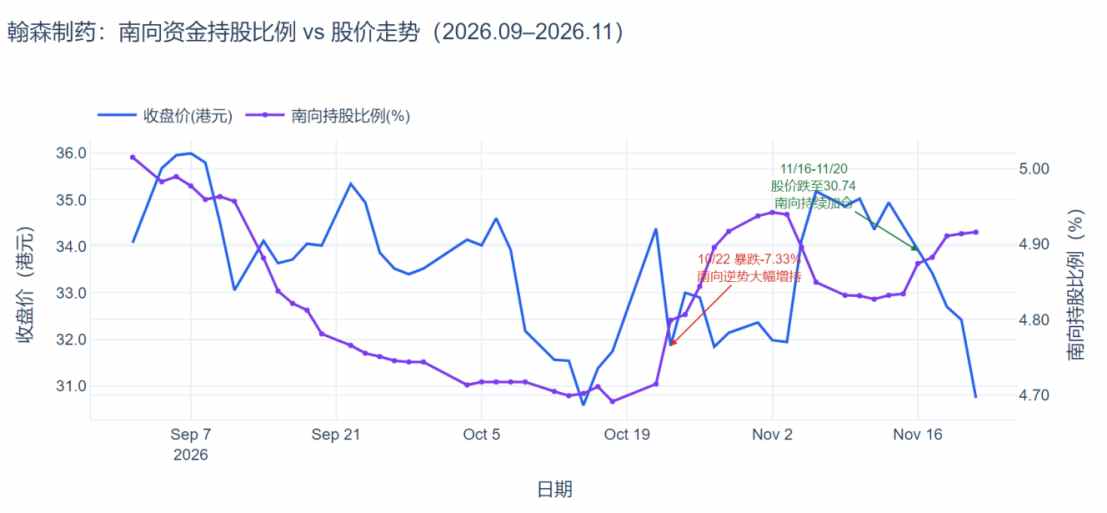
In particular, during the decline in Hanson Pharmaceuticals stock prices from November 17 to 20, Southbound Capital bucked the trend for 4 consecutive days of decline, with a cumulative net increase of 4.946 million shares, and the shareholding ratio rose from 4.87% to 4.92%. Judging from the time window for increasing accumulation, deuterosoxitinib NDA is undoubtedly an important catalyst.
As mentioned above, deuterosoxitinib is the first domestically produced oral TYK2 variant inhibitor independently developed by Hanson Pharmaceuticals and the second to be declared for marketing in China. Until then, only BMS deuterium clexitinib, a selective TYK2 inhibitor, was approved for marketing worldwide.
According to the Zhitong Finance App, deuteroxitinib is an oral highly selective TYK2 allosteric inhibitor. In September of this year, its phase III study to treat plaque psoriasis reached the main end point and several secondary endpoints.
The study results showed that in the 16th week of treatment, deuterosoxitinib achieved a psoriatic area and severity index drop of at least 75% from the baseline, and the proportion of patients who achieved a static physician's overall assessment score of 0 or 1 and a decrease of at least 2 points from the baseline period were significantly higher than the placebo group. At the same time, more than half of patients treated with deuterosoxitinib achieved a PASI 90 response, and nearly 1/3 achieved a PASI 100 response.
Furthermore, deuterosoxitinib also showed good safety and tolerability. Its safety characteristics were similar to similar TYK2 inhibitors, and no new safety signals were observed.
Although the efficacy and safety data of this drug can no longer be considered a scarce selling point in the domestic psoriasis treatment market, its oral drug properties are expected to directly threaten the dominant position of the BMS deuteroclexitinib family, and bring domestic patients the choice of domestically produced drugs in terms of convenience and long-term management needs.
Furthermore, one of the major advantages of Hanson commercialization is that it has maintained a high pass rate of product health insurance admission for many years. It is worth mentioning that in the 2025 national health insurance catalogue adjustment, Hanson's nine innovative drug indications were all included, and the health insurance admission success rate was 100%, reflecting the systematic competitive advantage in clinical evidence organization, health insurance negotiation strategies, and government affairs docking.
In this context, medium- and long-term funding bucked the trend during the deuterosoxitinib NDA window. Perhaps the bet is that Hanson is once again replicating the commercialization rhythm of “going public in the same year and entering medical insurance the next year” on this product, and thereby obtaining first-mover pricing rights in the domestic psoriatic oral medication market.