


In an environment where the pharmaceutical sector has recently revived and capital allocation has been accelerated, Xiantong Pharmaceutical-B (09941), which entered the Hong Kong stock market as the “first share of 18A nuclear drugs”, has undoubtedly attracted investors' attention. However, its performance on the first day of listing was unsatisfactory.
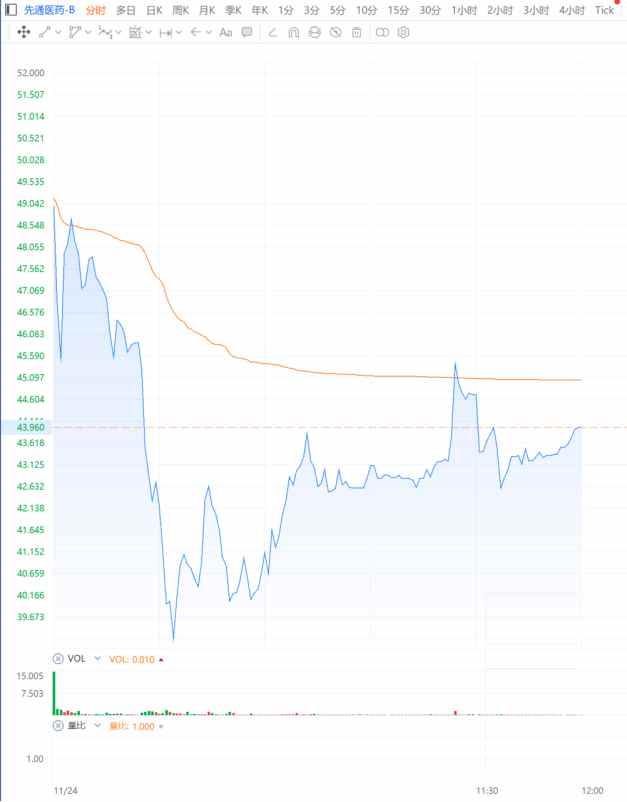
On November 24, Xiantong Pharmaceutical opened low on the first day of listing. The company's stock price swung to a low of HK$38 within 40 minutes of opening, falling more than 25% from its offering price of HK$52.
The dark market skyrocketed, and the listing plummeted
Sorting through the evolution of Xiantong Pharmaceuticals from the dark market to the key price on the first day of listing, investors can easily find that its overall stock price showed a three-stage trend of “high opening - rapid killing - breaking”.
In the dark market stage, although there are significant differences in the opening prices of various platforms, they are basically about 20% higher than the company's issuance price. Among them, the Livermore platform offered an opening offer of HK$76, which is 46.15% higher than the issue price, corresponding to a profit of up to HK$1,200 per lot, which attracted widespread attention in the market.
However, market excitement stopped at the opening. After that, Xiantong Pharmaceuticals' undermarket share price fell all the way down. Phillip's undercover market fell all the way from the opening of HK$76 to the closing of HK$49.32, a drop of 35.11%. On the first day of listing, Xiantong Pharmaceutical's stock price opened at HK$49, 5.77% lower than the issue price.
In fact, dark trading is essentially a market driven by sellers' offers, and the “high points” seen by investors are often unable to actually trade. However, Xiantong Pharmaceutical's closing price of HK$49.32 on Phillip's undermarket may be a price signal closer to actual supply and demand, but it is already 5.2% lower than the issue price, laying down psychological expectations for the first day's break.
It is easy to see that after Xiantong Pharmaceutical went public for the first time, the opening price was almost close to yesterday's closing price of HK$49.32, which indicates to some extent that its undercover market luckers did not get a premium exit window, which ultimately prompted the company's stock price to open directly low on the first day of listing and continue to decline.
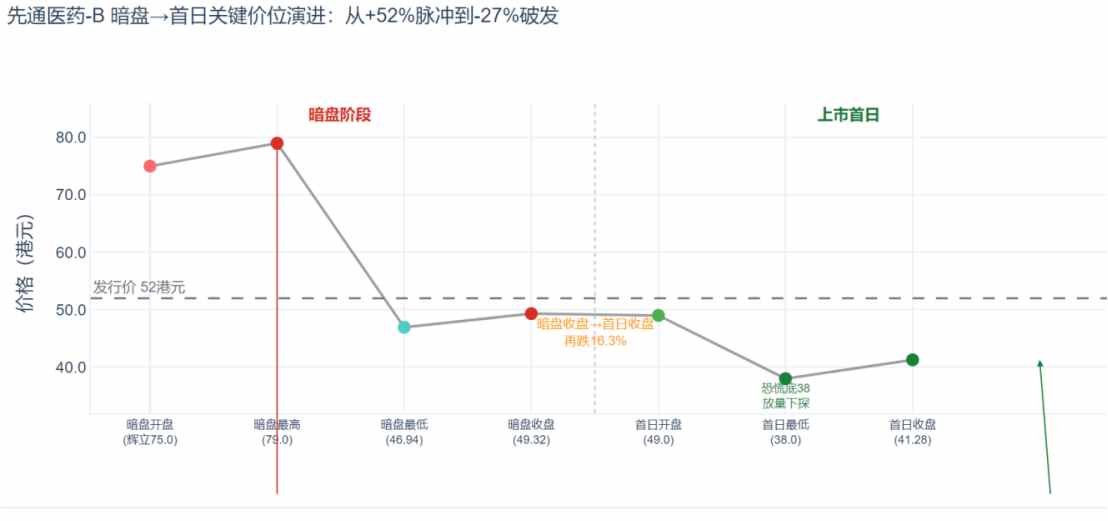
The Zhitong Finance App observed that in terms of market performance on the first day of listing, Xiantong Pharmaceutical's stock price reached a high point, and the subsequent trend was basically dominated by bears in the market. Although the stock price showed a certain pullback after hitting the bottom of the HK$38 intraday panic, the stock price decline narrowed to less than 13% at one point, indicating a sharp long and short game in the market, due to weak chassis copying, compounding the volume decline of more than 1.5 million shares in early trading, the difficulty for Xiantong Pharmaceutical's stock price to form an effective short-term rebound structure in the subsequent market.
Behind the scenes from the dark disk to the real thing
According to the issuance plan, Xiantong Pharmaceutical will now sell 6.561 million H shares globally. In terms of public sales in Hong Kong, the company was oversubscribed by 5228.77 times. This actually shows the market's renewed enthusiasm for Xiantong Pharmaceutical.
However, the actual first-hand winning rate was only 1.50%, which means that most of the winners were leveraged financing orders. In the context of a subscription where only 50 shares were signed in the first hand, the leveraged financing interest rate was 4%, and the financing ratio was 90%, the winners naturally had a strong motivation to cash out on the first day. Furthermore, Xiantong Pharmaceutical received only 3.01 times the subscription during the national distribution phase and did not introduce any cornerstone investors.
According to the Zhitong Finance App's historical financing details, in the last two rounds of pre-IPO sprints (capital increase in January 2025, share transfer in May 2025), the company's post-investment valuation has been pushed to about 87.86 yuan/share, with a converted RMB valuation of about RMB 5.188 billion. However, the company set a price limit of HK$52.00, which is as high as 39.2% compared to the primary market valuation discount rate, and the valuation inversion is obvious.
Generally speaking, discounted issuance often indicates that issuers and underwriters do not receive sufficient institutional support during the bookkeeping stage, and can only rely on price limits and zero foundation to facilitate transactions.
For Company 18A, the issue price itself is a “risk pricing” of the risk of the pipeline being realized by the market. Lowering the price limit means that the company's IPO sponsor is cautious about the company's ability to accept liquidity after listing.
In addition to pricing, whether Xiantong Pharmaceutical can get through after it is marketed has also become the biggest concern in the market.
From the perspective of price stability, Xiantong Pharmaceutical sold 6.561 million H shares globally, raising a net capital of about HK$277 million. According to the green shoe mechanism set up by Xiantong Pharmaceutical in its current IPO, its overallotted shares totaled 984,400 shares (accounting for 15% of the global sale). Based on the issue price of HK$52, the maximum available capital for the current price stabilization operator is about HK$51,188,800.
However, after Xiantong Pharmaceuticals went public for the first time, the early trading turnover reached HK$797.27,800. Green Shoe funding only covered 64.19% of the early trading volume, which seemed somewhat “worth nothing” in the face of panic sales.
It is worth mentioning that the Green Shoe capital mainly comes from the capital raised from the over-allotment portion. According to the Green Shoe mechanism clearly disclosed by the company in its prospectus, price stabilization actions must be based on investors agreeing to “delayed delivery arrangements”. If no investors agree to delay delivery in international placements, price stabilization actions cannot be carried out, and overallotment rights will not be exercised.
However, as mentioned above, Xiantong Pharmaceutical did not introduce any cornerstone investors, and its international placement was overbought by only 3.01 times and 61 underwriters. These institutional undertakers do not have any lockdown arrangements and can sell all of their chips on the first day of listing. Therefore, in the face of pressure to lose money, it naturally tends to be cashed out on the first day rather than delayed delivery.
In other words, if no one signs a delayed delivery agreement, it may be difficult to effectively implement Xiantong Pharmaceuticals' green shoe mechanism this time.
On the other hand, the essence of price stability with green shoes is actually “using real money to hold a price bottom line supported by fundamentals.” However, as an 18A company, Xiantong Pharmaceutical is currently unprofitable, and has a long core pipeline settlement cycle, so it is difficult to provide a stable valuation anchor for the company from a fundamental perspective in the short term. Under this fundamentals, Xiantong Pharmaceutical's issuance price of HK$52 is more a reflection of the company's balanced game price during the IPO bookkeeping stage, rather than the “bottom line of value” supported by fundamentals.
Therefore, when the market chooses to reprice Xiantong Pharmaceuticals, even if the green shoe mechanism works smoothly, price stabilization operators lack sufficient motivation to continue buying close to the issue price. When the stock price on the first day of listing was broken through panic selling, if Xiantong Pharmaceutical wanted to hit the “entry” threshold later, it would need to wait for the market to continue to test its value resilience as the “first share of 18A nuclear drugs.”