


The Zhitong Finance App learned that although the European car market faces challenges such as maintaining record high fuel prices and pressure on household budgets, the strong increase in demand for electric vehicles still provided a market for the ninth month in a row, driving European car sales growth for the ninth month in a row.
The European Automobile Manufacturers Association (ACEA) said on Tuesday that the number of new car registrations in Europe increased 3.4% year-on-year in October to 1.13 million vehicles. Pure electric vehicles led this growth and continued the marked acceleration since the second half of this year; pure electric vehicles and plug-in hybrid vehicles together accounted for 43% of new vehicle registrations, up from 31% in the same period last year.
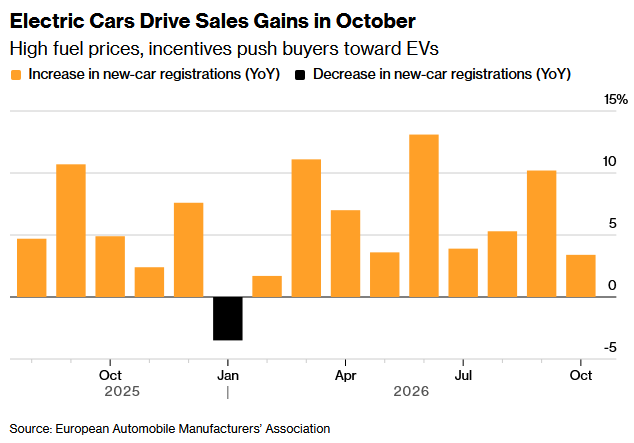
High oil prices and car purchase incentives drive consumers to electric vehicles, and European car sales have been growing for nine consecutive months
Government incentives, higher gasoline prices, and a growing variety of more affordable electric models have all contributed to this growth. Automakers, including Volkswagen, Renault, and Stellantis NV, are launching lower priced pure electric vehicles, and Chinese automakers are also increasing their market choices. Furthermore, the European charging network continues to improve.
Germany and France led the increase in sales of pure electric vehicles. The sales volume of pure electric vehicles in both countries increased by about 80%, and the market share reached about 40%. The introduction of government subsidy policies for low- and middle-income car buyers is driving demand for car purchases.
The strong performance of demand for electric vehicles occurred against the backdrop of the overall automobile market facing a less favorable environment. The war in the Middle East pushed fuel prices to record highs and forced governments to intervene to ease the cost pressure faced by households. France has supported commuters, while Germany and Spain have taken steps to lower gasoline and diesel prices. These measures may currently help maintain demand for cars, but high energy costs may further erode household budgets and make consumers more hesitant to buy high-value products such as cars.
Meanwhile, for European car manufacturers, the electric car boom is a double-edged sword. Increased sales help manufacturers meet emissions targets, but the profitability of pure electric vehicles is generally lower than that of fuel vehicles in the same class. At a time when corporate profits are already under pressure, the shift to electric vehicles has dragged down profit margins as a result.
Volkswagen and Stellantis both issued warnings during the release of the third quarter earnings report that the share of electric vehicles in their sales structure continues to rise, and the low profit margins of such models are putting pressure on the company's profitability.
The market is also becoming increasingly competitive. Chinese automakers continue to expand their share of the European market with competitively priced electric vehicles and hybrid models, and both BYD and Chery have more than doubled year-on-year vehicle registrations in Europe last month.
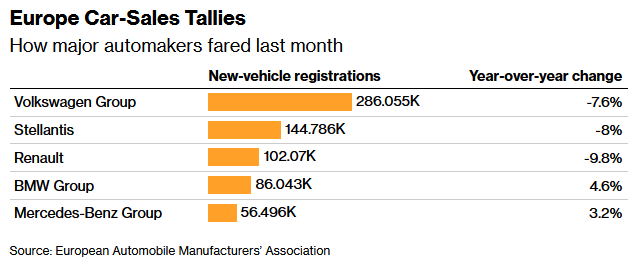
The market performance of major automakers last month
Low profit margins and high costs are further increasing the urgency for European car manufacturers to control spending. Volkswagen is implementing one of the largest restructuring plans in the automotive industry. It is currently promoting more flexible working hours and limiting wage growth to reduce labor costs in Germany.
The Mercedes-Benz Group also wants employees to work longer hours without a corresponding increase in pay, and warned that if an agreement cannot be reached with labor representatives, the German factory may eventually face operational risks.
Bloomberg Intelligence analysts Michael Dean and Giacomo Reglin said that European automakers will need to cut production capacity and reduce the size of employees to offset competitive pressure from Chinese rivals in the local market and lower profit margins brought about by pure electric vehicles.