


The Zhitong Finance App learned that despite the US tariff policy, low-cost steel in Asia continues to be favored by US buyers. The boom in data center construction is squeezing local supply and driving up steel prices. As a result, imported steel from overseas is once again popular.
The 50% tariff introduced by the Trump administration has drastically reduced the volume of overseas steel goods flowing into the US. However, as domestic steel prices in the US hit a four-year high, in recent months, low-priced steel from East Asian sellers has continued to flow into the US market.
According to aggregated data from the American Steel Association, as of October, South Korea's flat steel imports surged 68% over the same period in 2025; Vietnam's steel import declarations in October doubled compared to the final arrival volume in September, reaching 213,000 net tons, making it the fourth largest supplier of steel abroad to the US in that month.
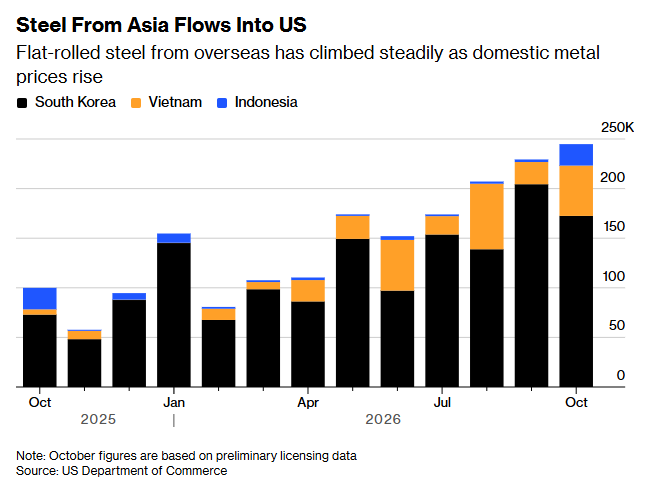
According to information, the rapid expansion of artificial intelligence (AI) and the required power infrastructure has caused the US steel demand to grow far beyond expectations. From building foundations to server racks and ventilation ducts, all kinds of projects use a large amount of steel; this boom in construction is straining local supply — orders from steel mills fill up rapidly, making it difficult for local steel mills in the US to meet demand.
Wells Fargo analyst Timna Tanners said, “The market is very competitive in steel-grabbing. U.S. steel mills are undersupplied and are even cutting the 2027 supply agreement volume.”
The continued return of overseas steel also revealed the limitations of Trump's tariff policy. The original purpose of this tariff policy was to raise the cost of overseas steel and protect local steel mills such as NUE.US (NUE.US), Steel Dynamics (STLD.US), and Cleveland Cliff (CLF.US). However, continued strong demand for steel has pushed US steel prices to such a high level that foreign sellers are still profitable even if they bear tariffs.
Jefferies analyst Albert Leilini mentioned in a recent research report that even when tariffs and shipping costs are factored in, some imported steels are still nearly $400 cheaper per ton than local goods.
This week, Nucor Steel, the largest steel company in the US, raised the listing price of hot rolled coils to 1,330 US dollars per short ton, continuing the continuous price increase that began in the summer. Hot rolled coil is the most widely used steel category, and can be used in many products such as automobiles and building materials.
Spot prices in the market are rising at the same time. The price of hot-rolled steel in the US recently surpassed 1,300 US dollars/ton, compared to less than 900 US dollars a year ago.
Nucor Steel CEO Leon Topalian said in an earnings call at the end of October: “Imports have continued to pick up in recent months, with South Korea's steel imports surging sharply. But let's be clear: demand fundamentals are still strong. Even though imports have gradually increased this year, local steel shipments have continued to rise quarter by quarter over the past three quarters.”
Longer delivery times
With the rise in steel prices and the contraction of imports in the early stages, US steel mills have increased production. According to data from the American Steel Association, US steel production increased 5.9% year over year in the week ending November 14. However, the increase in production has not eased supply constraints: steel mill maintenance has stopped, orders are full, and early imports have declined, so there is still a shortage of steel that can be obtained immediately by buyers.
For a small manufacturer like Marlin Steel, that meant a longer wait for delivery. The company specializes in steel wire and sheet metal custom products.
Marlin Steel CEO Drew Greenblatt said that the company only buys steel from the US; now orders are placed with steel mills, and the delivery period has been extended to 8-12 weeks, compared to only 1-3 days a year ago. To this end, companies began to take the initiative to stock up.
“It's hard for us to re-adjust prices to our customers, and we're in a very passive situation. So I'm now stocking up as much as possible to ensure continuous delivery. The procurement volume has far exceeded actual needs.”
The Korean steel market is dominated by giants such as POSCO Holdings (POSCO Holdings) and Hyundai Steel (Hyundai Steel), and production capacity is abundant; under weak local demand, steel mills continue to seek export markets. Vietnam has rapidly expanded production in recent years, and all categories such as construction steel, hot-rolled coils, pipes, and galvanized sheets can be supplied to foreign countries.
This trend has alarmed local US manufacturers. They have long accused their Asian peers of using the US as a dumping market.
In September of this year, US steel companies collectively called on the Trump administration to launch an investigation into the surge in South Korea's steel imports, focusing on construction steel, pipes, and flat-rolled steel. In September alone, South Korea shipped 519,000 tons of steel to the US, up 21% from August; Japan's steel imports jumped 60% during the same period.
Citibank analyst Alexander Hagin wrote in the customer report: “Low end customer inventory and data center demand combined with seasonal inventory replenishment. Multiple factors resonate, and the US steel market is clearly strained in supply. It remains to be seen when this round of shortages will ease.”