


The Zhitong Finance App learned that Korea's artificial intelligence (AI) chip dividends are spawning a wave of year-end settlement capital inflows, which may push the won to start a new round of appreciation.
SK Hynix (SKHY.US) and Samsung Electronics plan to exchange large amounts of huge export revenue into domestic currency to pay dividends and record employee bonuses; at the same time, the AI hardware business brings huge profits, and the two companies also need to raise more won and pay large taxes to the government.
Macro Hive and Korea Investment Securities anticipate that this inflow of capital is expected to support the rise of the won to 1 US dollar to 1200 won at the end of the first half of 2027. Also based on this series of favorable factors, Goldman Sachs predicts that the won will strengthen to 1,280 won against the US dollar next year, an increase of about 5% compared to the exchange rate level of 1345.80 this Wednesday.
Market analysts said that this payment of funds will be concentrated in the next few weeks, which will benefit the won and add momentum to the cumulative increase of 7% against the US dollar this year. Although remittance of dividends from overseas investors will put pressure on the won in the short term, record export volume and high current account surpluses will support the won to maintain its main upward line in 2027.
Vivek Rajpal, Asia strategist at JB Drax Honore in Singapore, said, “The core logic is that exporters still have huge demand for dollar settlement. Even if sentiment in the AI sector weakens, there is still room for the won's appreciation trend to continue.”
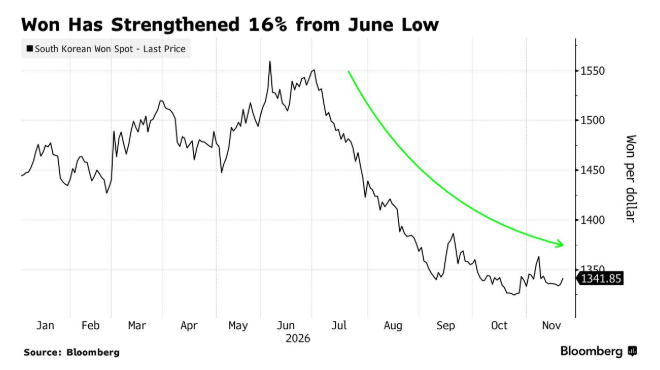
Since hitting a 17-year low in June, the won has cumulatively rebounded about 16%. Export companies, led by chip manufacturers, continue to sell US dollars to raise funds for domestic projects. The won led the performance of all Asian currencies this year and is expected to record its biggest annual increase since 2017.
Under the dual effects of booming memory chip sales and the South Korean government's push for listed companies to increase shareholder returns, South Korea's two major chip giants have launched an unprecedented dividend plan.
According to the announcement documents, Samsung will pay a cash dividend of 30 trillion won (about US$22.3 billion) for the third quarter on November 27, which is about 12 times the average quarterly dividend since the beginning of 2025.
SK Hynix, on the other hand, plans to complete the current quarter's dividend of 14.1 trillion won around the end of the year. The dividend scale is more than 50 times the quarterly average since the beginning of 2025.
Dividend remittance flow
Korean investment securities economist Moon Dawoon believes that dividend payments support the won. The amount of dollars exchanged by a company for dividends is likely to be higher than the won sold by overseas investors to remit the dividends.
Of course, a significant portion of this dividend goes to overseas shareholders, and foreign investors often quickly exchange the won dividend for the US dollar.
According to estimates based on shareholding data, overseas investors are expected to receive about 15 trillion won in dividends from Samsung; SK Hynix's foreign shareholders will also receive nearly half of the total bonus amount.
Kookmin Bank economist Lee Minhyeok estimates that, consistent with the practice of previous years, Samsung's foreign shareholders will probably remit half of the dividends, corresponding to a scale of about 5 billion US dollars.
Lee pointed out that global institutional settlements and market transactions were weak at the end of the year, compounded by the strengthening of the US dollar and the correction in the semiconductor sector, the impact of this capital outflow will be amplified.
Referring to Samsung's dividend point on November 27, he said, “The won is facing a lot of downward pressure this week. Some investors will exchange dividends for dollars to lock in earnings sooner than usual.” However, he remains optimistic about the strengthening of the won for a long time.
The chip boom dividend will also spawn record employee bonuses at the beginning of next year. Chip companies may further sell dollars to raise Korean won for distribution.
The Bank of Korea estimates that in 2027, leading Korean chip, automobile, and shipbuilding companies will pay a total of 60 to 70 trillion won in bonuses, which is about six times this year's 10.9 trillion won.
Samsung and SK Hynix routinely distribute annual incentives in the first quarter. The central bank estimates that for these two companies alone, the bonus amount for the first quarter of next year will be close to 60 trillion won.
Mingze Wu, a foreign exchange trader at StoneX Financial, said that bonus payments will cause phased fluctuations in the Korean won exchange rate, but the general trend is difficult to reverse, and the pace of distribution of bonuses and special incentives is likely to be scattered.
Tax payment
Also, it is worth noting that companies whose fiscal year ends in December are required to complete corporate income tax payments by the end of March of the following year, which will force exporting companies to raise won in advance.
Benefiting from the huge profits in the semiconductor industry, the Korean government expects corporate tax revenue to reach 478.6 trillion won in 2026, a record high, up 28% from the previous year. Macro Hive estimates that the tax payment process will generate a net demand of approximately 102 billion won, helping the won to reach 1 dollar to 1200 won by mid-2027.
JB Drax's Rajpal said that chip makers' tax payments and bonus payments will be key variables affecting the trend of the won.