


The Zhitong Finance App learned that tonight at 21:30 Beijing time, the US Department of Commerce will release the October Personal Consumption Expenditure (PCE) price index — the last major data before the Thanksgiving holiday, and the last complete inflation reading before the Federal Open Market Committee (FOMC) meeting on December 8-9. Overall inflation is expected to rise to 3.8% year on year from 3.6% in September, core inflation rose to 3.2%, and the 25 basis point rate hike in December was almost locked in; there is only one real suspense — the tail risk of “adding 50 basis points at a time” in Waller's opinion, how much the market should price, and it is AI transactions that have just experienced a round of sharp declines.
What will the data look like: Energy “stains” inflation into the core
The nowcast model shows that overall PCE is expected to rise to 3.8% year on year in October (3.6% in September). High energy prices are driving food inflation and seeping into core inflation. Details “will make the Fed uncomfortable.” The model replicates the Bureau of Economic Analysis (BEA) methodology on a monthly basis, using CPI, PPI, and import price data to estimate the PCE deflator — since some underlying data and seasonal adjustment factors are not disclosed, there are minor tracking errors. The average absolute error of this caliber since its inception is only 3 basis points (overall and core), and almost all of the errors are concentrated in the “core services excluding housing” category, which accounts for the highest proportion of confidential data.
Analysts in the Trading Economics survey expected overall 0.3% month-on-month, 3.8% year-on-year, core 0.3% month-on-month, and 3.2% year-on-year; the Cleveland Fed Inflation Nowcasting model predicted an overall month-on-month ratio of 0.31%, 3.21% of the core month-on-month, and 3.21% year-on-year.
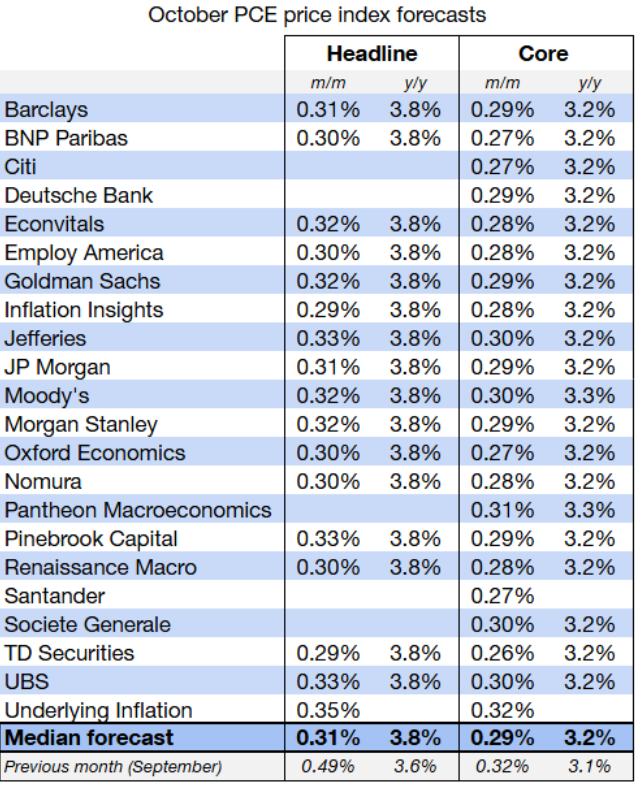
It is worth noting that the overall PCE in September was 0.5% the fastest in six months, and 3.1% of the core was the highest in five months; the October CPI (released on November 10) fell 0.4% month-on-month and 0.6% in September, but the core has been fixed at 0.3% for three consecutive months — this is why Waller set “0.3% of the core month-on-month” as the trigger line for 50 basis points.
Citigroup Research unravels structural variables for the next few months and suggests three directions:
The January-February inflation readings have historically been strong. This is particularly true in 2026, partly due to the fact that AI-related computer software prices tend to rise in the first half of the year; in 2027, if shipping costs are further transmitted to commodity prices after the holiday discount is lifted, there is still an upward risk.
Health services may do the opposite. Health service prices were 0.6% month-on-month in January 2026, contributing 11 basis points of the 40 basis point increase in core PCE; however, in January 2027, Citi only assumed 0.2% month-on-month, and did not even rule out a slight decline — the one-year increase in Medicare (Medicare) physician payments under the OBBBA Act (passed in summer 2025) only covers the 2026 calendar year, and payments will fall back in 2027 under current law, and the final health insurance rate table released earlier this month has taken this into account. The variable is: if the funding bill that kept the government open after December 11 reinstates these payments, or if private payers are strong enough to hedge, the downside risk will be reduced.
Used car sideboard. Manheim wholesale prices traded sideways in the first half of November, with Citi retaining only a slight upward assumption for used car CPI during the year; new cars and used cars are among the consumer prices most sensitive to interest rates, and 2027 is expected to remain moderate as demand for automobiles weakens.
Impact on the Federal Reserve: 25 basis points locked, 50 basis points a “dispute over credibility”
The current policy interest rate is 3.75%-4.00% (25 basis points in September, suspended at 10-2 in October), and the market has already surpassed “December Plus or Not”: after the CPI was released on November 10, CME FedWatch showed a 100% probability of raising interest rates. Currently, the market expects a probability of raising interest rates of 25 basis points in December to about 95.8%, and the cumulative probability of raising interest rates of 50 basis points by January next year is about 55.5%.
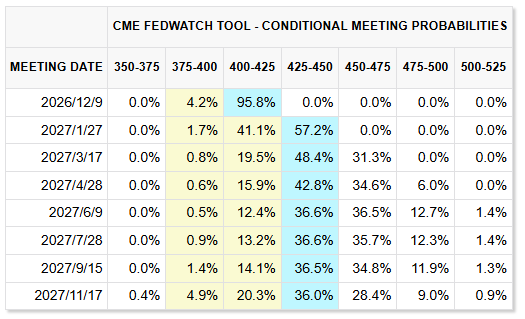
The differences are in magnitude and pace. Governor Waller said at the Bank of England's London meeting: If the core CPI is still 0.3% or higher in October, “we should consider raising interest rates by 50 basis points in December, adding only 25 would put the Fed's credibility at risk”; while Federal Reserve Chairman Walsh opposed using forward-looking guidance to promise a path ahead of time, Waller argued “if you don't want to give a signal, just add it once.” The opposition is also clear: New York Federal Reserve Chairman Williams made it clear that “the current situation does not require dramatic action,” Cleveland Fed's Hamak and Dallas Fed's Logan support tightening but gradually, while St. Louis Federal Reserve's Mussalem is expected to raise interest rates up to four times by spring 2027. Wall Street is in agreement: Goldman Sachs expects to add 25 basis points each in December and March; Bank of America and Deutsche Bank expect 25 basis points three times in a row in December, January, and March, and the interest rate cap will rise to 4.75%.
The weight of tonight's data in this debate is that it is the last complete evidence of inflation before the December meeting. Nowcast analysts are on the side of the “progressives” — “the probability that the market is overpricing the 50 basis point rate hike” on the grounds that the recent drop in oil prices is “conducive to overall inflation peaking in the fourth quarter”. The transmission of energy to the core will ease in 2027, while the stock market is lackluster, falling demand for home buyers, and moderate wage growth should keep service inflation healthy.
The Federal Reserve has actually already stated this meaning for the market. Director Bauman estimates that the core PCE for October may be 3.3% — with energy costs being “driven by artificial intelligence demand,” but she also gave a dovish end: as the pressure of AI expansion and the Middle East conflict abates, and the job market is not overheated, next year's core PCE will be closer to the 2% target (according to the Business Times). Citibank economist Veronica Clark (Veronica Clark)'s previous hint was more direct: if officials fail to implement the December rate hike, the main risk would be a further sharp adjustment in the stock market or widening credit spreads.
The transmission chain between US stocks and AI transactions
After tonight's data was released, US stocks were not facing a single transmission chain, but three intertwined ones:
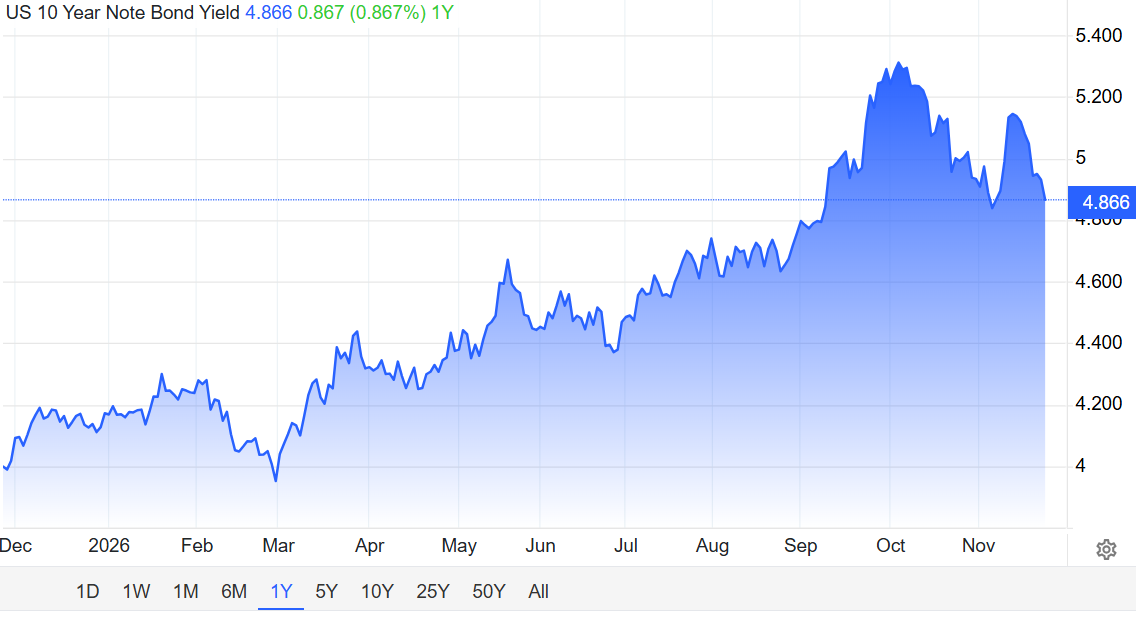
The first is the direct impact of the interest rate path on the valuation of AI growth stocks. The S&P 500 and the Dow both confirmed a pullback range on Friday, and the 10-year US Treasury yield is approaching the 29th closing day above 5% in recent years — tying the 2007 record. If the core PCE falls above 0.3% month-on-month tonight, and the probability at the end of 50 basis points rises again, the short-term yield and the US dollar will rise again, and the long-term attributes of the AI sector will be revealed first: Dell has fallen by more than 20% in the past two weeks, and SoftBank has dropped nearly 40% in November. The sensitivity of valuation to discount rates has been repeatedly verified by the market.
The second one is more subtle: AI is both a driver of inflation and an inflation-sensitive asset. Bauman listed AI demand as one of the drivers of inflation; Goldman Sachs pointed out that AI infrastructure construction is driving up upstream hardware and electricity costs; Citi even listed “rising AI-related computer software prices” as a structural factor of strong inflation at the beginning of next year. In other words, the AI capital expenditure boom itself is fueling inflation, and interest rate hikes that suppress inflation are in turn taking away the valuation support of AI transactions — this closed loop is a core characteristic that distinguishes this round of markets from previous tech bulls. Tonight's data will once again visualize the tension of this closed loop.
Furthermore, the AI sell-off itself could be holding back the Federal Reserve by 50 basis points. On Tuesday, SoftBank's five-year CDS spread soared to 501 basis points. Oracle, Alphabet, SpaceX and CoreWeave set a record overnight, and the CoreWeave spread of 1,314 basis points is already in a difficult range; Guosheng Securities's judgment is that the US stock adjustment and the widening credit spreads for AI companies mean that financial conditions have been tightened, and the sharp interest rate hike “may cause an unnecessary liquidity impact” — this is the toughest argument of the progressives within the Federal Reserve, and the stock market rebound triggered by Hwang In-hoon's reinstatement cannot be transmitted A mirror image of the credit market (after Hwang In-hoon's reinstatement, the steady divergence of stock increases and debt remained stable for only one day). If the data stands at just 25 basis points tonight and the credit market continues to expand, the combination of “raising interest rates but slowing down the pace” may instead give AI hardware that has surpassed the decline.
There is another verification after Thanksgiving: The year-end shopping season, which begins on Black Friday, is an empirical proof of “whether households can absorb energy and borrowing costs” — the NRF expects holiday retail sales to increase 4.2% year over year, surpassing $1 trillion for the first time, while the University of Michigan consumer confidence 51.5 is still at an all-time low, and 57% of respondents bluntly said that high prices are eroding living standards. If consumer resilience is as expected in institutional surveys (personal consumption expenditure adjusted for inflation is 0.1% month-on-month), there is more room for the Federal Reserve to “gradually raise interest rates”; if consumption stalls under high interest rates, AI transactions are no longer facing valuation issues, but profit issues.