


The Zhitong Finance App learned that from November 1 to 22, the passenger car market retailed 984,000 vehicles in the national passenger car market, down 25% from the same period last November and 1% from the same period last month. Since this year, retail sales have accumulated 15.962 million vehicles, a decrease of 22% over the previous year. From November 1 to 22, passenger car manufacturers across the country wholesale 1.26 million vehicles, a decrease of 21% compared to the same period in November last year, and an increase of 9% over the same period last month. Since this year, a total of 23.63 million vehicles have been sold, down 7% from the previous year.
New energy: From November 1 to 22, the national passenger car new energy market retailed 702,000 vehicles, down 13% from the same period last November, up 7% from the same period last month. The cumulative retail sales volume of 9.57 million units since this year was 9.57 million units, down 13% year on year; from November 1 to 22, passenger car manufacturers sold 965,000 new energy vehicles, up 3% from November last year, up 13% from the same period last month, and a total of 14.188 million vehicles have been wholesale since this year, up 9% year on year.
Penetration rate: From November 1 to 22, the penetration rate of new energy retail sales in the national passenger car market was 71.3%; from November 1 to 22, the penetration rate of new energy wholesale by passenger car manufacturers nationwide was 76.6%.
Retail sales trend in the national passenger car market in November 2026
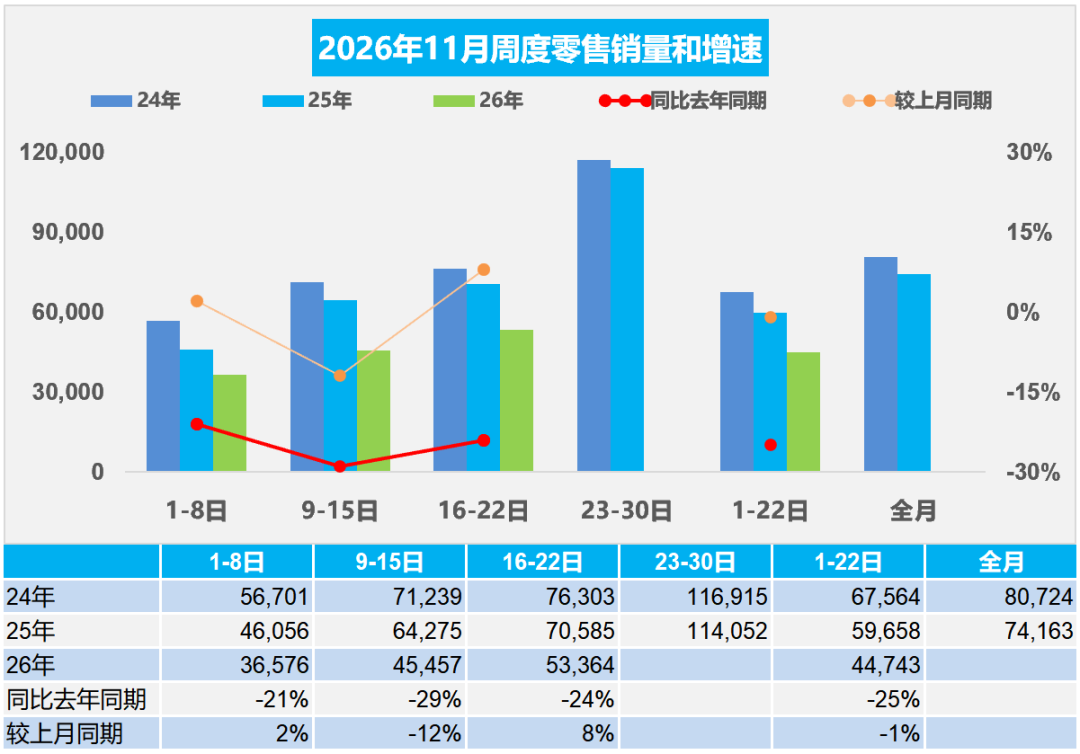
In the first week of November, the national passenger car market sold an average of 37,000 vehicles per day, down 21% from the same period in November last year, and up 2% from the same period last month.
In the second week of November, the national passenger car market sold an average of 45,000 vehicles per day, down 29% from the same period last November and 12% from the same period last month.
In the third week of November, the national passenger car market sold an average of 53,000 vehicles per day, down 24% from the same period in November last year, and up 8% from the same period last month.
From November 1 to 22, the national passenger car market retailed 984,000 vehicles, down 25% from the same period in November last year, down 1% from the same period last month; since this year, 15.962 million units have been sold, down 22% from the previous year.
In November, domestic retail showed the characteristics of “policy support, weak repair, and extreme structural differentiation”. Retail sales continued to show significant negative year-on-year growth in November. The incremental support in November was mainly due to the centralized release of “Double 11" finance and replacement equity, but retail performance was weak in the first two weeks. Next, let's take a look at the effects of new product launches at the Guangzhou Auto Show to attract customers, and the immediate demand for “last train” replacements brought about by the trade-in subsidy policy ending within the year. The restrictions on volume reduction are obvious. Weak consumer income expectations have led to strong wait-and-see sentiment and lengthening the replacement cycle; although oil prices have been lowered in the short term, the central position is still high, suppressing fuel vehicle consumption, and the share of fuel vehicles has shrunk further.
Structure and competitive characteristics: The penetration rate of new energy sources continues to reach new highs, becoming the only definitive increase. The marginal utility of the price war bottomed out. Competition moved from “global price reduction” to hierarchical hand-to-hand combat — high-end competition for smart driving and experience, mid-range competition for comprehensive replacement solutions, and accelerated clearance of tail fuel and weak brands. Overall, the November car market relied on a policy window and a “structural underpinning” maintained at the end of the year. There was no reversal in the market. Only models with strong pure electric/hybrid products can win customers, and the industry has completely entered the knockout stage.
Wholesale sales trend of passenger car manufacturers across the country in November 2026
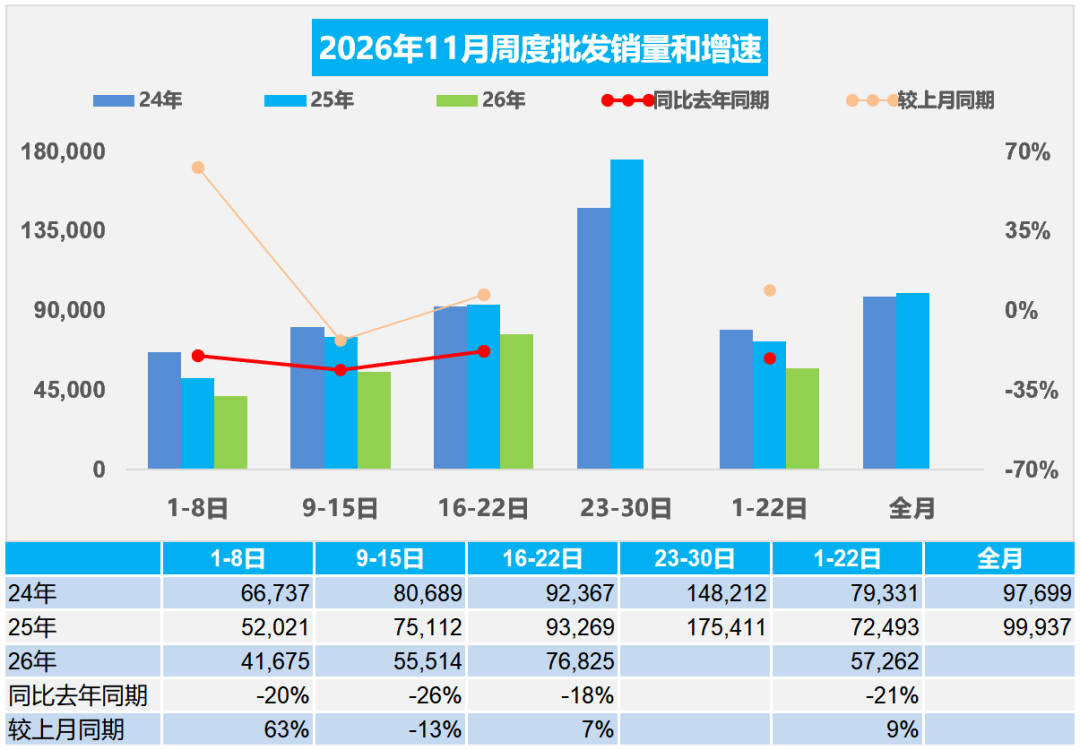
In the first week of November, passenger car manufacturers across the country sold 42,000 vehicles per day, down 20% from the same period in November last year, and up 63% from the same period last month.
In the second week of November, passenger car manufacturers across the country sold 56,000 vehicles per day, down 26% from the same period last November and 13% from the same period last month.
In the third week of November, passenger car manufacturers across the country sold 77,000 vehicles per day, down 18% from the same period in November last year, and up 7% from the same period last month.
From November 1 to 22, passenger car manufacturers across the country wholesale 1.26 million vehicles, down 21% from the same period last year, and up 9% from the same period last month; since this year, a total of 23.63 million vehicles have been sold, down 7% year on year.
In November, wholesale manufacturers showed weak repair characteristics of “a weak start and pressure on the back.” November was mainly pressured by an increase in working days, the warm-up of new cars at the Guangzhou Auto Show, and sales targets at the end of the year. On the supply side, high-impact models have entered a phase of increasing production capacity, and manufacturers are speeding up the pace of new car launches to support wholesale data. However, this is essentially a “push” act by the manufacturer to transfer inventory to the channel.
Currently, dealers generally face tight capital chains and high inventory pressure, compounded by early policy overdrafts, sluggish fuel vehicle production and sales, and declining willingness to pick up vehicles at terminals. Although the share of new energy wholesalers continues to rise, the “wholesale gap” is large, indicating that the increase in wholesale sales is not a reflection of actual terminal digestion. It is difficult for dealers to survive, channel reservoirs have peaked, and the subsequent wholesale growth rate will be constrained by weak retail sales.