


The Zhitong Finance App learned that there are various signs that the market is going through the peak of fear, but before investors return in a big way, they need a new source of belief — especially the current market pattern, which has revived people's memories of the horrible sell-off of risky assets in 2018.
Monday's rebound seemed technical: after Hwang In-hoon's reinstatement at Nvidia, low-profile and short investors made up their exposure in a big way, igniting at least a temporary recovery in AI trading. But Nvidia's news barely answered the question driving this round of sell-off: can huge AI spending generate sufficient returns. Technology stocks are weakening again, which indicates a lack of optimism in the market in this regard.
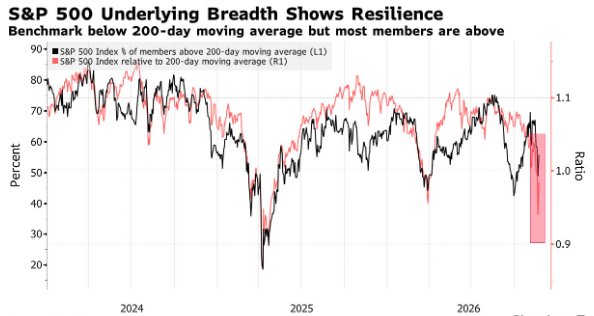
J.P. Morgan's market intelligence team, led by Andrew Tyler (Andrew Tyler), said: “A rebound will come, but given the resistance from the AI/tech sector, the uncertainty of the interest rate hike cycle that has just started, and the associated impact on profit prospects in 2027 and 2028, we still can't believe that any rebound will turn into a sustainable rise. We are moving back to a tactical cautious view.”
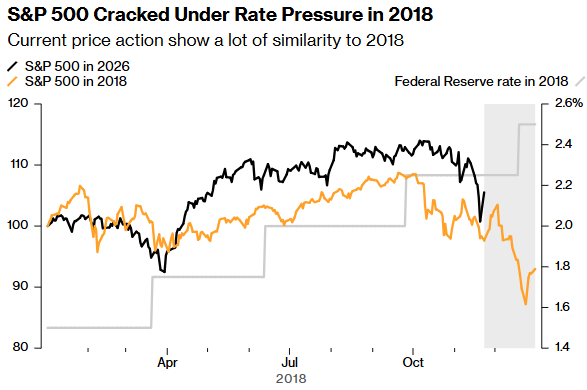
As markets generally expect the Federal Reserve to continue to raise key interest rates in December and beyond, the team became one of many market commentators to see 2018 in the shadows. Back then, the S&P 500 index was sold off in the fourth quarter, against the backdrop of a hawkish central bank continuing to raise interest rates.
According to the bank's trading flow data, buying in the broader tech sector appeared strong on Monday, with volume 66% higher than the 20-day average. However, the transaction value of the S&P 500 IT index was almost unchanged from last Friday, and the index only recovered its most recent round of decline — there is little evidence that investors are ready to catch up with this round of rebound. The team recommended a market-neutral strategy.
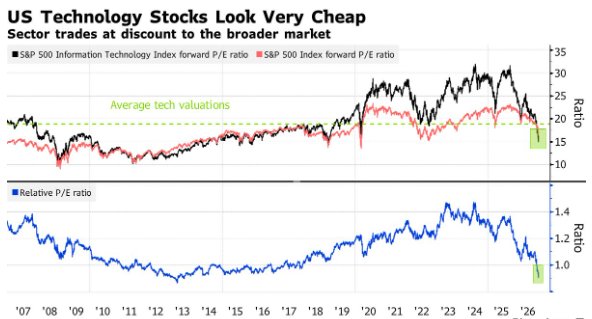
However, although recent trends have brought back memories of 2018, the opinions given by a series of indicators are less pessimistic. The underlying economy is still strong, and profit prospects are still positive — profits from median individual stocks are growing at a rate of about 12%, and profit margins are at record highs. Furthermore, the drastic reduction in valuation means that once profit expectations are lowered, undervaluation may provide a buffer. The premium of technology stocks over the S&P 500 has completely disappeared. Currently, they are traded at a 10% discount and are at the bottom of the 20-year range.
Christian Stocker (Christian Stocker), chief stock strategist at Yushin Bank, said: “Investors are no longer asking whether AI investments will continue. They are increasingly asking whether the path from investment to monetization will be slower, more uneven, and more dependent on favorable financing conditions than previously thought. “Recent market fluctuations suggest that the AI narrative is still complete, but the market is increasingly reluctant to anticipate a straight path to future profit growth.”
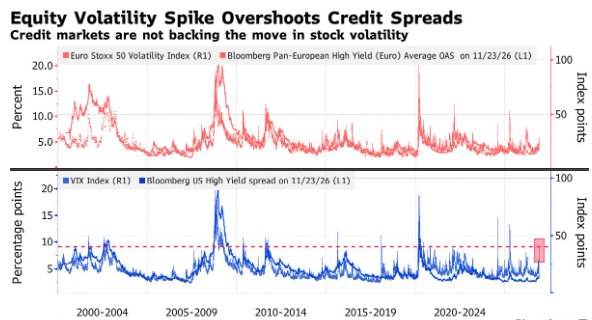
The extreme surge in volatility—VIX was once close to 40 and closed above 35 on Friday—is rare even in the past 30 years. So far, this has not been accompanied by an uncontrolled widening of credit spreads, although they have risen to their highest level in 18 months. Concerns are piling up, but balance sheet pressure is not an immediate issue.
Société Générale strategist Manish Kabra (Manish Kabra) pointed out that once VIX rose above 30 in history, it actually peaked 4 times out of 5; in the 12 months since then, the S&P 500 has risen by an average of 22%, with an average probability of an increase of 87%. They think this points to a round of rebound, but they also said that after the valuation has been reduced by 30%, the Federal Reserve still needs to send a signal to drive a wider revaluation.
Despite this, the market may have passed its most frightening moment, but it is unlikely that it will soon return to excitement. The Trump administration has indicated that it will protect AI construction at any cost. However, the Democratic Party's sweep will take effect in January, and it may become much more difficult to push for policy adoption at that time. More importantly, the tone released by the Federal Reserve regarding inflation data and interest rate paths remains unclear, and depends on whether the war can be resolved to keep oil prices down, or at least stabilize oil prices.
Jefferies strategist Mohit Kumar (Mohit Kumar) said, “We see some similarities between the 2018 currency cycle and the current one.” He cited falling oil prices, growth concerns, and lower stock markets, while at the same time the Federal Reserve's hawkish tone and is preparing to raise interest rates in December. They expect overall inflation to peak in the next few months. “If we're right, December should mark the culmination of the Federal Reserve's hawkish stance.”