


The Zhitong Finance App learned that US stocks rebounded strongly on Monday as Huang Renxun returned to Nvidia (NVDA.US) to promote the restoration of market sentiment and investors turned back from panic to excitement. However, since the structural risks faced by artificial intelligence (AI) exchanges that drive the rise in US stocks have not been eliminated, technology stocks pulled back again on Tuesday, dragging down the S&P 500 index. Before Wednesday, S&P 500 futures and NASDAQ 100 futures continued their decline, falling 1.7% and 2.6%, respectively.
Despite recent deep adjustments in US stocks, Wall Street is still confident about the trend of US stocks in 2027 — compiled data shows that Wall Street's consensus target point for the S&P 500 index at the end of 2027 was 8,471 points, which has room to rise by about 18% compared to the closing point of the benchmark stock index on Tuesday. Among them, Deutsche Bank strategist Binky Chada is one of Wall Street's most optimistic bullish figures. He expects the S&P 500 index to recover from the recent sharp decline and close at 9,000 points by the end of 2027, which means there is 25% room for growth. This target point is tied with the target given by Yardeni Research and is the highest on Wall Street.
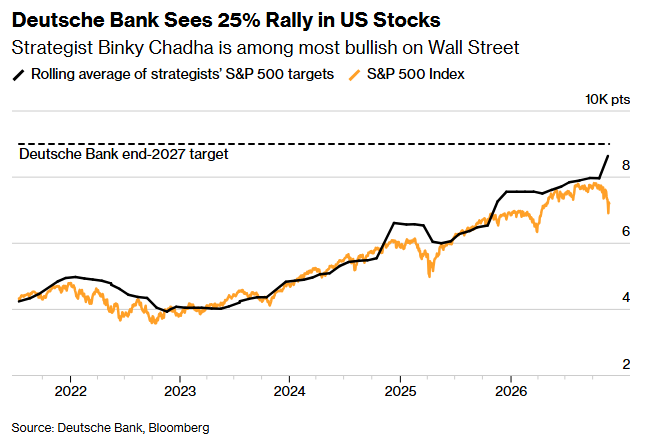
Chada believes that the sell-off in US stocks, led by technology stocks, is only a temporary phenomenon. He pointed out that similar volatility shocks usually take 6 to 8 weeks to fully dissipate. Meanwhile, he wrote in a client report that risk-averse investors have cut their stock positions to a lower level. Judging from historical experience, as long as the economy does not fall into recession, this situation often indicates that the market is about to rebound.
Chada said, “Our supply and demand analysis framework comprehensively considers changes in investors' positions, capital inflows, stock repurchases, and new stock issuance. The results show that the market is expected to continue to achieve strong returns until the end of this year, while high single-digit returns are expected next year.”
Although investor holdings have declined sharply and market sentiment has weakened significantly, partly reflecting expectations that corporate profit growth will stagnate, Chada expects the earnings per share of S&P 500 companies to increase 19% to $430 in 2027. Although it is slower than the 30% growth rate in 2026, it is far better than the profit growth rate of only 5% implied by the current position layout of hedge funds, and also better than the 16% expected by Wall Street. In addition, the coverage of corporate profit growth is also expanding. Seven of the 11 industry sectors have achieved double-digit growth, and the median profit growth of constituent stock companies has reached more than ten percentage points.
The Deutsche Bank strategist predicts that the AI spending growth rate of large tech companies will peak and slow down, but as the scope of AI applications continues to expand, the profit growth rate of these companies should accelerate. At the same time, manufacturing and recruitment activities are picking up, helping to drive economic growth beyond the technology industry and spread to a wider range of fields.
In terms of sector allocation, Chada is optimistic about stocks in the technology, finance, industrial, and healthcare sectors, while remaining cautious about most defensive industry sectors.
In contrast, J.P. Morgan strategists expect the S&P 500 index to rise to 8,200 points by the end of 2027. There is still room for growth of about 14% from the current level, and artificial intelligence will continue to be the core driving force for the profit growth of US stock companies. However, J.P. Morgan Chase's target target for the end of 2027 is more cautious than other major Wall Street investment banks.
In terms of corporate profits, J.P. Morgan predicts that the earnings per share (EPS) of S&P 500 companies will reach about 430 US dollars in 2027, an increase of about 15% over the previous year. The bank believes that the market still underestimates the actual demand for artificial intelligence. As the application of AI tools continues to spread, related investment and demand growth are expected to continue for a longer period of time, thus providing more lasting support for corporate profits.
A J.P. Morgan strategist pointed out that the market demand for AI tools indicates that the current AI growth cycle may last longer than investors had previously anticipated. In this process, phased supply bottlenecks and cyclical valuation adjustments similar to the current one do not mean that the popularity of AI applications is slowing down; on the contrary, they coincide with the development stage where AI applications are being rapidly penetrated.
This means that although J.P. Morgan Chase's forecast for US stocks to rise in 2027 is lower than the overall level of Wall Street, the bank has not changed its optimistic judgment on the AI supercycle and corporate profit growth prospects. Short-term market fluctuations and valuation adjustments are not enough to shake its confidence in the long-term upward trend of US stocks.
Furthermore, Michael Wilson, the chief US stock strategist at Morgan Stanley, set the target for the S&P 500 index at 8,700 points by the end of 2027, and expects the earnings per share of the S&P 500 index components to reach 420 US dollars in 2027, which is higher than his expectations of $369 in 2026. The bank believes that corporate profit growth will still be the main driving force for the rise in US stocks. Continued AI capital expenditure cycle, expanded scope of application, and stabilizing oil prices and interest rates will all support the market.
Goldman Sachs also set the target point for the S&P 500 index at 8,700 points in 2027, but it is relatively cautious in judging profit growth. The bank expects the profit growth rate of S&P 500 companies to slow to about 11% in 2027 from about 30% in 2026. Goldman Sachs believes that even if the growth rate of AI infrastructure investment slows, the US economy and corporate profits are expected to maintain moderate growth, easing valuation pressure, and declining inflation and bond yields will also support the stock market. However, the bank is particularly concerned about whether corporate profit prospects deteriorate further in 2028, as this may become an important risk under pressure on market valuations.
In broader institutional forecasts, the target range for the S&P 500 index at the end of 2027 given by J.P. Morgan Chase Private Bank is 8,500 to 8,700 points, and the range given by Wells Fargo Investment Research is 8,600 to 8,800 points.
Organizations' optimistic expectations face realistic tests
Wall Street's optimistic judgment on US stocks in 2027 has some fundamental basis: US corporate profits are still expected to grow, investment in AI infrastructure has not completely ended, and economic growth is likely to spread from the technology industry to other industries. Recent market adjustments have also reduced the valuation of some stocks to a certain extent, improving the potential return space for the next year.
Whether corporate profits can continue to grow is the most important factor supporting the rise of US stocks in 2027. Deutsche Bank and J.P. Morgan Chase both expect earnings per share of the S&P 500 index to reach around $430 in 2027, corresponding to increases of around 19% and 15%, respectively. If this forecast is realized, even if market valuations do not expand further, corporate profit growth itself can provide considerable support to the stock index. Meanwhile, Morgan Stanley expects earnings per share of $420 in 2027, while Goldman Sachs's forecast for earnings growth is more conservative. Differences in the judgments of profit growth among institutions are actually an important source of differences in their target points.
Second, the investment cycle of the AI industry is still one of the biggest variables in the outlook for US stocks. Under an optimistic scenario, cloud service providers and large technology companies will continue to invest in data centers, chips, and computing power infrastructure, which will drive demand growth in industrial chains such as semiconductors, software, network equipment, and power supply; as AI applications gradually enter enterprise production and business processes, related investments are expected to translate into revenue growth, cost reduction, and profit margin improvement. At that time, AI will not only support the profits of tech giants, but may also drive the profit expansion of financial, industrial, healthcare and other industries by increasing productivity.
However, the risk is that an increase in the scale of AI investment does not necessarily mean a simultaneous increase in return on investment. If the speed of data center construction exceeds actual computing power requirements, or if the willingness of enterprise customers to pay and the efficiency improvements brought about by AI applications fall short of expectations, huge capital expenses may turn into depreciation, financing costs, and free cash flow pressure. Especially when interest rates are still high and the market's valuation requirements for technology stocks tend to be stricter, investors may further lower their profit expectations and valuation levels for AI industry chain companies.
Furthermore, it is worth paying attention to whether the breadth of the market can continue to improve. Previously, the rise in US stocks depended to a large extent on a few large technology stocks. High market concentration meant that once AI trading was reversed, the index was easily dragged down by the decline of a few weighted stocks. The recent performance of the Dow and Russell 2000 indices is stronger than technology stocks, indicating that capital is looking for investment opportunities other than tech giants. If manufacturing, finance, healthcare, and industrial companies can relay to contribute to profit growth, the basis for rising US stocks will be broader, and it will also be more conducive to achieving the higher goals predicted by institutions such as Deutsche Bank and Morgan Stanley.
However, the macroeconomic environment may still be a constraint. If inflation continues to be higher than expected, the Federal Reserve may delay easing or even re-tighten policies, driving up corporate financing costs and the discount rate faced by stock valuations. Furthermore, the situation in the Middle East and oil price fluctuations, power and regulatory restrictions faced by data center construction, and the US government's policy attitude on AI infrastructure investment may all affect corporate capital expenditure and market risk appetite.
Generally speaking, differences in institutional forecasts are reflected not only in index points, but also in judging the sustainability of AI-driven corporate profit growth. Some organizations believe that AI infrastructure construction is still in a long-term investment cycle, and that current capital expenditure will eventually be transformed into computing power requirements, cloud service revenue, and enterprise productivity improvements. Other institutions worry that hyperscale cloud service providers continue to increase capital expenses, which may put pressure on free cash flow, and that the revenue and profits from AI applications are not enough to cover huge investment costs. This means that whether US stocks can meet rising expectations in 2027 largely depends on whether AI investment can actually transition from the capital expenditure expansion stage to the profit realization stage.