


The Zhitong Finance App learned that after the latest round of sharp shocks in US stocks, investors planning to buy on dips should act with caution, because many indicators in the options market have not yet sent a convincing signal, and it is impossible to confirm that the worst period in the market has passed.
As Hwang In-hoon returned to Nvidia (NVDA.US) to restore market sentiment and investors turned from panic to excitement, the S&P 500 index rebounded sharply by nearly 5% on Monday in a trading day after entering a technical correction. However, since the structural risks faced by artificial intelligence (AI) exchanges that drive the rise in US stocks have not been eliminated, technology stocks pulled back again on Tuesday, dragging down the S&P 500 index. S&P 500 futures continued their decline before Wednesday's market.
It is worth noting that in recent years, the S&P 500 index's astonishing rebound on Monday has become a typical characteristic of the market, and has also disrupted the old saying about the market — when the stock market rises, it's like climbing stairs, and when falling, it's like riding an elevator. Alexis Maubourguet, founder and chief investment officer of Swiss asset management company ADAPT Investment Managers, said: “Over the past three and a half years, the market has taken elevators regardless of whether it has risen or fallen.”
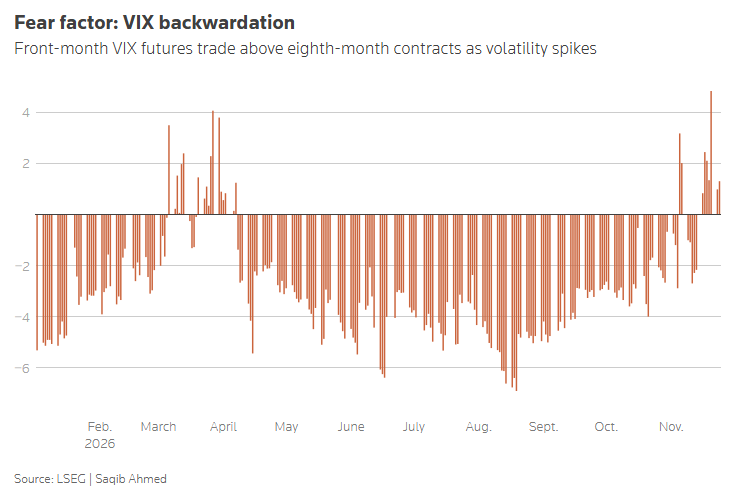
Although this trend pattern may reappear, the options market is currently sending some signs of caution. As of press release, the Chicago Board Options Exchange (Cboe) Volatility Index (VIX), known as the Wall Street “Panic Index,” surged more than 16% to 30.73, lower than last Friday's high of 40, but still far above its long-term median of 17.6. At the same time, futures linked to this index are still in a negative spread, that is, the trading price of recent contracts is higher than that of forward contracts. This suggests that investors are far more concerned about the risks in the coming weeks compared to the farther future.
Matthew Thompson, co-portfolio manager at Little Harbor Advisors, said, “When you see that the VIX index is above 30 and the futures curve is inverted like now, judging from historical experience, this usually means that an extreme tail event may occur in the market.” “We have been increasing our defensive positions,” he added.
Media analysis of Chicago Board Options Volatility Index futures data shows that in the past ten years, the inversion of the VIX futures curve usually lasts a short time, with a median duration of about 4 trading days. However, during the severe sell-off period, such as the market crash caused by the COVID-19 pandemic in 2020 and the market decline caused by the 2025 tariff policy, this state of inversion continued for several weeks.
The market rebound on Monday helped the overall volatility curve to decline, but the continued inversion of the curve still indicates that investors' unease remains high. Rocky Fishman, founder of Asym Research, said in a report about the market impact brought about by Nvidia: “We believe that the normal rebound in the market was too strong after the announcement of Nvidia-related news, so we believe it is worthwhile to hold protective positions in the next few days.”
No one dares to say the bottom has been reached
US stocks have recently experienced large-scale sell-off, but in fact, there have been no fundamental changes in fundamentals. Many valuation indicators have already highlighted layout values, and reverse capital should have been strong. However, for many professional asset managers, as the US is about to enter a shortened trading week during the Thanksgiving holiday, there are still too many unresolved questions, making it hard to believe that the bottom has been discovered.
Ave Mazza, CEO of Roundhill Investments, said: “The market is currently facing a bunch of challenges at the same time — inflationary pressure, interest rate hikes in December, and the market is beginning to re-doubt the true return level of AI business in 2028 and 2029. These issues cannot be solved within a week, and the market is not clearly favorable and catalyzed, making it difficult for buyers to firmly enter the market.”
The Goldman Sachs stock trading team reminded customers that a panicked decline like last week's in US stocks is usually a good buying opportunity, but there are two key differences in the current market. First, the Federal Reserve is still in the interest rate hike cycle; second, the investor position structure is very complicated: hedge funds are generally extremely pessimistic. Leverage has reached a five-year low, but other capital positions are still high, and the bet is that hedge funds will be forced to make up later. Therefore, Goldman Sachs traders suggest that if they want to seize the last-minute opportunity of this round of volatility, they can sell put options instead of going to the bottom of the stock market.
Joe Gilbert, portfolio manager at Integrity Asset Management, put it bluntly: “I feel like the selling pressure is running out, and a rebound is imminent, but there is currently no clear discernible upward catalyst.”
Risks are still endless
Hwang In-hoon's return to Nvidia allayed investors' most serious concerns and boosted a sharp rebound in AI-related stocks on Monday, but it did not eliminate the structural risks faced by AI transactions, and market concerns about AI investment returns, macroeconomic prospects, and policy risks have not disappeared.
This is the core test facing AI transactions today. Over the past few years, global tech giants have competed to invest hundreds of billions of dollars to build data centers, procure AI chips, expand servers and network equipment, and allocate huge computing power resources to train and run large-scale AI models. But as the scale of capital expenditure continues to expand, investors' focus is shifting from how much capital the company invests to how much additional revenue, profit, and free cash flow these investments can actually generate.
For hyperscale cloud service providers such as Microsoft, Amazon, Alphabet, and Meta, whether AI infrastructure investment can be transformed into cloud computing revenue growth, corporate customer payment requirements, and higher operational efficiency will directly determine whether their capital expenditure is economically reasonable. At the same time, data center construction also involves large supporting costs such as power supply, cooling systems, network equipment, land, and financing. Even as demand for AI continues to grow, companies must prove that the additional revenue is sufficient to cover equipment depreciation, energy consumption, and operating expenses.
This means that the end of the Nvidia management turmoil has more eliminated a short-term uncertainty in the AI industry chain, yet it still hasn't answered the industry's most important question: when will AI infrastructure investment actually generate sufficient returns to match the scale of investment.
Furthermore, some strategists believe that US President Trump's attempt to protect Nvidia by calling for Hwang In-hoon's return may cause longer-term concerns. Ed Mills, a Washington policy analyst at Raymond James, said in a report: “Wong In-hoon's reappointment as CEO of Nvidia may provide short-term relief to the market, but we believe this will intensify congressional scrutiny of the company, strengthen scrutiny of the AI industry, and increase the possibility that the two parties will jointly push for legislation and restrict the sale of advanced technology to China.”
From a broader perspective, recent fluctuations have hardly changed the situation of crowded transactions and increasing correlation between different markets. Some strategists say that the stock market has maintained strong returns for a long time, prompting market participants to adopt various forms of leveraging and risk taking.
Alexis Maubourguet said: “I think the risk exposure that has now been lifted is only a very, very small tip of the iceberg.” “I think the real question to think about is whether there is still time to exit risky assets.”
Act with caution
However, other investors believe that this market correction is only a brief phenomenon. Noel Smith, chief investment officer at Convex Asset Management, said, “I'm more inclined to think the market will rebound.” He said, “I am watching the flow of funds, and I am also watching the transactions that appear in the VIX options market.” He pointed out that relevant trading activity indicates that traders expect the market to calm down in the future.
Noel Smith said that Trump's role in driving Hwang In-hoon's return also reminded investors of the so-called “Trump put” (Trump put) — a concept that if the stock market is in trouble, the Trump administration will intervene to stabilize the market.
A hawkish shift in the Federal Reserve's stance could also boost investors' risk appetite. Noel Smith said, “If the Federal Reserve shifts to an easing stance, the market will soar sharply.” However, Noel Smith also added that before judging that the market has bottomed out, he is more willing to wait for confirmation signals that the volatility of each market will gradually decline.
Matthew Thompson chose a cautious strategy. He said, “The VIX Index is around 30, usually closer to the bottom of the stock market, rather than the beginning of a sharp decline... but in the current situation, if the judgment is wrong, the consequences will be quite serious.”