


- Pfizer announced an exclusive licensing agreement with Starna Therapeutics to develop and commercialize three pre IND in vivo CAR T programs for autoimmune disease outside Greater China, with Starna receiving an upfront US$330 million payment plus potential milestones and royalties.
- The deal gives Pfizer access to Starna’s in vivo CAR T platform across inflammation, immunology and oncology. This reinforces management’s push to rebuild the pipeline while managing upcoming patent expirations and reallocating capital away from a shrinking COVID portfolio.
- We will now look at how Pfizer’s investment narrative is reshaped by this in vivo CAR T expansion within autoimmune disease.
Pfizer Investment Narrative Recap
To own Pfizer today, you need to believe the shift away from a shrinking COVID portfolio toward oncology, obesity and autoimmune therapies can eventually support earnings while cost savings protect margins. The analyst consensus Narrative on Simply Wall St leans on execution of roughly US$9.7b in targeted productivity gains and the ramp of newer products to offset revenue pressure.
In the near term, the key swing factor is whether launched and acquired drugs really backfill declining COVID sales as expected, while legal disputes and drug pricing reforms stay manageable. The Starna in vivo CAR T deal is directionally aligned with that pivot but does not materially change near term revenue or the main risk around pricing and pipeline setbacks.
The berobenatide funding agreement with Blackstone Life Sciences is tightly linked to these same catalysts. Pfizer keeps full ownership and control of its GLP 1 obesity candidate while offloading up to US$1.5b of development spend through 2028, which matters when earnings, free cash flow and dividend coverage are already under strain.
For you as a shareholder, that structure means obesity investment can continue at scale alongside the new in vivo CAR T work, without leaning further on the balance sheet to the same degree. Success or disappointment in obesity and oncology, combined with how efficiently Pfizer converts this higher risk R&D into approved, priced therapies under tighter policy scrutiny, remains central to how the overall story plays out.
Pfizer’s current analyst narrative points to forecast revenues of US$53.8b and consensus earnings of US$8.8b by 2029, based on an assumed 5.5% yearly decline in revenue and a rise in earnings from US$4.0b today. This implies earnings would need to more than double, a little over 2x, in that timeframe.
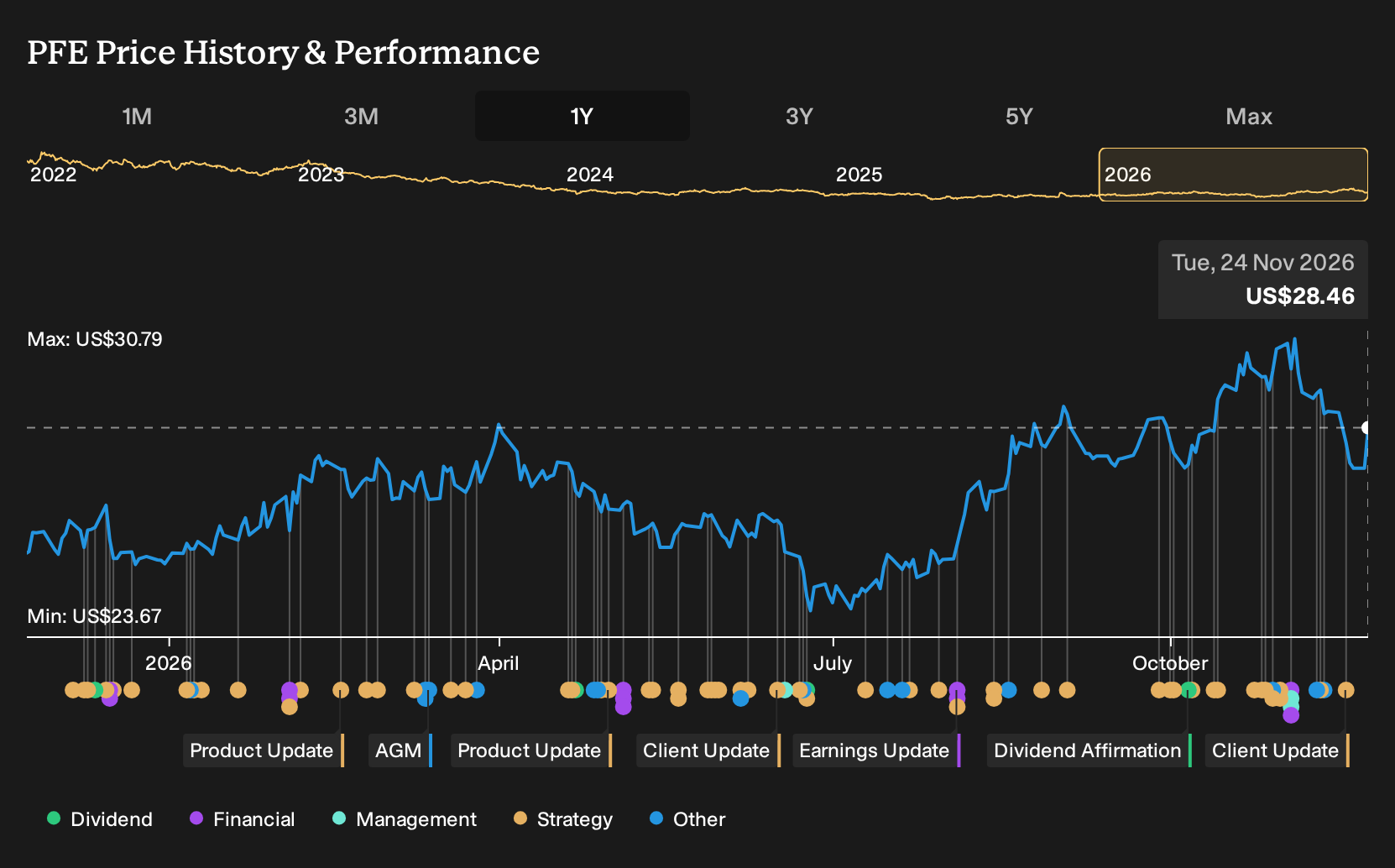
Uncover why Pfizer's fair value indicates a 4% potential upside to its current price, which could narrow quickly.
Exploring Other Perspectives
You might see the Pfizer story very differently if you focus on the more cautious view around earnings power. The lowest analysts were modelling revenue of about US$50.2b and earnings of US$6.7b by 2029, which already felt tight before this CAR T deal. You can treat today’s news as a fresh reason to compare those assumptions with your own.
Explore 10 other Pfizer fair value estimates, including one that suggests as much as 12% downside from the current price.
The Verdict Is Yours
Disagree with existing narratives? Extraordinary investment returns rarely come from following the herd, so consider trusting your own research and judgment.
- A great starting point for your Pfizer research is our analysis highlighting 2 key rewards and 4 important warning signs that could impact your investment decision.
- See our latest analysis for Pfizer. The report includes a comprehensive fundamental analysis summarized in a single visual, the Snowflake, making it easy to evaluate Pfizer's overall financial health at a glance.
Looking For More Investment Ideas Beyond Pfizer?
If this Pfizer update has sharpened your view on risk, reward and balance sheet strength, you can use that same lens across the wider market with the Simply Wall St Screener.
- For investors who want quality at a reasonable entry point, scan through 37 high quality undervalued stocks that line up strong fundamentals with prices that may not yet reflect them.
- If capital preservation sits higher on your priority list, filter for 31 resilient stocks with low risk scores that pair sturdier finances with more measured risk profiles.
- To widen your hunting ground beyond widely followed blue chips, review 13 elite penny stocks with strong financials that combine smaller market caps with stronger balance sheets and financials than many peers.
Have feedback on this article? Concerned about the content? Get in touch with us directly. Alternatively, email editorial-team@simplywallst.com