


I have a crazy idea for you, which involves placing a bullish multi-leg options wager on Kinross Gold (KGC). Across the board, KGC stock would be considered a treacherous, potentially reckless idea. Simply put, there are very few reasons to have confidence in the gold mining sector overall. KGC is particularly problematic thanks to its 100% Strong Sell rating by the Barchart Technical Opinion indicator.
To add to the technical woes, we’re talking about an equity that has lost roughly 37% of value on a year-to-date basis. Little reason exists to believe that the near-term picture offers a point of contrast, with Kinross Gold stock suffering a more than 20% decline in the trailing month.
If we move to the fundamentals, the problems become even more stark. As Google Finance’s summary sheet noted, Kinross suffered a revenue miss on lower sales volume in the third quarter, contributing to the fallout in KGC stock. Further, investors must fret about rising operational and cost pressures, along with a securities fraud class action lawsuit.
Are there positives? Yes — Kinross did manage to beat on earnings during Q3. As well, management is committed to enhancing capital returns to shareholders. But are these factors enough to move the technical and fundamental needle? That’s where the market appears to answer in the negative.
Still, what’s intriguing about KGC stock from a pure speculation standpoint is the quantitative picture. Generally speaking, when looking at Kinross’ historical share price data, periods of extreme bearishness tend to transition northward to a bullish state.
To be clear, this transitional observation is an inductive inference. There’s simply no law of nature that forces Kinross Gold stock to mean revert higher. However, the opportunity is that few in the market seem to be offering much confidence for a (temporary) comeback narrative — not in this environment.
So, if you’ve got the risk tolerance, I’ve got the idea.
What’s the Justification for Bullishness in KGC Stock?
Let’s address the elephant in the room: what’s the justification for being bullish on Kinross Gold stock when so many factors appears bearish? The answer is the typical market mechanics behind mean reversion. When sentiment is stacked so strongly to the negative side of the ledger, that directional bias becomes oversaturated, potentially resolving in a contrarian response higher.
Consider the current quantitative profile of KGC stock. In the past two months, Kinross has printed 10 weekly candlesticks in the technical chart — and seven of these candlesticks were negative (where Friday’s close ended up lower than Monday’s open). Basically, there’s a seven-to-three ratio between negative-to-positive sessions, which implies that the bears enjoy dominance.
Right now, the consensus opinion appears to be that the smart money lacks upside confidence in KGC stock, if the latest volatility skew is anything to go by. Either way, we really shouldn’t be surprised if pessimism clouds Kinross and the rest of the gold mining complex.
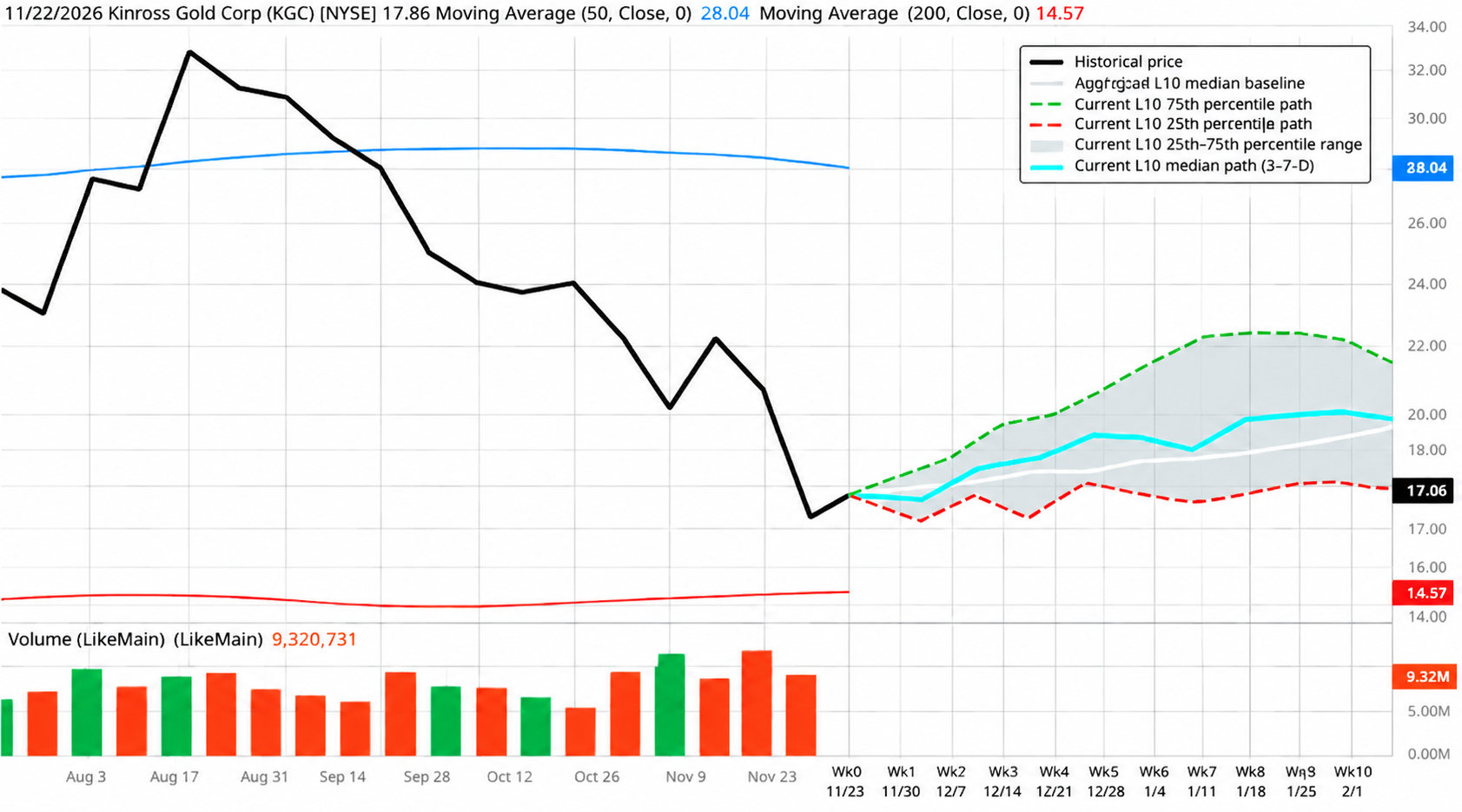
However, we do know that when we filter historical data for the flashing of the 7-to-3 ratio over the past five years, KGC stock tends to rise higher over the next 10 weeks over what would be expected relative to its aggregate historical performance.
In other words, observed patterns indicate that there’s a higher chance of upside if you acquire Kinross Gold stock after it flashes the aforementioned ratio rather than buying KGC without a thought regarding its current quantitative state.
When you drill down into the numbers, there’s a probabilistic range between 38.5% and 46.2% that KGC stock will exceed the $21 price level on or near mid-January. Assuming that this estimate turns out to be accurate, debit-side options traders may be incentivized to consider the 20/21 bull call spread expiring Jan. 15.
Why EV Calculations Point Favorably for Kinross Gold Stock
Now for the obvious follow-up question: what makes the January 20/21 bull spread so special? It comes down to its capital-efficient balance between low upfront cost, massive reward potential and a decently sized win probability.
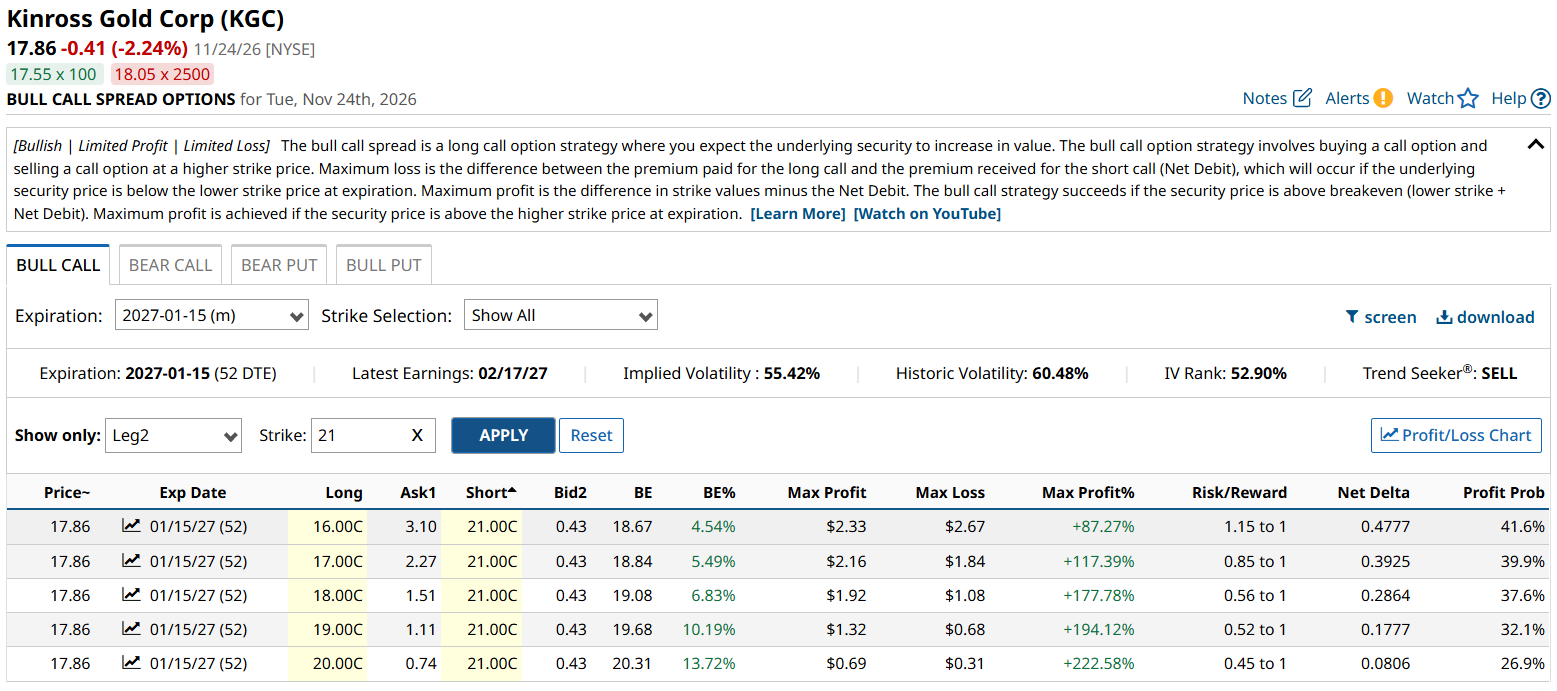
Let’s look at the key stats:
- Net debit (wager) of $31.
- Maximum payout (American-style odds) of 222.58%.
- Win probability between 38.5% and 46.2%.
Plug these figures into an expected value (EV) calculator and you get a reading — at the lowest win probability — $7.50 or a return on capital (ROC) of +24.19%. That’s a solid metric, meaning that debit buyers (again, assuming that the forward-looking analysis is accurate) are incentivized to take the shot.
On the most optimistic end, EV rises to $15.20, translating to an ROC of 49.03%. Again, if the win probability happens to be accurate, there is definitely an incentive to target Kinross Gold stock.
To be fair, most of the validity of this trade hinges on the inductive inference above. If the transition from bearish-to-bullish state does not occur to the observed median magnitude, then this trade will most likely be a bust. About the only positive at that point would be that you’d only lose $31 per spread.
Nevertheless, if the win probability really happens to be in the upper 30s at minimum, then the math would favor the risk taker. It’s your call, obviously, but I wouldn’t readily dismiss Kinross Gold stock until you’ve more fully examined the evidence.
On the date of publication, Josh Enomoto did not directly have a position in any of the securities mentioned in this article. All information and data in this article is solely for informational purposes. For more information please view the Barchart Disclosure Policy here.