


Ambarella (AMBA) shares plunged by 33% in premarket trading on Wednesday, extending a roughly 20% slide in Tuesday's regular session and dragging the stock from a $44.47 close into the high $20s, which puts the edge AI chipmaker's market value near $2 billion.
The notable but underappreciated twist is that the culprit isn't weak demand for edge AI itself — it's the data center AI buildout, which is absorbing global DRAM supply and inflating memory prices so sharply that Ambarella's customers are pulling back on orders. That makes Ambarella an unusual casualty of the very trend that has powered chip stocks, and it reframes the selloff as a supply story rather than a referendum on its own products.
Ambarella's Q3 Miss Was the Appetizer
Fiscal third-quarter revenue rose 6.2% year over year to $115.2 million, landing at the bottom of the company's guidance range and short of the roughly $119 million consensus, while adjusted EPS of $0.28 missed estimates of about $0.32.
Profitability also eroded, with GAAP gross margin slipping 180 basis points to 57.8%, though that miss paled next to what management said about the coming quarter.
A Fourth-Quarter Guide That Shocked the Street
Ambarella guided fourth-quarter revenue to $70 million to $75 million — far below Street expectations near $112 million and implying a sequential decline of roughly 37% at the midpoint, a stunning collapse for a company that just posted year-over-year growth. In other words, the company expects to book more than $40 million less revenue next quarter than it just reported.
With operating expenses guided roughly flat at $57.5 million to $59.5 million, the revenue cliff swings Ambarella to an adjusted operating loss of about $15 million, compared with an adjusted operating profit of about $11 million last quarter.
How AI Data Centers Are Squeezing AMBA
Management blamed an intensifying global memory shortage, explaining that as data center demand soaks up DRAM supply, customers are canceling, pushing out, or delaying orders. It is a problem Ambarella cannot fix on its own, since memory pricing and availability are being dictated by data center buyers far upstream.
Weakness first surfaced in consumer IoT — internet-connected consumer devices — but it is now spreading into enterprise and automotive, broadening a problem that once looked contained to a single end market.
Wall Street Resets Its Targets
Analysts have reset expectations sharply. Bank of America downgraded AMBA to “Underperform” with a $30 price target, and Morgan Stanley cut the stock to “Equal-Weight” with a $45 target. Rosenblatt slashed its price target to $55 and Needham, who rates the stock “Buy,” also issued a $45 price target.
The balance sheet offers a cushion, with $282.8 million in cash and securities and no meaningful debt burden, an amount equal to roughly 14% of Ambarella’s current market value.
Takeover speculation could also help provide a floor under a stock that has now shed roughly half its value across two sessions, with names like Qualcomm (QCOM), NXP Semiconductor (NXPI), and even Nvidia (NVDA) being raised as potential suitors.
However, the Recovery Timeline Looks Shaky
Management still expects fiscal 2028 to be a growth year, but peers suggest memory constraints may persist into the second half of 2028, which challenges that timeline and raises the risk that order disruptions last longer than the company hopes.
The macro tape is hostile too, with chip stocks under heavy pressure, PCE inflation data pointing to a likely rate hike next month, and thin holiday liquidity amplifying moves in both directions.
AMBA’s earnings reaction in the pre-market session is far more exaggerated than what the options market priced in, with implied volatility pointing to an expected price swing of only 6% as of last night’s close.
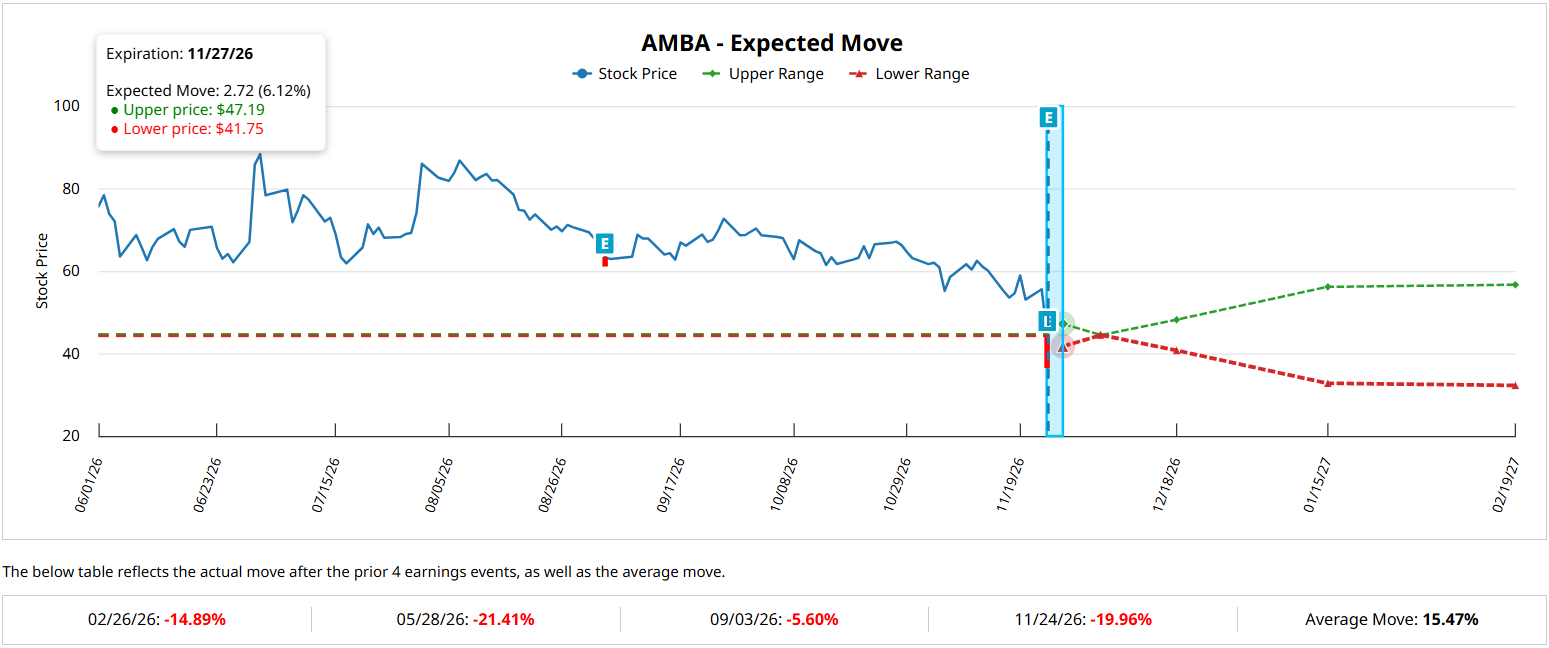
That means the stock is set to open deeply oversold – but for traders, macro headwinds argue for patience rather than chasing an oversold bounce until memory pricing shows signs of easing. Until then, Ambarella offers a wry lesson for investors: in an AI gold rush, even an AI chipmaker can end up on the wrong side of the supply chain.
This article was created with the support of automated content tools from our partners at Sigma.AI. Together, our financial data and AI solutions help us to deliver more informed market headline analysis to readers faster than ever.
On the date of publication, Sarah Holzmann did not directly have a position in any of the securities mentioned in this article. All information and data in this article is solely for informational purposes. For more information please view the Barchart Disclosure Policy here.