


UiPath (PATH) has steadily strengthened its position in enterprise automation by bringing robotic process automation (RPA), artificial intelligence (AI) and business orchestration under one roof. Its growing push into agentic AI, which allows software agents to carry out complex business processes, opens the door to a larger opportunity in an increasingly competitive market.
That opportunity, however, comes with its share of challenges. Shares have come under pressure as questions are mounting over whether the automation specialist can maintain its momentum amid intensifying AI competition. Although Q2 FY2027 revenue exceeded Wall Street's expectations, annual recurring revenue (ARR) growth slowed year-over-year (YoY) to 12%, while net new ARR slipped to $37 million from $49 million in Q1.
Adding to the unease, concerns about AI pricing have also picked up. These developments have made the stock's recent performance difficult to overlook. Thus, the upcoming Q3 FY2027 earnings report, scheduled for release after the market closes on Thursday, Dec. 3, would shed light on the business's underlying momentum.
The update is also expected to offer useful clues about revenue growth, customer demand, profitability, and management's expectations for the remainder of the financial year.
About UiPath Stock
Headquartered in New York, UiPath is a global software provider specializing in AI-powered automation. With a market cap of nearly $5.7 billion, its integrated platform brings together AI agents, RPA, and human workflows to simplify business processes, improve operational efficiency, and help organizations get more done.
Despite its expanding technology portfolio, PATH stock has had a difficult run on the market. Shares have declined 15% over the past year and plunged 30% year-to-date (YTD). The weakness has also persisted in recent months, with the stock falling 31% over the past three months and losing another 18% over the last month.
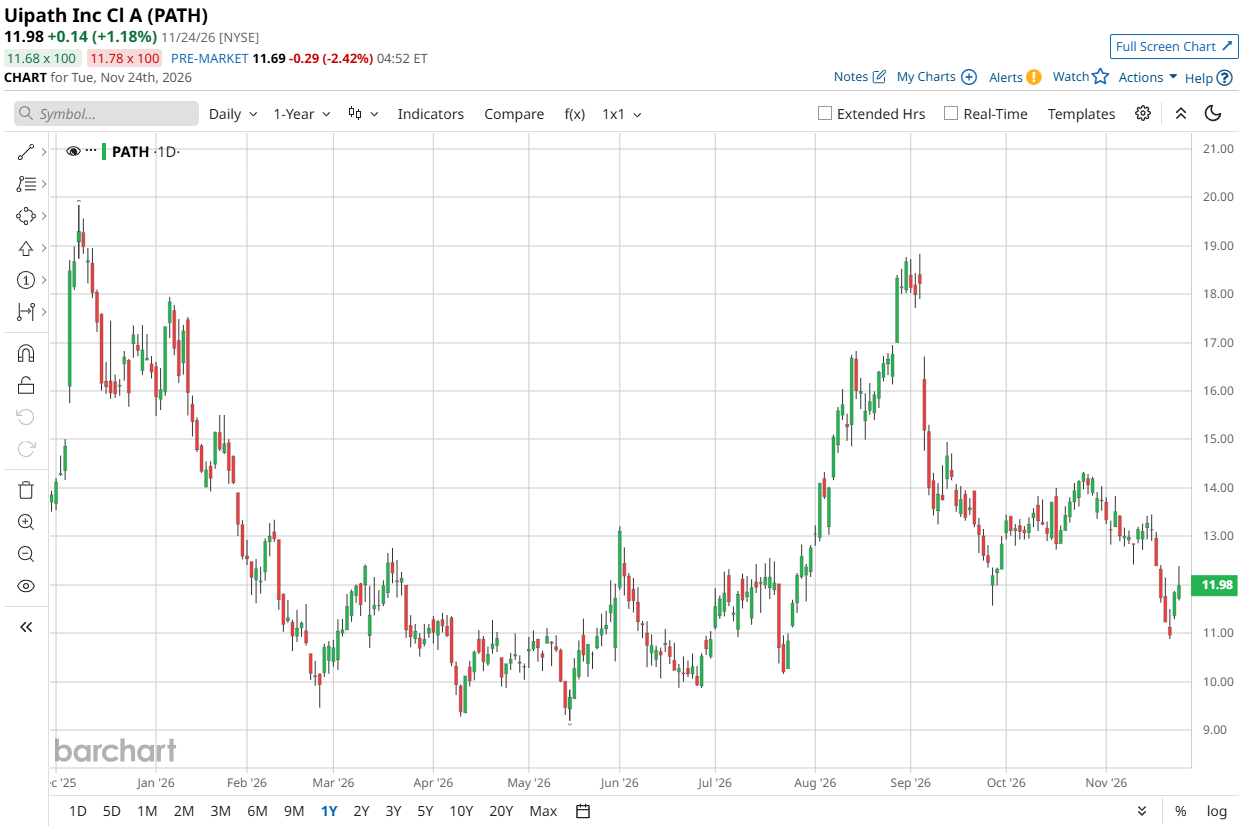
At current levels, PATH stock is trading at 15.21 times forward-adjusted earnings. The multiple is below both the industry average and its own five-year average, indicating a premium valuation.
A Closer Look at UiPath’s Q2 Earnings
On Sept. 3, the automation specialist reported Q2 FY2027 revenue of $410.3 million, up 13.4% YoY, beating analyst estimates of $397.9 million. ARR rose 12% from the year-ago value to $1.94 billion.
The bottom line offered encouragement. Non-GAAP gross margin came in at 82%, supported by non-GAAP operating income of $89 million. Non-GAAP net income edged higher from the year-ago figure to $80.9 million, while non-GAAP EPS held steady at $0.15, matching analyst expectations.
Cash generation was less impressive but remained meaningful. Adjusted free cash flow totaled $160.8 million for the six-month period, and the business finished the quarter with $1.4 billion in cash, cash equivalents, and marketable securities.
Much of that strategy revolves around making orchestration the connecting thread between established automation tools and the wider AI opportunity. New offerings such as Maestro Case and Maestro Flow aim to bring AI agents, robots, systems, and employees together, allowing them to coordinate work across increasingly complex business processes.
Looking ahead, management's full-year FY2027 guidance calls for revenue of $1.789 billion-$1.794 billion and ARR of $2.065 billion-$2.070 billion as of Jan. 31, 2027. Non-GAAP operating income is expected to reach approximately $445 million.
For Q3, the outlook is equally specific. Revenue is projected at $440 million-$445 million, while ARR is expected to reach $1.992 billion-$1.997 billion as of Oct. 31. Management also anticipates non-GAAP operating income of approximately $100 million.
On the other hand, analysts project Q3 FY2027 EPS to surge 233.3% YoY to $0.10. For FY2027, earnings are expected to increase 172.2% from the previous year to $0.49, while the forecast for FY2028 calls for a further 16.3% YoY gain, taking EPS to $0.57.
What Do Analysts Expect for PATH Stock?
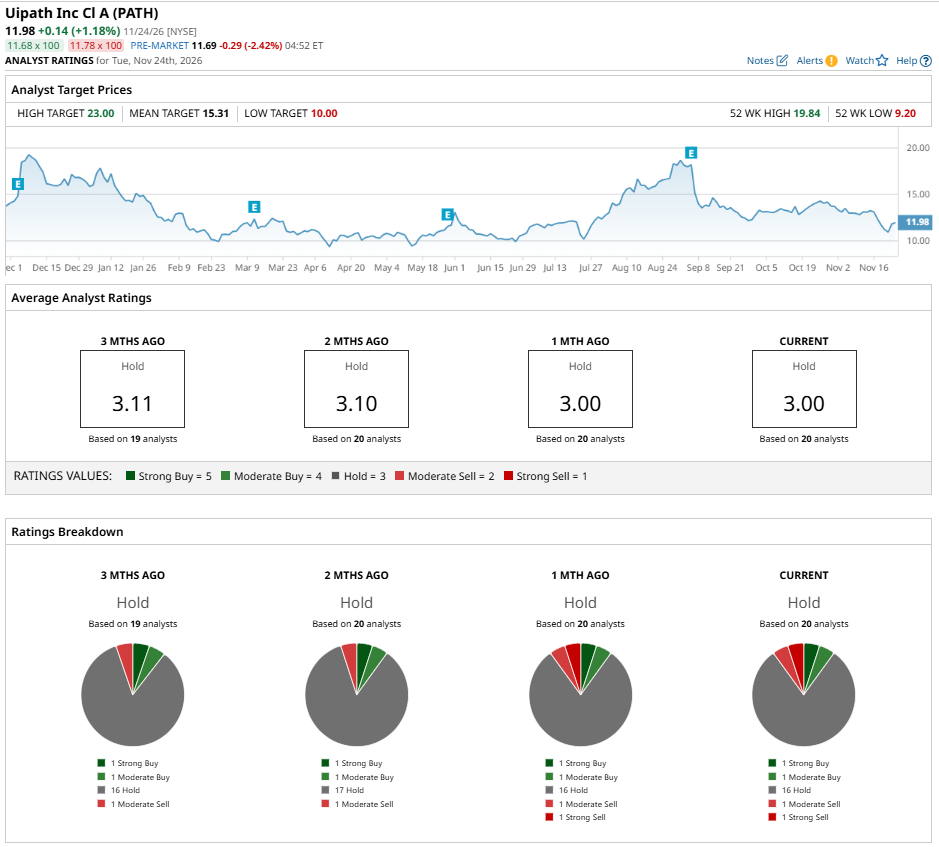
Despite the longer-term opportunity in automation and AI, Wall Street remains divided on how much confidence to place in PATH stock at current levels. The overall rating stands at "Hold," reflecting a largely cautious stance among the 20 analysts covering the stock. Their recommendations include one "Strong Buy," one "Moderate Buy," 16 "Hold," one "Moderate Sell," and one "Strong Sell."
Price targets, meanwhile, leave some room for a recovery. The average target of $15.31 represents potential upside of 28%, while the Street-high estimate of $23 points to a gain of 92% from current trading levels.
On the date of publication, Aanchal Sugandh did not directly have a position in any of the securities mentioned in this article. All information and data in this article is solely for informational purposes. For more information please view the Barchart Disclosure Policy here.