


The Zhitong Finance App learned that two stock analysts from the same Wall Street research institution publicly expressed diametrically opposite views on the prospects for the newly listed shares of Anthropic PBC (ANT.US), the hottest stock on the market. This move is quite rare.
Hedgeye Risk Management communications and software analyst Andrew Freedman (Andrew Freedman) has continued to publish relevant reports since the company's IPO. In an interview on Wednesday, he said that judging from the current stock price level, it is already attractive to long-term investors. Meanwhile, his colleague Felix Wang (Felix Wang), a global technology analyst, sent a research report to clients on Tuesday, recommending shorting the stock.
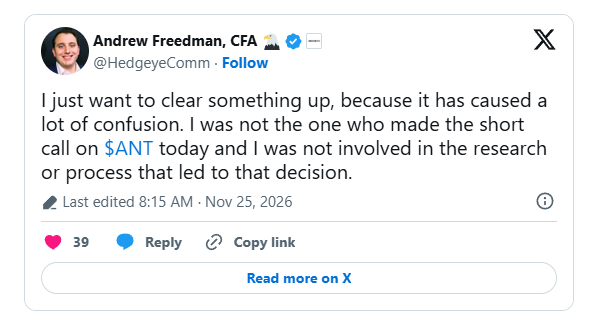
After Wang posted his bearish opinion, Friedman immediately drew a clear line with him on social media, claiming that he had not participated in the research and judgment process behind this shorting conclusion.
The core of Wang's bearish logic is that the data center that Anthropic relies on to support computing power continues to increase in difficulty. At the same time, he has doubts about the long-term commercial demand for Anthropic's big model. Friedman, on the other hand, is bullish, and is betting that Anthropic will create a new operating system for the enterprise side, compounding the signs of strong short-term demand. Wang gave a price target of $59, while Friedman's reasonable valuation target was $92.
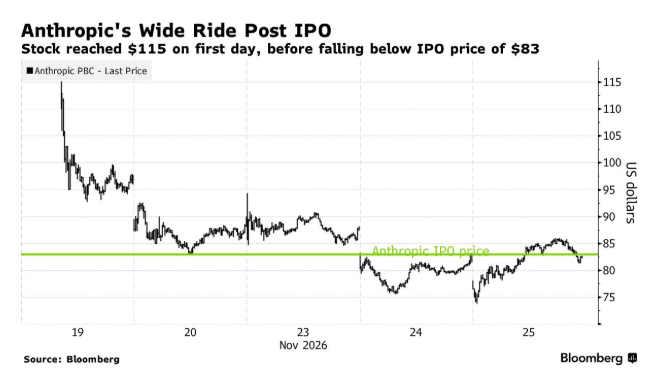
There are many rivalries within the same organization, reflecting huge differences in the entire market over how to price the disruptive potential of artificial intelligence (AI) and the core corporate value of the racetrack. This also highlights the fact that this individual stock is full of controversy: after listing, its valuation soared to $2 trillion, then quickly retreated. The stock dropped below $74 on Wednesday, then recovered and fluctuated around the issue price of $83.
There have also been cases in history where opinions within the same institution were divided. For example, in 2023, Morgan Stanley strategists and portfolio managers made very different judgments about market trends.
But research teams at Wall Street institutions usually form a unified view, especially when it comes to individual stocks. In Hedgeye, an independent research institution, Friedman is the chief analyst covering Anthropic; however, this AI company has a wide business coverage and also falls under Wang's research category.
Hedgeye has yet to respond to requests for comment.
Friedman's view is more in line with Wall Street's general optimism about Anthropic. Of the 17 analysts who covered the stock, 15 gave the stock a “buy” rating.
Friedman himself is one of only two analysts to give a “hold” rating. In an interview, he mentioned that short-term investors with an investment cycle of 3 to 6 months may be able to wait for a more suitable low entry. The reason is that Anthropic has a number of IPO-locked shares, which may cause selling pressure after the lockdown period ends in the next few months.
However, looking at the longer cycle, Friedman believes that Anthropic products have a 15% to 20% chance of growing into an operating system similar to Microsoft (MSFT.US) for white-collar workers. He explained that once realized, Anthropic will no longer sell only the original intelligence capabilities output by the Claude model, but also the ecosystem of plug-ins and applications that employees use on a daily basis.
“The core point is that whoever controls the operating system of the work scene has the initiative. This is Anthropic's bullish logic: in the long run, it is expected to grow into a platform-based company against Microsoft.”
Friedman also referred to real-time data: Despite Anthropic's suggestion that product usage may decline during the winter holidays, the company's revenue has continued to grow since the last disclosure of operating data.
Friedman believes that in the long run, Anthropic will simultaneously experience a double cost dividend. First, as the efficiency of computing power increases, the cost of training and inference calls for new models is decreasing year by year; second, after this round of “extremely tight demand”, the price of computing power is expected to fall. In his view, even if the company cuts AI call pricing, these dividends can support profit margins.
On the other side, Wang said in an interview that Anthropic's huge demand for computing power may collide with an environment where capital is becoming more cautious about AI infrastructure projects. The continued rise in financing costs for new cloud vendors such as CoreWeave (CRWV.US) has confirmed this risk. Wang believes that the insufficient supply of computing power will directly limit Anthropic's commercial monetization space.
At the same time, fierce competition from rivals such as OpenAI will continue to depress AI token pricing, which requires increased usage to make up for the revenue gap. However, Wang is worried that the demand side will not keep up. He predicts Anthropic's revenue of 120 billion US dollars next year, which is lower than analysts' unanimous expectations of 136 billion US dollars.
Wang also acknowledged that the cutting-edge model is expected to spawn breakthrough applications such as new drug development, but “it is difficult to give a clear implementation schedule” and the corresponding revenue is currently not included in performance expectations.