


The Zhitong Finance App learned that Wall Street financial giant J.P. Morgan Chase's latest forecast report shows that although the booming global cutting-edge artificial intelligence industry will soon usher in a growth platform period, companies closely linked to AI will continue to raise about 450 billion US dollars through the open investment-grade credit bond market in the upcoming 2027 to use capital expenses related to the construction of increasingly large and close to trillion US dollars of AI data centers.
The US stock Dow Jones index pulled a “deep V” and closed higher, but the credit market used real money to question the rebound. J.P. Morgan Chase (hereinafter referred to as “Xiaomo”) even predicted a wave of 450 billion US dollars in AI debt issuance. The agency's latest forecast report covering the global credit bond market shows that so far this year, although 2026 is not over, global AI-based companies have issued a total of 368 billion US dollars of investment-grade bonds, far exceeding the scale of previous years. By the close of the US stock market on Wednesday, although the US stock market had recovered most of its intraday losses and got out of “Deep V,” the risk premium for AI borrowers had risen sharply, and the divergence between the stock market and the credit market showed that this round of rebound had not been confirmed by broader funding.
As of November 25 (Wednesday) EST, the weekly trading of the US stock market, the Dow unexpectedly achieved a “deep V” rise after erasing a decline of more than 1,000 points. The S&P 500 index and the Nasdaq Composite Index also recovered most of their intraday losses, and almost closed higher after a sharp fall of about 5% in a single day. However, the two core forces in the AI computing power industry chain—CoreWeave and Nvidia's five-year credit default swap (CDS) spreads both hit new highs, and CoreWeave's yield on a 2031 bond is approaching 18%.
After Hwang In-hoon's major return to Nvidia on Monday, the global stock market, especially technology stocks linked to AI computing power, can be described as surging and credit asset response was clearly weak. The Goldman Sachs trading desk judged that short recovery was an important driving force, and BTIG also advocated using a rebound to reduce risk exposure. J.P. Morgan predicts AI capital spending will nearly double to $1.4 trillion in 2027, and open market investment-grade bonds will increase to $450 billion. Since a significant portion of the capital has already been funded for construction in 2027, the additional financing next year will mainly support the 2028 project, and the capital expenditure growth rate is expected to slow significantly at that time.
Whether this round of rebound in technology stocks in the stock market can continue, in addition to focusing on the bears' recovery trend and whether Wall Street institutions and retail investors will continue to add large-scale long buying positions, we also need to focus on how high interest spreads and large-scale new bonds are willing to take on; if loan conditions continue to be tightened, the first thing that will be affected will be the trillion-dollar AI data center construction or expansion plans that have not yet locked in capital and subsequent AI chip orders.
The investment-grade corporate bond market mentioned by Wall Street financial giant J.P. Morgan Chase mentioned above is a credit market in a broad sense, commonly known as an “investment-grade credit market” (investment-grade credit market). The “credit market” is broader in scope, and also focuses on high-yield corporate bonds, leveraged loans, private equity credit, etc. The “investment grade bond market” refers to the specific financing channel for companies to issue 450 billion US dollars of bonds. The “credit market” can be used to summarize the overall risk pricing reflected by indicators such as corporate bond spreads and credit default swaps (CDS).
J.P. Morgan predicts that the AI debt issuance frenzy will reach 450 billion US dollars in 2027
Voya statistics show that the amount of AI-related investment-grade bonds issued in the first half of 2026 has surpassed the full year of 2025. The debt issuance calculation in J.P. Morgan Chase's latest research report shows that in 2026, the global AI-based investment grade bond issuance scale was US$368 billion, and it is expected to further increase to 450 billion US dollars in 2027, an increase of about 22%.
The J.P. Morgan analyst team emphasized that although the booming artificial intelligence industry will usher in a growth platform period in the future, companies will still raise 450 billion US dollars through the open investment-grade bond market next year for AI-related capital expenses. A team of J.P. Morgan financial market analysts led by Tarek Hamid (Tarek Hamid) and Nathaniel Rosenbaum (Nathaniel Rosenbaum) wrote that total AI-related capital expenditure will nearly double to $1.4 trillion in 2027 and stabilize the following year.
Analysts expect capital expenditure growth to slow significantly in 2028 as industry spending enters a more stable operating level. The cautious statements of Asian tech giants such as Tencent and Alibaba may have provided an early signal for this. They wrote in the research report that as the growth rate of the entire industry slows down, expectations for capital expenditure for the next quarter in late 2027 or early 2028 will remain basically the same. It is currently difficult to determine whether the market will react positively or negatively at that time.
They believe that this shift will make it easier for the credit market to predict the supply of bonds, but a halt in spending growth may also disrupt investor sentiment.
J.P. Morgan predicts that from 2027 to 2031, the AI industry will build 151 gigawatts of data center capacity, at a total cost of 7 trillion US dollars. Most projects require several years of construction and early funding, and a significant portion of the capital required for the 2027 construction plan is already in place. This means that the funds raised in 2027 were actually prepared for 2028.
In addition to investment-grade bonds, the bank expects the company to raise $65 billion through leveraged financing and raise $25 billion to $35 billion through securitized products in 2027.
Faced with such a huge scale of financing, the debt market's ability to handle it will be close to the upper limit. Cash-rich hyperscale cloud vendors are expected to take on more equity capital investment. Over the next five years, the industry is expected to require US$2.9 trillion in equity capital, mainly from the cash flow generated by the company's own operations.
At the same time, the target of financing is shifting from physical data center facilities to computing power hardware. The strategist wrote that the share of AI accelerator financing in public and private equity markets is likely to rise sharply. By 2031, GPU financing requirements could reach four times the financing requirements for power-equipped computer room buildings (power shells).
Other agencies' predictions are different. Goldman Sachs expects AI capital expenditure of hyperscale cloud vendors to increase by 50% to 1.2 trillion US dollars next year. Entext, a research firm headquartered in London, predicts that spending growth will slow to about 25% in 2027.
The US stock market unexpectedly got out of “Deep V”, but the AI bond market raised prices for the next round of expansion
As of the close of trading on November 25, EST, the rebound triggered by Hwang In-hoon's reinstatement had been backfired for two consecutive days, but the “deep V” reversal market unexpectedly emerged on Wednesday, making some investors convinced that the rebound would continue, but the global credit market clearly didn't think so.
On Monday, Nvidia rose 31.48%, and its market capitalization increased by about $952 billion. The S&P 500, Nasdaq Composite Index, and the Philadelphia Semiconductor Index rose 4.73%, 6.51%, and 14.03%, respectively. Since then, on Tuesday, the three core benchmark indices have declined by 0.50%, 1.48%, and 7.88%, respectively. Micron Technology and AMD, the two most popular stocks in the AI hash-themed bull market — also moved up 19.04% and 6.85% to sharp declines of 11.01% and 8.86%.
On Wednesday, the Dow Jones Index, the supermarket benchmark index covering Nvidia, Apple, Microsoft, Amazon, and Google's parent company Alphabet, closed up 0.33% after erasing a one-day decline of 1,000 points, while the S&P 500 index and the Nasdaq Composite Index pulled back from an intraday decline of about 3.2% and 4.6% to a narrow decline of 0.25% and 0.62%, respectively. The Philadelphia Semiconductor Index also closed down 0.65% from a one-day drop of nearly 8%.
The stock market has recovered intraday losses, yet the risk premium for AI borrowers is rising. J.P. Morgan predicts AI capital spending will nearly double to $1.4 trillion in 2027, and open market investment-grade debt issuance will increase by about 22% to $450 billion. On the day the forecast was released, CoreWeave's yield on a 2031 bond was close to 18%, and the 5-year credit default swap (CDS) spread rose by a record 209 basis points to an unprecedented 1,534 basis points. The five-year implied default probability based on the swap pricing model was over 70%. CoreWeave's 5-year credit default swap (CDS) spread soared 209 basis points (2.09 percentage points) in a single day, also the biggest single-day increase on record.
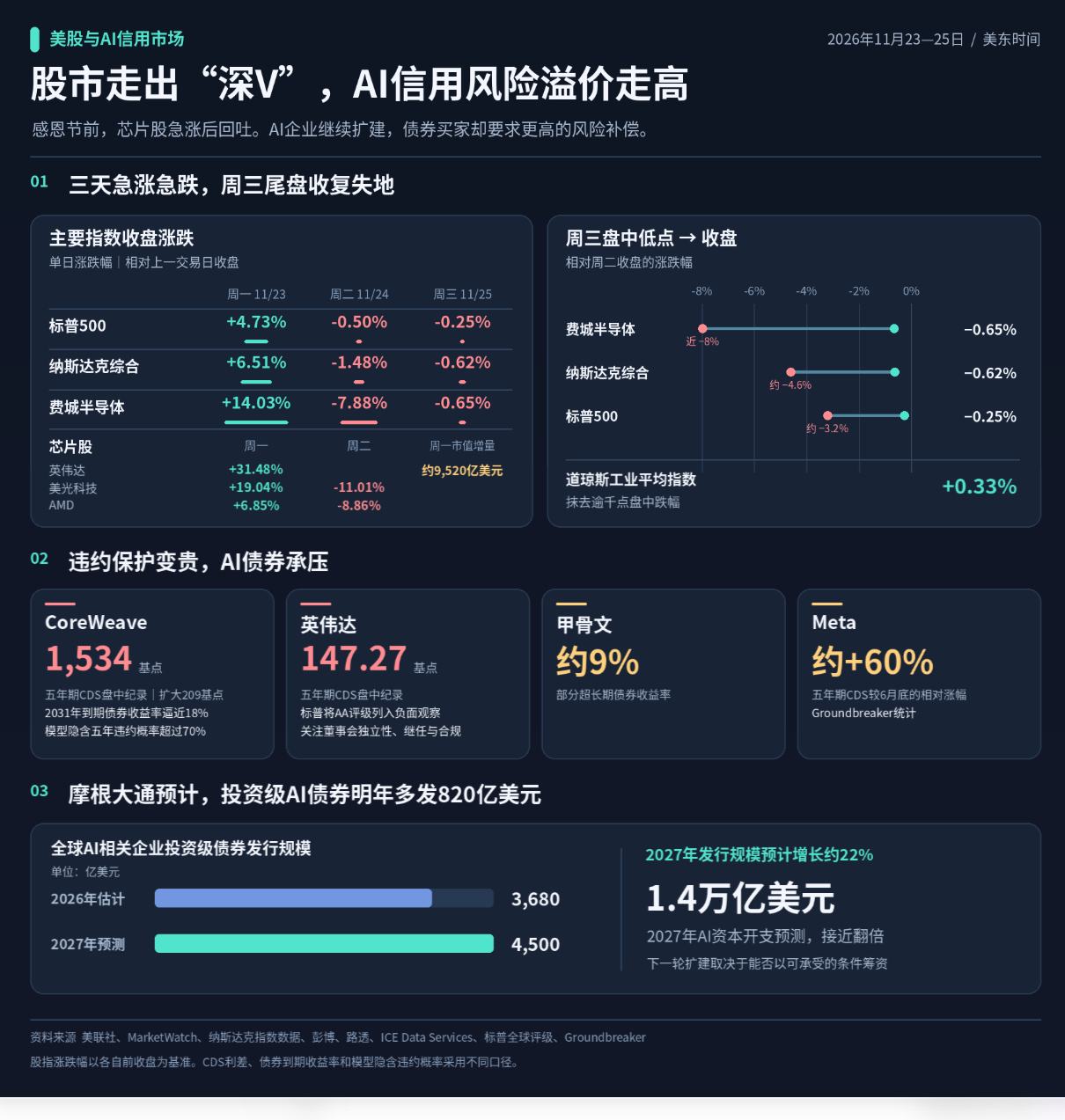
In addition, credit bond market pricing data also shows that Nvidia, the largest leader in the global AI computing power industry chain, also hit a new high of 147.27 basis points in the five-year CDS market. S&P Global Ratings included its AA rating as a negative observation, focusing on board independence, succession arrangements, and regulatory compliance. The yield on some of Oracle's ultra-long-term bonds is close to 9%, and Meta's 5-year CDS is also about 60% wider than at the end of June according to Groundbreaker statistics. Whether projects with the same or similar ratings can continue to raise money according to their original conditions has become a more important issue than a single day's stock price rebound.
Rich Privorotsky (Rich Privorotsky), head of the Goldman Sachs trading desk, believes that global credit assets clearly outperformed the stock market on Monday, in line with the characteristics of short recovery driving a rebound; CoreWeave's stock price surged 22.3% on the same day, but the yield on a bond due in 2031 rose 20 basis points to 16.57%.
Mitsubishi UFJ financial strategist Derek Halpenny (Derek Halpenny) believes that the Federal Reserve may still raise interest rates; this is the only variable that allows investors to re-evaluate whether AI expansion can continue to be funded; Hwang In-hoon's return can quickly affect stock positions, and whether additional loans can cover interest still depends on specific cash flow growth indicators for large-scale AI infrastructure projects.
Nick Ferres (Nick Ferres), chief investment officer at Vantage Point, said that the bond market is still charging AI industry partners with mutual financing and off-balance sheet commitments assumed by large cloud vendors; these arrangements allow credit risk to be transmitted along leases and guarantees. Mark Clegg (Mark Clegg), a senior fixed income trader at Allspring, believes that the sell-off has made AI bonds more attractive, but the market is still looking for a transaction price. Robert Cohen (Robert Cohen), head of corporate credit at DoubleLine, believes that the yield on some large cloud vendor bonds can already cover the associated risks.
The money raised in 2027 will determine the 2028 project. How will credit pressure spread to AI chips and broader AI infrastructure orders?
Financing can be tightened before tenants default, or before demand for computing power weakens. Large-scale AI data center construction projects usually use long-term rent to repay debts. If the credit premium of the lessee or guarantor rises, the lender may lower the mortgage valuation, reduce the loan amount, and require the project sponsor to supplement more share capital.
After re-estimating 25 parks with a total cost of about US$207 billion, Groundbreaker found that the collateral valuation decreased by about 16% and the owners' equity valuation decreased by about 40%. Among them, the equity valuations of Oracle and CoreWeave-related projects fell by about 72% and 91%, respectively. These are model valuation changes. The recent quotation data of AI cloud computing supergiant Oracle's five-year credit default swap (CDS) interest spread of 316 basis points surpassed Bearsden at a specific point in early 2008, which can be described as a comparative explanation of the high cost of protection. However, in 2008, Bearsden still faced short-term financing breakdowns and counterparty risks. Measuring systemic pressure required additional observation of these channels.
J.P. Morgan's time difference is the key to understanding this round of sell-off. A significant portion of the construction in 2027 has already been funded, so the funded park can still purchase GPUs, high-bandwidth memory (HBM), and network equipment as planned. The new capital raised in 2027 mainly supports construction in 2028. If high credit premiums cause loan amounts for new projects to shrink, operators may first list the shelves in batches, delay server purchases, and then affect the growth rate of chip and storage orders.
The Bank of America strategy team led by Bank of America's chief investment strategist Michael Hartnett, who has the title of “Wall Street's Most Promising Strategist,” recently released a research report showing that what the agency is very worried about recently is that if this process is compounded by weakening employment in the US, data center engineering, equipment procurement, and consumption will drag on each other. The Bank of America stock market strategist team he leads is still based on a soft landing, and the S&P 500 outlook at 6,666 points corresponds to a hard landing scenario. This also explains why bond issuance and shipments can still grow in 2027, yet the market may revise 2028 order expectations ahead of schedule.
The rebound has not been widely acknowledged by the credit market, and pressure is still concentrated on some issuers. As of October 30, interest spreads on US investment-grade cash bonds widened by about 13 basis points during the year, with weaknesses concentrated on technology and communications. As a historical reference, it expanded by about 20 basis points from 2018 to November, and then expanded by about 25 basis points in a single month in December. This Wednesday, the investment-grade CDX, which measures overall credit risk, widened 3.1 basis points to 65.63 basis points, the highest since March 31. In the AI bond sample tracked by the Wall Street Journal in the same period, the price of investment-grade securities rose in the middle of the day and the price of high-yield vouchers fell.
BTIG's senior strategist Jonathan Klinsky also discovered that in the history of the NASDAQ 100, there were 12 cases where it fell at least 5% in a single day and rose at least 5% the next day, 11 fell cumulatively over the next 3 trading days, and 12 times all retreated within the next 30 trading days. Therefore, for the current round of global technology stock market, and especially for the rebound trajectory of AI computing power and the semiconductor sector, the more convincing confirmation signal is that credit spreads for highly leveraged borrowers continue to narrow, and that new projects can be funded at acceptable prices and amounts.