


The Zhitong Finance App learned that in a global economic briefing entitled “Global Trade of AI to Broaden in 2027” (Global Trade of AI to Broaden in 2027), AI-related commodity trade will no longer be limited to computing power hardware such as chips and servers, and demand for semiconductor equipment and power distribution equipment will rise rapidly. More economies such as the Eurozone, Japan, and China will share AI trade Dividends, a recovery in capital spending in the non-AI sector will further amplify this trend.
AI trade has entered diversified expansion, and the year-on-year growth rate of US imports has exceeded 100%
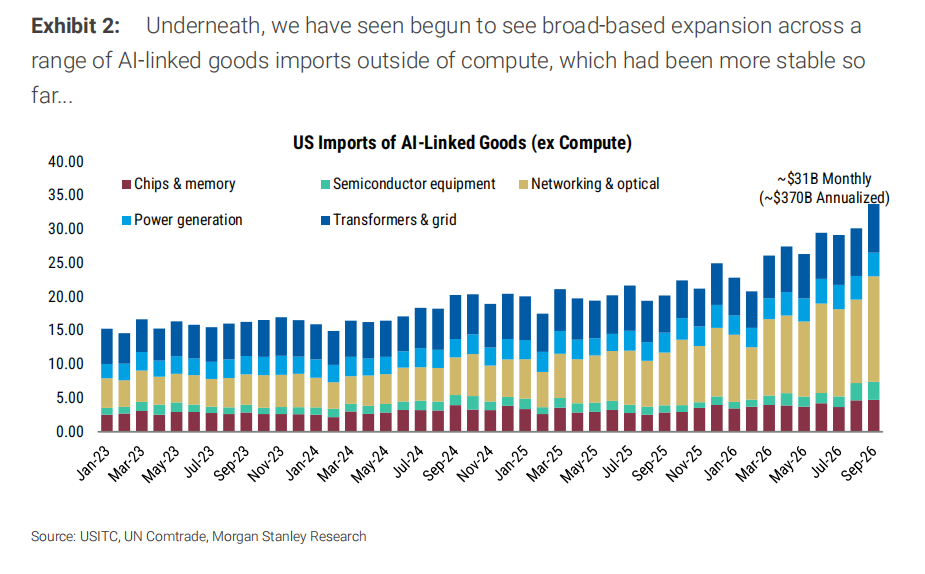
According to the report data, the scale of imports of AI-related products in the US continues to explode. Under a broad caliber, monthly imports of AI-related products have exceeded 100 billion US dollars, compared with only 30 to 40 billion US dollars per month in 2024. Such products account for nearly 30% of total US imports. The monthly import scale of AI infrastructure products other than core computing power servers has reached 31 billion US dollars, equivalent to an annualized scale of about 370 billion US dollars. The growth rate of imports of semiconductor manufacturing equipment, power generation, and power grid equipment is particularly prominent.
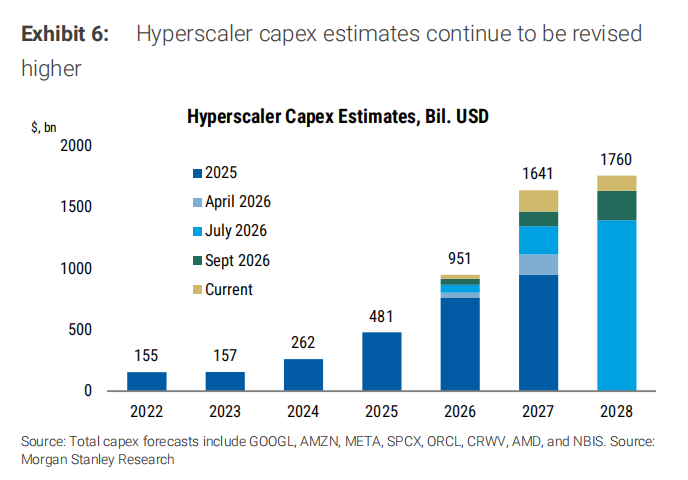
The year-on-year growth rate of AI-related imports in the US has exceeded 100%, and the second-order change in the growth rate has also changed from negative to positive, which means that trade expansion itself continues to accelerate. Analysts expect global AI capital spending to climb to $1.6 trillion in 2027 and reach $1.8 trillion in 2028, but there is a risk that some 2028 investments will be delayed until 2029. The capital expenditure forecast for hyperscale cloud vendors continues to rise, reaching US$1.641 trillion in 2027 and further rising to US$1.76 trillion in 2028. The scale of imports of AI-related products is highly consistent with the trend of capital expenditure.
Furthermore, the trade structure is undergoing a critical transformation: in the past, AI trade was mainly driven by servers and chip storage, but the current growth momentum is spreading to power infrastructure such as semiconductor production equipment, optical network equipment, turbines, and transformers. This indicates that the AI investment cycle has passed through the early stages of simply purchasing computing power hardware and has begun to shift to building a manufacturing, communication, and power infrastructure to support AI operations.
Meanwhile, Asia's non-AI capital expenditure cycle is accelerating, and US non-AI capital expenditure is expected to gradually increase steadily from 2027 to 2028, providing additional support for global commodity trade. The scale of imports of Asian capital goods has rebounded to the strongest level since the beginning of the 21st century. In addition to local capital expenditure, exports are also an important force driving the upward trend in the regional industry. Asia is experiencing a capital expenditure supercycle not limited to AI.
Supply Chain Restructuring: More Countries Deeply Participate in the AI Trade Chain
With the expansion of trade categories, AI dividends are no longer concentrated in traditional semiconductor production sites such as Taiwan and South Korea, and the global supply pattern is clearly divided:
Taiwan and South Korea still have a firm grip on the supply of core computing power components such as chips and memories; Mexico has become an important server assembly hub; Thailand, Malaysia, and Vietnam continue to rise in the share of optical communications and network equipment assembly; Japan and the Eurozone are more upstream in the industrial chain, leading the export of power infrastructure equipment such as semiconductor manufacturing equipment, turbines, and transformers.
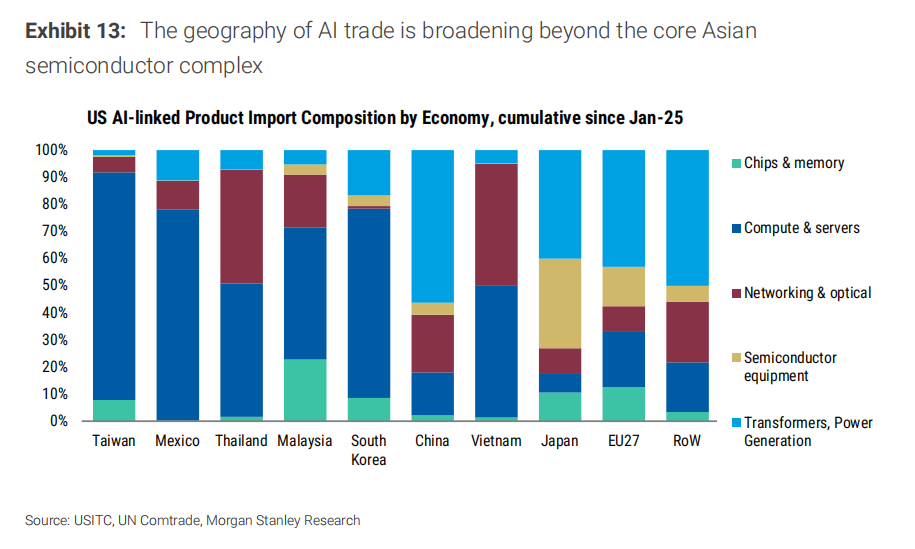
Japan's AI-related export structure is very representative. Semiconductor manufacturing equipment accounts for more than 40% of AI exports in its statistics, and servers and computing power products account for less than 2%. Export destinations are mainly aimed at East Asia, China, and ASEAN, and direct exports to North America and Europe account for relatively low direct exports, which are deeply tied to the wave of semiconductor production expansion in Asia. In the second quarter of 2026, electronic and electrical products became the biggest contributor to Japan's rising export prices. While AI hardware brought an increase in export revenue, it also boosted the cost of imported parts from Japan.
The Eurozone also focuses on upstream capital goods. Exports of AI-related products grew at a year-on-year rate of about 10%, and the focus of exports is gradually shifting to Asia rather than the US. Dutch lithography equipment is typical. Europe does not seek to become a computing power hardware manufacturing center; instead, it relies on the global wave of semiconductor production expansion to export high-end industrial equipment. However, Morgan Stanley also warned that it is difficult to transfer the upstream equipment boom to Europe's overall broad capital goods cycle, and structural bottlenecks still exist.
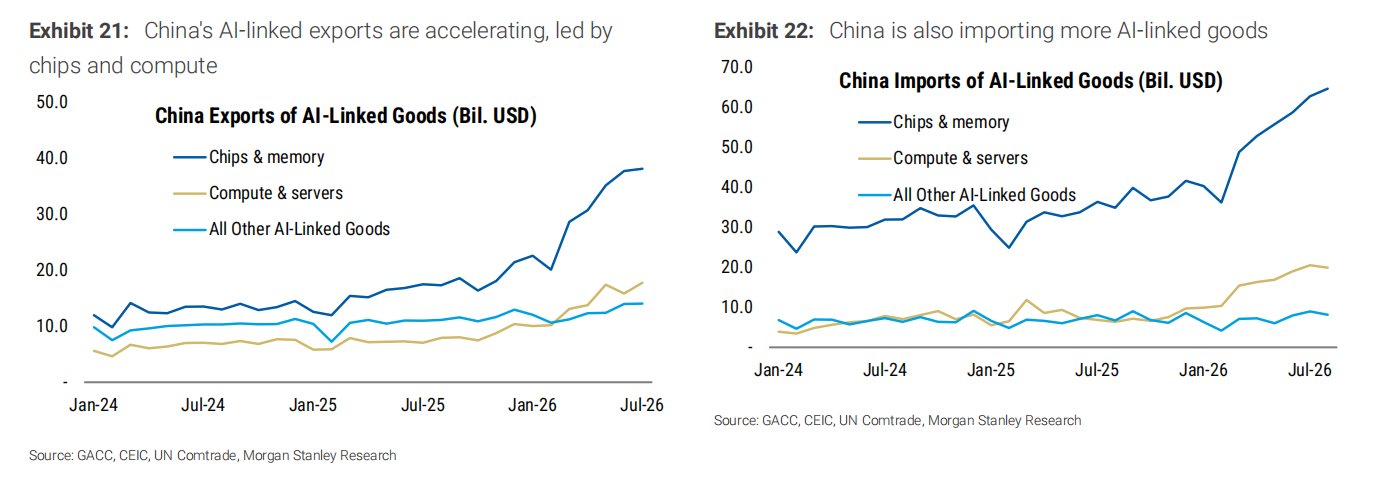
China is deeply embedded in the two-way AI trade chain. It is not only a net importer of AI hardware, but also exports a large number of related electromechanical products. Domestic storage-related trade activities have accelerated markedly, and export unit prices for machinery and electrical equipment have continued to rise, reflecting the transmission of upstream cost pressure downstream. However, export controls on advanced chips and semiconductor equipment will continue to restrict the pace of domestic AI industry chain construction, and equipment sales by overseas suppliers to China will be disrupted by inventory digestion and policy controls.
Overall, global AI presents a K-shaped trade pattern: AI and semiconductors drive a high increase in nominal trade, and the traditional consumer electronics boom is still weak.
US data centers face power shortages, and some construction projects are delayed backwards
Morgan Stanley estimates that the electricity demand for AI data centers in the US will reach 130 GW by 2027, but the available supply is only 107 GW. Even if the user's own power generation is superimposed and part of the computing power demand spills over to Asia, there is still a significant power gap. Production of power equipment such as transformers and turbines is highly concentrated in Eurasia, and capacity expansion will take several years. Even if the US strongly supports local manufacturing, it will not be able to break away from import dependency in the medium term. Supply-side production capacity and delivery cycles will limit the speed of transformation of demand to actual imports.
Affected by the introduction of data center regulation policies in some states after the US midterm elections, Texas, Ohio and other places will delay data center construction plans totaling about 5GW from 2028 to 2029, which is equivalent to 20% of the original plan to increase capacity in 2028. Analysts kept the 2027 capital expenditure forecast unchanged, but there is a risk of a downward revision of the 2028 capital expenditure. On the one hand, the project extension will increase the pressure on the 2028 electricity gap, and on the other hand, it will also slightly ease the tight electricity supply situation that year. The construction of computing power may delay the pace of AI implementation and the release of productivity, but it will not end the current capital expenditure cycle; it will only lengthen the construction cycle.
Delays in computing power construction will force some AI computing power demand to spill out to Asia, Europe, Africa, and the Middle East. Since January 2025, the cumulative net imports of excess core computing power and hardware from economies other than the US have exceeded 120 billion US dollars, compared to 263 billion US dollars in the same period. The Eurozone, India, and China each had excess net imports of about US$20-23 billion. Regional data center construction prospects are broad: Southeast Asia's data center capacity may double to exceed 8 GW in 2024 to 2028; India is about 4.5 GW, with an average annual growth rate of nearly 50% from 2026 to 2030; European data center capacity will increase from 7 GW in 2024 to nearly 12 GW in 2028.
The overall investment to build a 1GW data center is about 40 to 55 billion US dollars, of which hardware equipment accounts for 30 to 40 billion US dollars, and the rest is supporting expenses for civil construction and engineering. Even if hardware relies heavily on imports, construction, installation, and local support can still drive the local economy. For the Eurozone, Japan, and India, a single 1GW project can bring 10 to 15 billion US dollars of domestic value added during the construction cycle. The driving effect on small economies will be more prominent, and foreign direct investment will also help absorb the financial pressure brought about by import expansion.
Price pressure is transmitted from chips to the outside, and upstream price increases gradually spread downstream
Early AI trade growth was mainly driven by shipments, and price increases were concentrated in segments with strong supply constraints, such as memory chips, which is what the market calls “chip inflation.” South Korea is the core source of rising prices. Storage makers' production capacity is skewed towards AI applications, driving up export unit prices; Taiwan, China follows. Export price pressure in regions such as Malaysia and Thailand is still moderate, and supply chain capacity expansion can absorb some of the new demand.
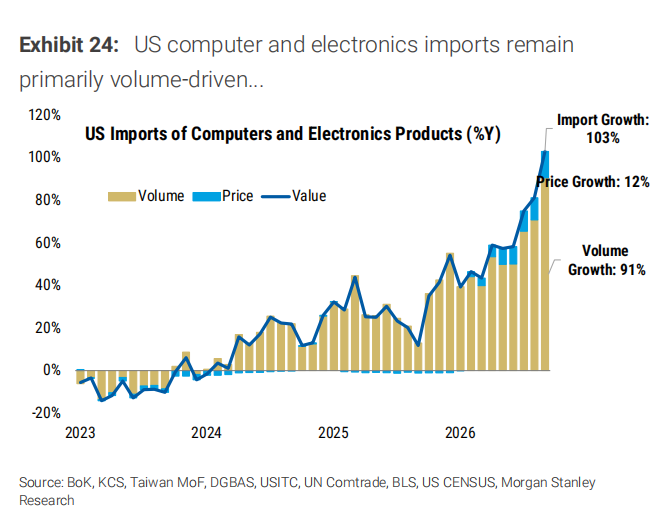
The bank pointed out that with the expansion of AI trade categories, price pressure will gradually spread to other capital goods such as semiconductor equipment and power equipment, but most segmented racetracks have a better existing production capacity base, and the overall price fluctuation will be weaker than in the previous chip sector. The global supply chain will cushion the impact of price increases. High-priced components from South Korea and Taiwan will only enter the US market after assembly is completed in Southeast Asia and Mexico, compounded by long-cycle supply contracts and inventory buffers. US import prices will have a clear time lag compared to upstream export prices. Up to now, the 91% increase in US imports of computer electronics products has been driven by volume, and the price contribution is only 12%, but in the future, upstream price increases will continue to be transmitted to terminals.
In terms of the impact of inflation, the rise in AI-related commodity prices will drive the US core PCE inflation to rise by about 30 basis points in 2026 and fall back to 20 basis points in 2027; the impact on core CPI is relatively small. The bank suggests that PPI disturbances caused by energy price fluctuations will be even greater, and that the price increase signals brought about by AI may be covered up in overall price data. Furthermore, nominal capital expenditure and actual computing power capacity will diverge: even if the scale of investment in the US dollar remains high, if construction of a large number of projects is postponed, the actual rate of additional computing power supply will slow down, causing a gap between nominal trade value, GDP growth, and AI productivity improvement.
Potential impetus to the US manufacturing industry
Structural changes in AI capital expenditure are also bringing opportunities to the US manufacturing industry. Currently, the construction of AI-related electronics, mechanical equipment, and power grids in the US has become the main driver for the recovery of industrial production. When capital expenditure is more skewed towards categories with a production capacity base in the US, such as power generation equipment and power transmission and distribution equipment, it will drive domestic output to a greater extent than the stage where imported chips and servers are highly dependent.
AI-related production has become an important driving force for the recovery of US industrial production, but Morgan Stanley also stressed that there is no widespread evidence of a return in the manufacturing industry, and whether it can continue to reduce dependence on foreign imports remains to be further observed.