


The flash crash of Wanwei Intelligent Technology (00209) in early trading on November 25 exposed the long-hidden structural fragility of this micro-market Hong Kong stock to the market in an extremely drastic way.
The stock opened at HK$1.63 on the same day. There were no abnormal signs at first. The real turning point came around 9:50 a.m., when the stock price plummeted from HK$1.60 to below HK$0.30 in just a few minutes, hitting an intraday low of HK$0.234. At one point, the decline was over 85%. The turnover expanded rapidly, with a full-day turnover of HK$36.602 million, and a turnover rate of 55.48%. For a micro market with a total share capital of only about 178 million shares, this speed of turnover means that chips are concentrated in a very short period of time, and buyers are almost too late to form an effective acceptance.
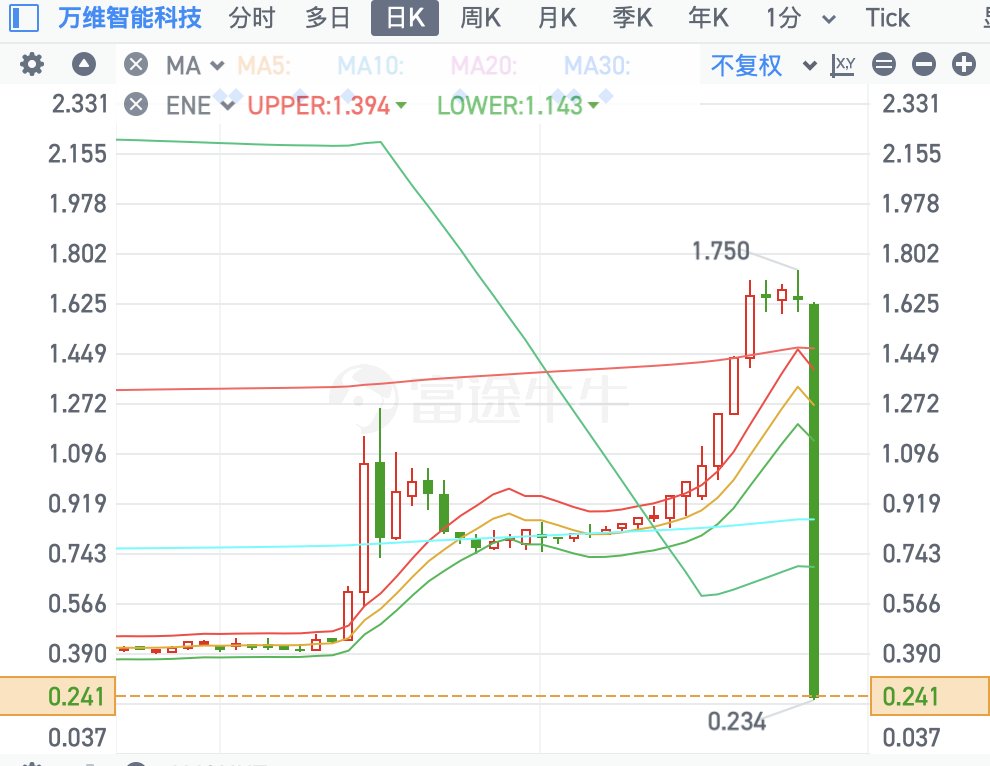
A sharp drop of this magnitude in a single day may seem sudden, but if we lengthen the timeline and cross-examine the three clues of transfer records, share financing, and stock price trends, is this collapse really untraceable? The answer lies in three lines of direction. Changes in position transfers outline the trajectory of chip transfers. Stock offerings and placements reveal the company's continued dependence on equity financing, while stock prices showed a typical pattern of alternating pulse-ups and cliff-style declines under the combined efforts of the two. This is not a simple change in stock prices; it is a “pre-engineering project” of capital operations leading to centralized liquidation of terminals.
After the flash collapse, the structure came back together in the dark
Transfer data is the most direct way to understand the Wanwei Intelligent Technology market. The so-called transfer of positions is essentially when shareholders transfer their positions between brokerage seats. This action itself is not directly equivalent to trading, but it often indicates that chips are being concentrated in a specific direction or are preparing for subsequent transactions.
According to data from the Hong Kong Stock Exchange, chips were undergoing a round of intensive migration on the eve of their collapse. Just two days before the flash crash, Wanwei Intelligent Technology continued to experience large-scale position changes. On November 24, shareholders transferred 4,038 million shares to Yongfengjin Securities, while transferring 6.49 million shares from Dahua Jixian, with a total market value of about HK$307.07 million, accounting for 10.25% of the issued shares. On November 23, the market value of the transferred shares also reached HK$10.5929 million, accounting for 3.60%. Chips totaling over HK$41 million were transferred between brokerage seats over the two days. This was no ordinary position adjustment.
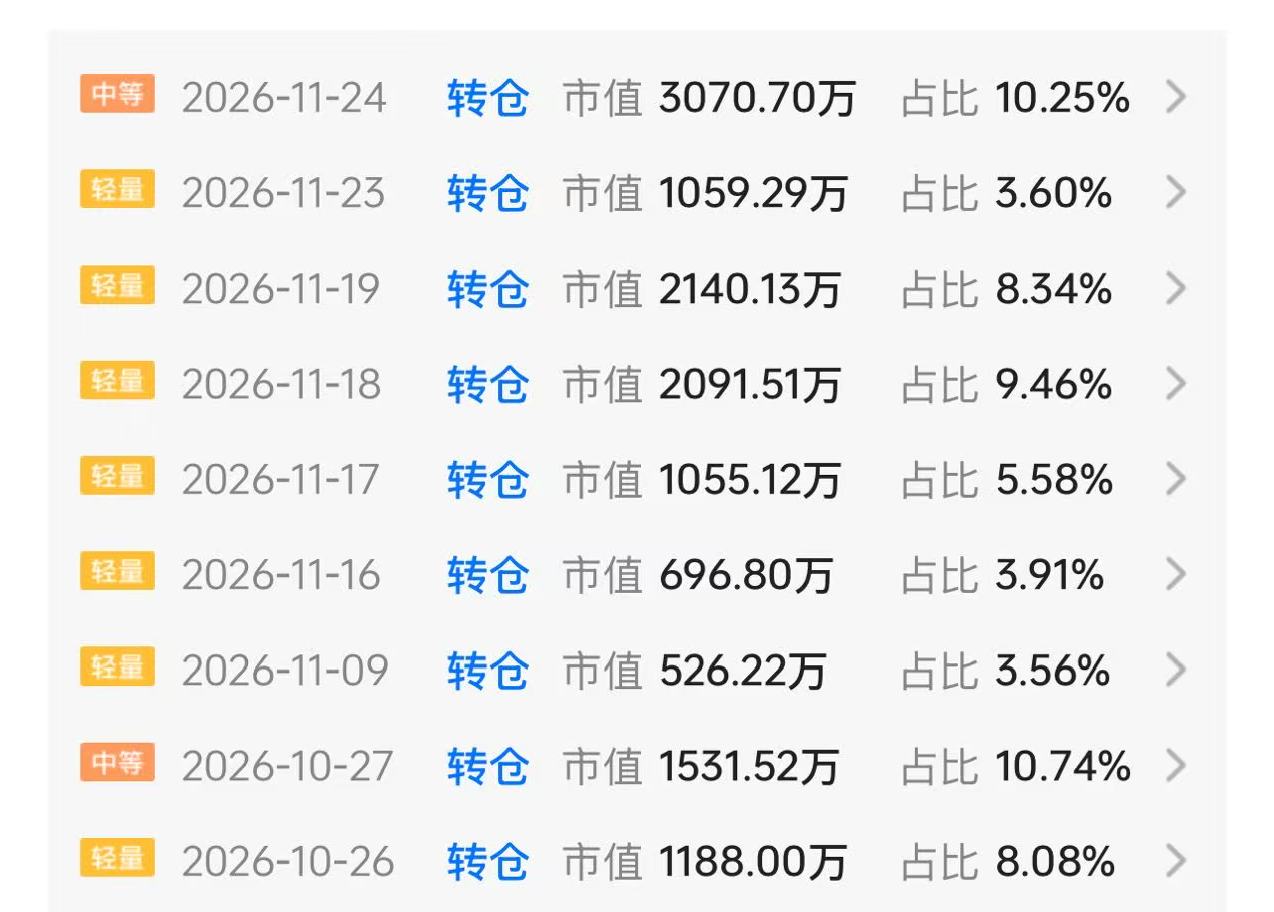
Previously, similar moves had been carried out one after another. In just over a month, the transfer was concentrated in favor of a few seats such as Yuanyuan, Yingtou, and Yongfengjin, while also withdrawing from Dahua Jixian and Merrill Lynch Yuandong. This model of entry and exit means that positions in micro-capitalization stocks are moving away from decentralized accounts to seats that are convenient for centralized operations. Considering that the total share capital of the stock is only about 178 million shares, a single transfer can easily account for close to double digits, and it goes without saying that its chip concentration is high. When a large number of chips are concentrated in a small number of fast-forward and fast-exit brokerage seats, the market naturally has the conditions to be leveraged or smashed by a small amount of capital. The final settlement of the transfer was completed on the 24th. On the 25th, this batch of chips was released centrally due to poor liquidity, causing the price to fall instantaneously. The chronological relationship clearly points to a chain of cause and effect: placement lays down chips, transfers back up chips, and centralized release causes a flash crash.
If the transfer of positions reflects the spatial distribution of chips in the secondary market, then stock supply and placement reveal the financial hunger at the company level in terms of time. The Zhitong Finance App notes that the pace of capital operation of Wanwei Intelligent Technology in 2026 is quite tight. At the beginning of 2026, the company completed a round of “one for seven” shares, then implemented a “ten in one” joint stock offering on July 24 to reduce the share capital that had greatly expanded due to the share offering back to a tradable price range. This “share offering - joint stock” combination operation itself already suggests that the previous share offering did not fundamentally resolve the company's financial situation. On October 2, the company announced that it plans to place up to 297.13,400 new shares. The adjusted placement price was set at HK$0.36 per share. The final settlement was completed on October 23, with a net raise of approximately HK$10.35 million. Judging from the use of fund-raising, the proceeds are intended to cover maintenance expenses for daily operations such as employee costs and administrative expenses, rather than any capital investment with the meaning of growth.
What is even more interesting is the correspondence between the time points of placement and stock price pulses. The placement was completed on October 23, and the first round of sharp increases happened during the placement promotion period in mid-October. There was a huge price difference between the placement price of HK$0.36 and the brief rise in the secondary market, providing a considerable floating window for undertakers at lower levels. However, the stock closed at HK$0.82 on the day the placement was completed on October 23, and the momentum to maintain the stock price subsided for a while. However, the story did not end there. In mid-November, the stock experienced a new round of appreciation, closing at HK$1.24 on November 17. At the same time, chips were frequently “relayed” between brokerage seats starting in mid-November. Considering that the total share capital of Wanwei Intelligent Technology is only about 178 million shares, this move, which can easily reach the millions of shares and is approaching double digits, is essentially moving scattered positions closer to seats that are convenient for centralized operations. It indicates that the final distribution of chips was not completed after the placement, but instead was brought back together and promoted again in November. Previously, the surge in mid-October and the pull-up in mid-late November formed the two peaks of the same trend, and the accelerated collapse on the 25th was the end point that these two peaks shared.
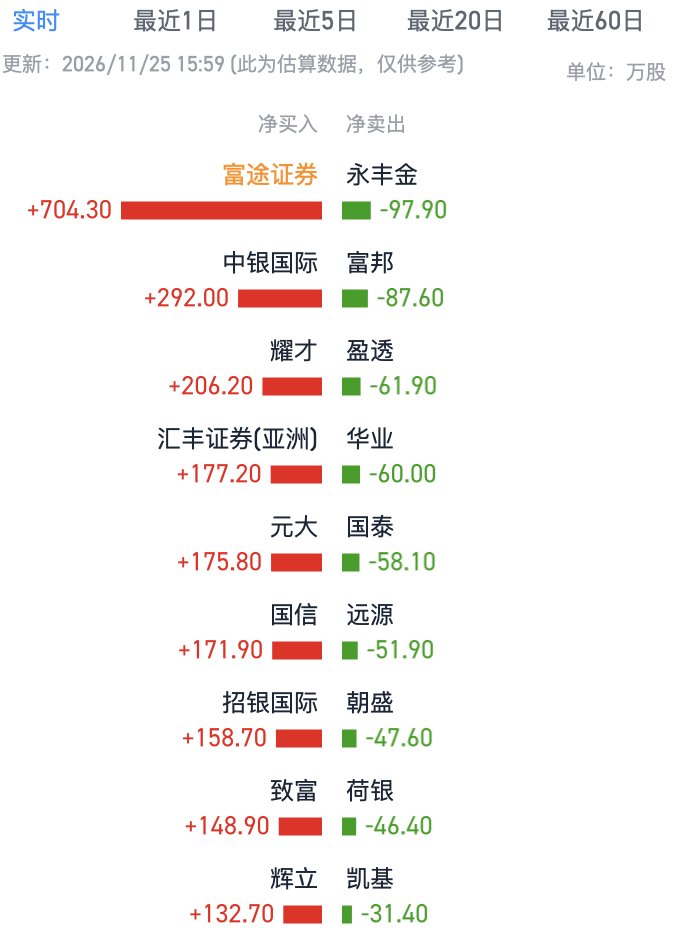
After-market brokerage trading data for the 25th provided the most intuitive micro footnote to this “centralized release.” On the net sales list for the day, Yongfeng Gold, Yingtou, and Yuanyuan Securities clearly listed — this is the operating seat where chips were heavily inflow in the early period. In particular, Yongfeng Gold, which had just accepted Dahua's transfer of positions the day before, quickly topped the net sales list on the 25th, and the “return of chips” in the early stages instantly evolved into centralized distribution. On the other hand, looking at the buyer's camp, Futu Securities, which had the largest net purchase, reached 7.04 million shares, followed closely by retail seats such as Bank of China International and Yaocai. This is by no means a contrarian undertaking by institutional or industrial capital; it is a blind “takeover” of extremely scattered retail capital at a low level. From dark places collecting chips to specific seats, to bright places pouring out at the moment when liquidity is exhausted, to unorganized retail groups taking over passively, the cause and effect closed to complete settlement.
A liquidation without a successor?
Financial data provides the final footnote to this picture. Wanwei Intelligent Technology's mid-term revenue in 2026 was HK$160.5 million, an increase of only 8.2% over the previous year, but the loss attributable to the company owner increased to HK$44.174 million, an increase of 15.3% over the previous year. The slight increase in revenue and the acceleration of losses indicate that the company's operating leverage has failed, and the pressure on the cost side cannot be absorbed through revenue growth. The company admits in its interim report that the current revenue level of the toy sector is insufficient to cover fixed costs, and the appreciation of the RMB against the US dollar has led to an increase in exchange losses to HK$11.9 million. Under such fundamentals, the company is unable to generate sufficient cash flow from operating activities to cover expenses; it can only repeatedly rely on stock offers and placements to maintain operations.
The loss of blood on the management side was directly reflected in the chip structure in the second half of 2026. The company is unable to generate enough cash flow from operating activities to cover expenses, so it can only maintain the platform by withdrawing from the old owner and releasing bulk goods into the market. In July, Wang Jingyu, the main shareholder, placed about 299 million shares of old shares at least HK$0.33 per share. After completion, the holdings returned to zero and resigned from all positions in August, and the old owner cleared the market; the October placement issued 29.71 million shares to no less than six independent third parties. The announcement made it clear that no assignee became the main shareholder, and no successor appeared. At the same time, every equity financing dilutes the original shareholders' equity while injecting new negotiable chips into the market. These chips, which were injected with no controlling shareholders and no industrial capital, made it difficult to find long-term holders at prices that lacked fundamental support, so they continued to find exit windows in the cycle of transfers and short-term transactions.
Personnel arrangements at the board level also confirm this: Zhao Kai, who took over as chairman after his resignation, resigned to “focus on other business arrangements” for just over a month. Currently, there are only two executive directors left — An Pingyan and Yao Zhengang. An Pingyan is 30 years old and was only appointed as CEO in June 2026. The announcement made it clear that he had nothing to do with any director, major shareholder or controlling shareholder of the company. He had no position as a director of any other Hong Kong stock listed company in the past three years, and his monthly remuneration was only HK$10,000; Yao Zhengang is a stock figure who joined the old company's financial system in 2014 and was transferred as an executive director in August 2025. He is also an executive director of Elephant Future Group and an independent non-executive director of Hong Kong Zhiyun Technology Construction. An unrelated, low-paid external airlifter, a permanent director of multiple companies left over from the old system. Both of them do not carry industrial resources or equity backgrounds. This is not an outpost where the new owner is stationed, but rather an executor who maintains the minimum operation of the platform after the old owner leaves the market.
The case of World Wide Intelligent Technology is not complicated, but it is typical enough. The transfer line reveals the direction in which chips are moving in the dark, the stock supply and distribution lines indicate the frequency of the company's dependence on equity capital, while the stock price line translates the movements of the first two lines into publicly visible fluctuations. At the intersection of the three lines is the state of existence of a microfinance company with tight cash flow, which repeatedly vacates between losses and financing.
The reason why the flash crash on the 25th was completed within a few minutes was because the transfer and placement of the previous few weeks had already pushed the chip structure to a critical point, and any slightly larger sale order could trigger a chain reaction. For bystanders, perhaps the most memorable aspect of this market is that when a stock's transfer frequency, financing frequency, and stock price volatility rise abnormally at the same time, there is often a relationship beyond coincidence between the three, and the final direction is usually not determined by those who are still looking for chips to exit the window.