


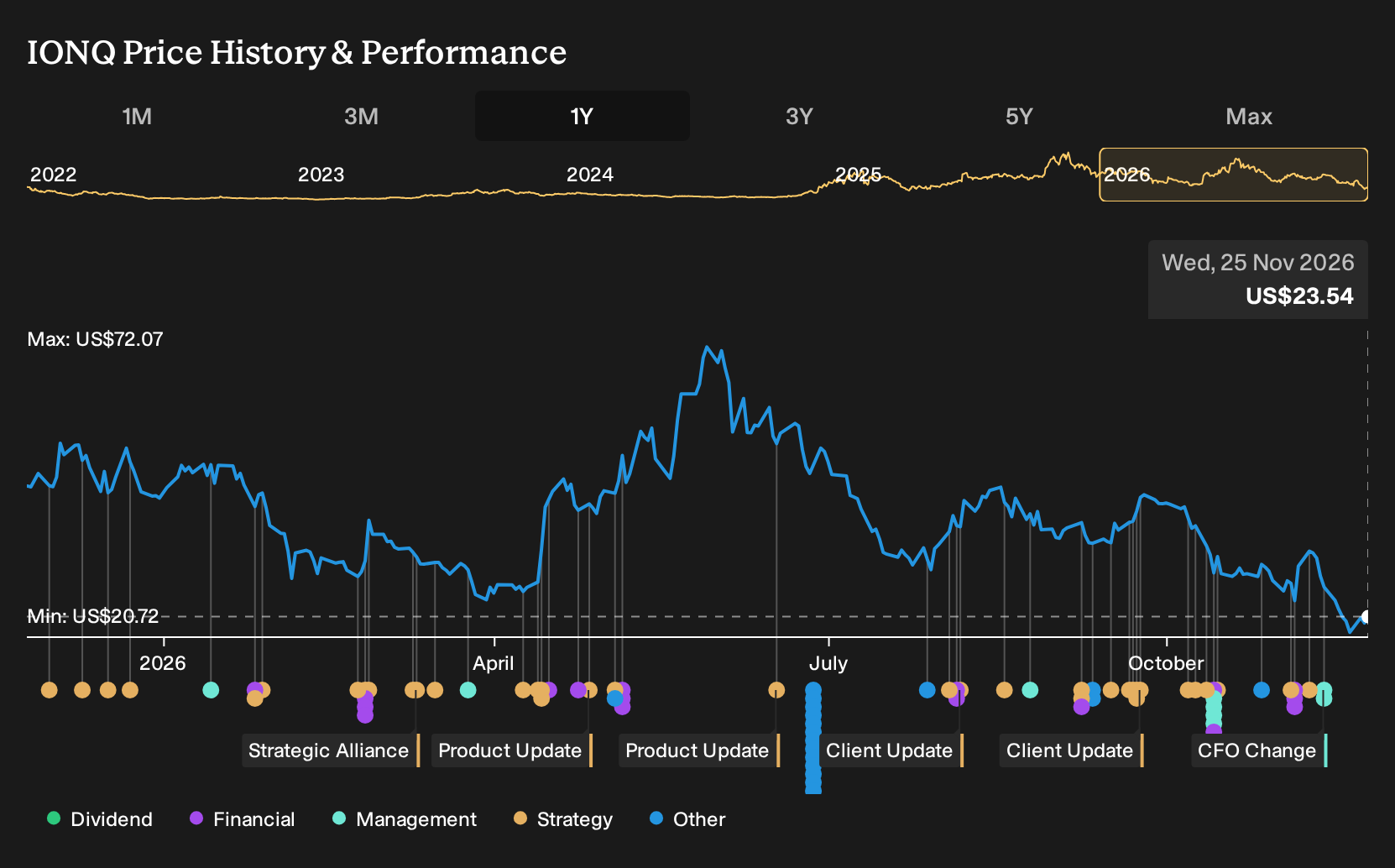
- IonQ appointed Gary Merrill as Chief Financial Officer, Treasurer, principal financial officer and principal accounting officer, and named Thomas Austin as Chief Accounting Officer, adding senior finance leadership with long experience in SaaS, compliance and public company reporting.
- The refreshed finance bench arrives as IonQ reports a sixth straight record quarter, new government contracts including DARPA and higher 2026 revenue guidance, tying operational momentum directly to upgraded financial oversight.
- Now the focus turns to how IonQ’s reinforced finance team and raised 2026 revenue outlook could reshape the longer term investment narrative.
Scan how the IonQ story compares with other quantum players by reviewing the hand-picked 22 quantum computing stocks shaping the next wave of compute and energy-efficient workloads.
IonQ Investment Narrative Recap
To own IonQ, investors need to believe that quantum hardware, networking and sensing can turn current contracts and government work into a durable commercial platform, and that short term volatility in earnings forecasts does not derail that path. According to davidlsander, an investor in the Simply Wall St Community, the big swing factor is execution on a capital light, fabless scaling model.
Right now the key near term catalyst is continued delivery on platform revenue and backlog while integrating chip manufacturing and services. The biggest risk is execution and governance, given forecast earnings declines, high non cash earnings, management turnover and a volatile share price that has fallen about 49% over the past year.
The most relevant piece of context for this CFO and accounting leadership refresh is IonQ’s recent run of record quarters and raised 2026 revenue guidance. That combination puts a lot of pressure on finance systems, controls and investor communication to keep pace with contract growth, government programs and expanding chip manufacturing activity.
New leaders with SaaS, compliance and public company reporting backgrounds arrive as IonQ deals with forecast earnings declines over the next three years, complex non cash items and no customer deposit funding. Stronger financial stewardship could influence how effectively IonQ funds its roadmap, manages dilution and supports the high conviction execution thesis that davidlsander lays out.
In davidlsander’s narrative, IonQ reaches a fair value of $85.00 if revenue compounds at about 267.9% a year and the business eventually settles at a 6.4% profit margin. Together, these assumptions imply a much larger, profitable quantum platform than what current reported numbers reflect.
Uncover why IonQ's fair value indicates a 261% potential upside to its current price that could narrow quickly.
Exploring Other Perspectives
One sharp contrast is dilution risk. The lowest analysts sketch a more cautious IonQ story, where heavy stock issuance weighs on returns even if the technology roadmap holds. Before this CFO news, they were pencilling in revenue of about US$898.6 million and earnings of US$181.8 million by 2029, yet still using a rich 161x P/E. This shows how differently reasonable people can see the same set of numbers and why it helps you to weigh a few competing narratives for yourself.
Explore 11 other IonQ fair value estimates, including one that suggests as much as 79% downside from the current price!
Decide For Yourself
Disagree with existing narratives? Extraordinary investment returns rarely come from following the herd, so trust your own analysis.
- A great starting point for your IonQ research is our analysis highlighting 2 key rewards and 4 important warning signs that could impact your investment decision.
- See our latest analysis for IonQ. The report includes a comprehensive fundamental analysis summarized in a single visual, the Snowflake, making it easy to evaluate IonQ's overall financial health at a glance.
Looking for more investment ideas beyond IonQ?
If the IonQ story has sharpened your thinking and you want to test that framework on other opportunities, the Simply Wall St Screener can help you quickly narrow the field to businesses that better match your risk appetite and return goals.
- For readers who care most about resilience, start with companies that score well on financial strength and balance sheet quality through the 31 resilient stocks with low risk scores.
- If dependable income matters more to you than price swings, focus on businesses with stronger cash flows supporting higher payouts by checking the 11 dividend fortresses.
- Those hunting for underappreciated opportunities may prefer businesses with solid fundamentals that the market has not fully priced by scanning the 20 high quality undiscovered gems.
Have feedback on this article? Concerned about the content? Get in touch with us directly. Alternatively, email editorial-team@simplywallst.com