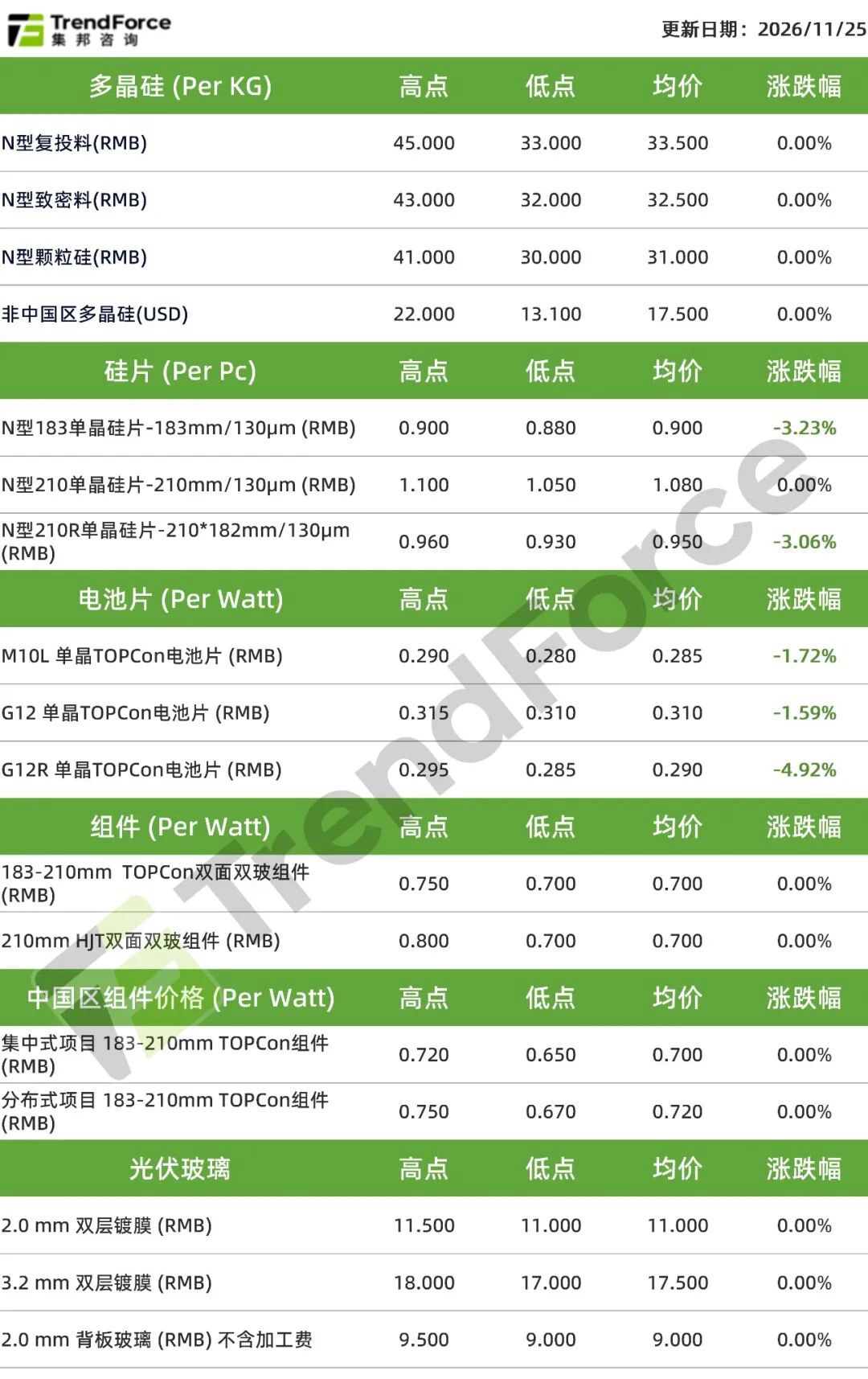
The Zhitong Finance App learned that TrendForce Jibang Consulting published an article stating that currently polysilicon inventory remains above 570,000 tons, and the overpressure on supply and demand is still high. Domestic polysilicon companies continued to cut production this month. Domestic silicon production is expected to drop to around 95,000 tons for the whole month, but compared to the slight excess demand for downstream pulsating crystals, the trend of inventory accumulation is slowing down.
On the demand side, procurement by downstream enterprises is still mainly based on stocks that need to be replenished. Trading activity in the spot market is low. Some polysilicon companies actively reduce prices and promote in the spot market, but prices in the futures market are significantly lower than spot prices, and some companies continue to replenish stocks through futures dealer prices.
As the end of the year approaches, capital and inventory pressure on some companies gradually increases. Combined with downstream demand, the possibility that polysilicon companies will cut prices and ship is increasing, and the risk of a clear and steady decline in overall polysilicon prices has further increased.
silicon wafer
The current silicon wafer inventory remains at around 28 GW, a slight increase from the previous period, and the market price focus continues to decline. Affected by the relatively abundant supply of silicon wafers and the continued weakening of battery prices, bargaining pressure in the silicon wafer sector has become more apparent, and some manufacturers have already experienced low price shipments.
By size, the mainstream price of 183 size silicon wafers was affected by weak supply and demand; the mainstream price dropped to around 0.90 yuan/sheet; the mainstream price of 210R size silicon wafers dropped to around 0.95 yuan/sheet; the 210N size was mainly driven by domestic centralized project demand, and the mainstream price remained around 1.08 yuan/sheet.
Overall, demand for all sizes is fatigued, compounded by the increased risk of falling polysilicon prices. Silicon wafer prices will still operate weakly, but there is limited room for decline.
photovoltaic cells
Photovoltaic cell inventories rose slightly to about 8 days this week, and prices of different sizes continued to diverge.
Among them, 183 size products maintained a weak supply and demand situation, and the price dropped to around 0.285 yuan/W; at the same time, due to the rapid decline in overseas demand, the price of 210R batteries dropped rapidly, and the mainstream transaction price dropped to around 0.29 yuan/W; the supply and demand pattern for 210 size batteries was fair, and the price dropped slightly to around 0.31 yuan/W.
It is worth noting that the current PV battery contract manufacturing model accounts for a high proportion, and the actual transaction price after conversion is generally lower than the market price. In the future, the overall price of photovoltaic cells will remain under pressure under the multiple pressures of weakening prices of silicon wafers and silver and the off-season terminals.
PV modules
Currently, domestic centralized photovoltaic projects are in the installation and completion stage at the end of the year. Orders for 210 size modules are delivered centrally, but demand for products of other sizes is still relatively weak. Most of the terminals are mainly about the delivery of orders that are just needed and that won the bid in the early stages, and the overall trading sentiment is lackluster.
Currently, leading companies charge 0.70-0.72 yuan/W for TopCon components, and second-tier companies maintain prices at around 0.68 yuan/W. There is a gap between high efficiency and medium- and low-efficiency components. However, some major manufacturers have begun to slightly lower prices for high-power components, and there are signs of loosening prices.
In the short term, as the overseas policy window gradually came to an end in November and domestic year-end projects entered the final stage one after another, domestic and foreign market demand showed a contraction trend. Market demand was dominated by stock orders, and follow-up on new orders was insufficient. Under pressure from supply and demand, there is a slight downside risk in prices. However, against the backdrop of increased anti-domestic expectations and heightened awareness of corporate cost control at the policy level, the industry's willingness to stabilize prices has increased. The future focus will be on the implementation of relevant policies and the polysilicon price situation.