


The Zhitong Finance App learned that as market concerns about the return on AI investment continue to ferment, as SoftBank (SFTBY.US) continues to promote large-scale artificial intelligence (AI) investments, its credit risk soared above 500 basis points for the first time in about four years, which also increases the possibility that the company's future financing costs will rise further.
As of 6:30 a.m. Tokyo time on Thursday, SoftBank's 5-year credit default swap (CDS) rose to 516 basis points, the highest level since October 2022, according to compiled data. A dollar bond issued by SoftBank in September had a coupon interest rate of 9.75%, making it the highest-yielding dollar bond in the company's history. Since its issuance, the bond's credit spread has widened by about 40% to about 644 basis points.
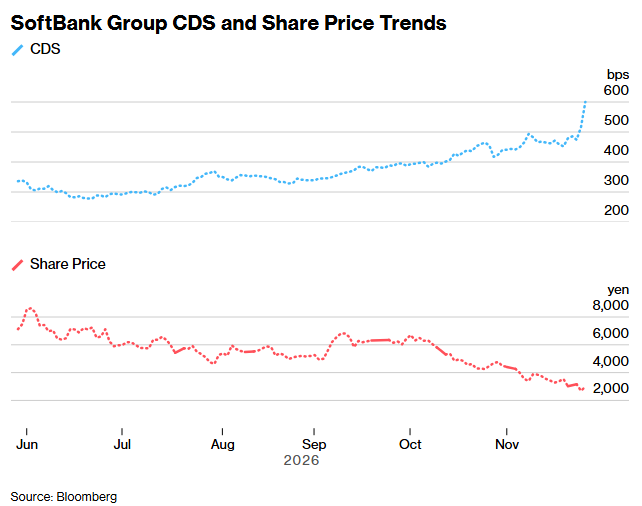
SoftBank CDS and stock price trends
Meanwhile, SoftBank's financial burden is already increasing. The company's financing costs for the July-September quarter increased 2.6 times the previous year to 461.9 billion yen (approximately US$2.9 billion). In the quarter, SoftBank raised about 9 trillion yen.
S&P Global Ratings said this month that SoftBank's key financial indicators are approaching the upper limit its credit ratings can tolerate. The agency estimates that SoftBank's loan-to-value ratio (LTV) has risen to more than 30% and is approaching the 35% rating reduction threshold.
At a time when SoftBank's credit risk is worsening, the AI trading boom is being reversed. The rebound in AI trading triggered by Hwang In-hoon's return to Nvidia lasted only one day. US technology stocks weakened on both Tuesday and Wednesday. After a record listing debut, Anthropic's stock price fell below the initial public offering (IPO) price in less than four trading days. OpenAI, on the other hand, has ruled out the possibility of an IPO this year, further increasing uncertainty about the final valuation and commercialization prospects of SoftBank's huge investment (SoftBank has already invested 64.6 billion US dollars in OpenAI).
The core test facing AI transactions now is that in the past few years, global tech giants have competed to invest hundreds of billions of dollars to build data centers, procure AI chips, expand servers and network equipment, and allocate huge computing power resources to train and run large-scale AI models. But as the scale of capital expenditure continues to expand, investors' focus is shifting from how much capital the company invests to how much additional revenue, profit, and free cash flow these investments can actually generate.
In this context, market questions about the future valuation of OpenAI and whether SoftBank can recoup the investment are deepening. The delay in the listing of OpenAI means that after SoftBank previously invested in OpenAI through large-scale financing, it may lack a clear channel to exit the open market in the short term, and the time taken up by related funds may also be further prolonged. If OpenAI goes public in the future, the relevant shares held by SoftBank will receive more clear liquidity channels. However, the delay in listing means that SoftBank will need to bear financing costs for a longer period of time while waiting for the investment value to be realized.
Widening interest spreads on bonds may also drive up the cost of SoftBank's future bond issuance and refinancing. Masahito Sugawara, senior strategist at Daiwa Securities, said, “The overall expansion trend of the AI business will not change, but it will take longer to commercialize it.” He pointed out that for AI companies that rely on future cash flow to repay debts, delays in the commercialization process may make refinancing more complicated and “cause investors to demand higher credit spreads.”
As Sun Zhengyi's multi-billion dollar AI projects continue to increase, and the future revenue returns these projects can bring are still largely uncertain, investors are increasingly concerned about this surge in spending. From bonds to share mortgages to financing secured by OpenAI shares, SoftBank is raising capital for AI investments in a variety of ways. The increasing number of financing instruments also means that its balance sheet is more sensitive to changes in interest rates, credit spreads, and the valuation of its AI assets. For SoftBank investors, the current core conflict is shifting to “when will AI investments pay off”. With OpenAI's listing schedule unclear, SoftBank's financial situation will be the top focus of investors' attention.