



Wrapping up Q3 earnings, we look at the numbers and key takeaways for the diversified financial services stocks, including Paymentus NYSE:PAY and its peers.
Diversified financial services encompass specialized offerings outside traditional categories. These firms benefit from identifying niche market opportunities, developing tailored financial products, and often facing less direct competition. Challenges include scale limitations, regulatory classification uncertainties, and the need to continuously innovate to maintain market differentiation against larger competitors expanding their offerings.
The 10 diversified financial services stocks we track reported a satisfactory Q3. As a group, revenues beat analysts’ consensus estimates by 0.7% while next quarter’s revenue guidance was 2.2% above.
In light of this news, share prices of the companies have held steady. On average, they are relatively unchanged since the latest earnings results.
Paymentus NYSE:PAY
Founded in 2004 to simplify the complex world of bill payments, Paymentus (NYSE:PAY) provides a cloud-based platform that helps utilities, municipalities, and service providers automate billing and payment processes.
Paymentus reported revenues of $372.2 million, up 19.8% year on year. This print exceeded analysts’ expectations by 3.7%. Overall, it was a very strong quarter for the company with a solid beat of analysts’ EBITDA and EPS estimates.
“Paymentus delivered another strong quarter, with 19.8% year-over-year revenue growth. This revenue performance drove growth in contribution profit and adjusted EBITDA of 20.6% and 38.6%, respectively. Our year-to-date results, combined with strong bookings and a sizable backlog, reinforce our confidence in achieving our 2026 financial targets as well as our outlook for 2027,” said Dushyant Sharma, Founder and CEO.
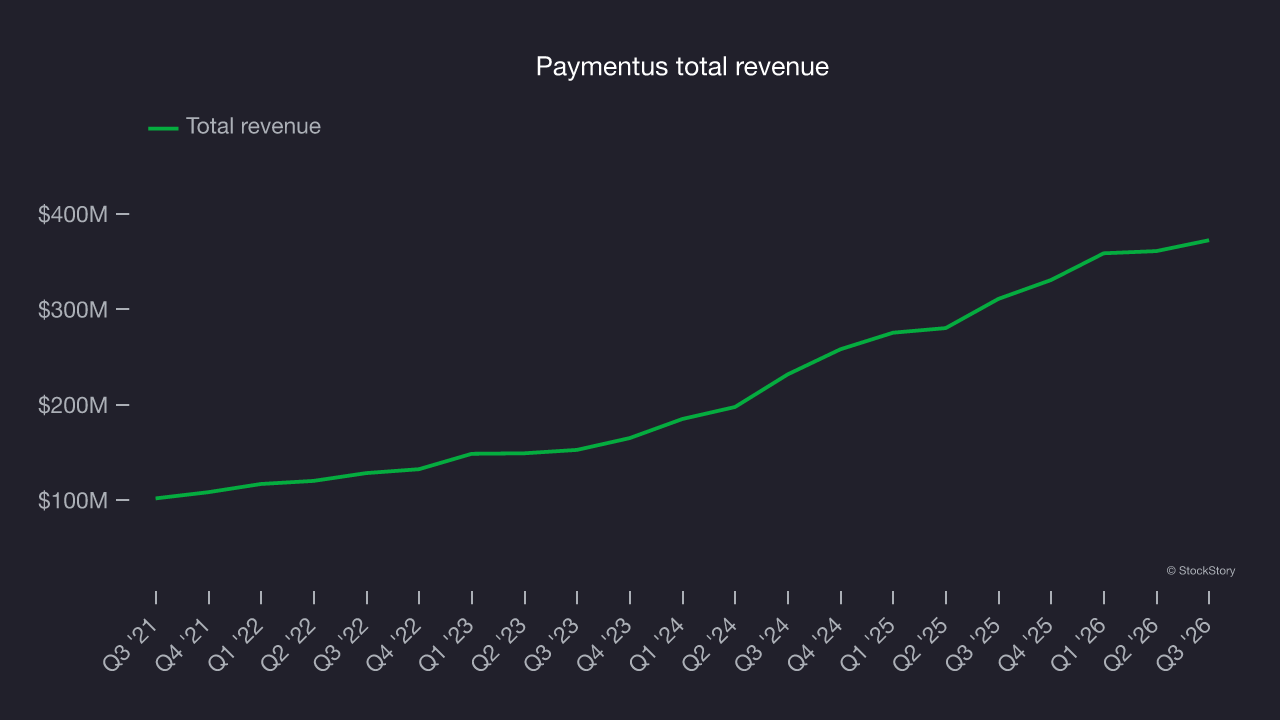
Paymentus scored the fastest revenue growth but had the weakest guidance update among its peers. Investor expectations, however, were likely higher than Wall Street’s published projections, leaving some wishing for even better results (analysts’ consensus estimates are those published by big banks and advisory firms, not the investors who make buy and sell decisions). The stock is down 3.2% since reporting and currently trades at $33.92.
We think Paymentus is a good business, but is it a buy today? Read our full report here, it’s free.
Best Q3: Western Union (NYSE:WU)
With a history dating back to 1851 when it began as a telegraph company, Western Union (NYSE:WU) is a global money transfer service that enables consumers and businesses to send funds across borders and currencies, typically within minutes.
Western Union reported revenues of $1.01 billion, down 2.3% year on year, falling short of analysts’ expectations by 1.2%. However, the business still had a very strong quarter with a beat of analysts’ EPS estimates and full-year EPS guidance exceeding analysts’ expectations.
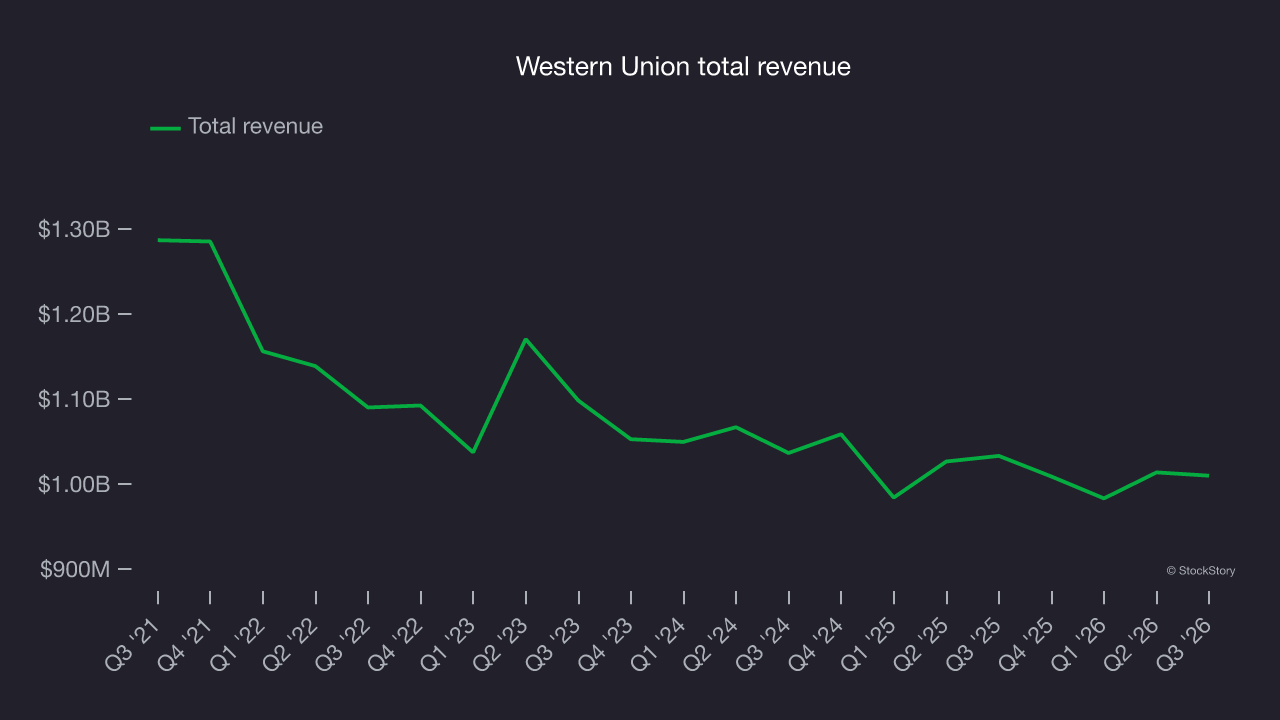
Although it had a fine quarter compared to its peers, the market seems unhappy with the results as the stock is down 4% since reporting. It currently trades at $6.33.
Is now the time to buy Western Union? Access our full analysis of the earnings results here, it’s free.
Weakest Q3: Payoneer (NASDAQ:PAYO)
Founded during the early days of global e-commerce in 2005 to solve international payment challenges, Payoneer (NASDAQ:PAYO) provides financial technology services that enable small and medium-sized businesses to send and receive payments globally across borders.
Payoneer reported revenues of $276.9 million, up 2.2% year on year, falling short of analysts’ expectations by 2.8%. It was an underwhelming quarter as it posted a significant miss of analysts’ EBITDA and yield estimates.
The stock is flat since the results and currently trades at $7.19.
Read our full analysis of Payoneer’s results here.
WEX (NYSE:WEX)
Originally founded in 1983 as Wright Express to serve the fleet card market, WEX (NYSE:WEX) provides payment processing and business solutions across fleet management, employee benefits, and corporate payments sectors.
WEX reported revenues of $780.1 million, up 12.8% year on year. This result beat analysts’ expectations by 3.2%. It was a very strong quarter as it also produced full-year EPS guidance exceeding analysts’ expectations and a solid beat of analysts’ EBITDA estimates.
WEX achieved the highest full-year guidance raise of the whole group. The stock is down 2.7% since reporting and currently trades at $184.27.
Read our full, actionable report on WEX here, it’s free.
PayPal (NASDAQ:PYPL)
Originally spun off from eBay in 2015 after being acquired by the auction giant in 2002, PayPal (NASDAQ:PYPL) operates a global digital payments platform that enables consumers and merchants to send, receive, and process payments online and in person.
PayPal reported revenues of $8.58 billion, up 2% year on year. This number came in 1.4% below analysts’ expectations. Aside from that, it was a solid quarter as it produced a solid beat of analysts’ EBITDA estimates and full-year EPS guidance exceeding analysts’ expectations.
The stock is up 5.1% since reporting and currently trades at $57.79.
Read our full, actionable report on PayPal here, it’s free.
Market update
Over the past year, investors have been forced to repeatedly answer the same question: What is the market’s biggest risk? The answer has changed several times, and each shift has reshaped market leadership.
Late in 2025 and early 2026, artificial intelligence became the market’s primary uncertainty. Investors questioned whether AI would erode software pricing power and weaken competitive moats as AI made it easier to replicate once-differentiated products.
By the spring, technology took a back seat to geopolitics. The U.S. conflict with Iran briefly became the market’s dominant narrative, raising concerns about oil prices, inflation, and global growth. But as energy markets remained orderly and fears of a prolonged supply disruption faded, investors quickly turned their focus back to fundamentals.
Want to invest in winners with rock-solid fundamentals? Check out our Top 6 Stocks and add them to your watchlist. These companies are poised for growth regardless of the political or macroeconomic climate.