


The Zhitong Finance App learned that as competition in the industry heats up and the boosting effect of interest rate hikes on profits continues to weaken, the Bank of Japan sector is facing increasing pressure to settle profits.
The Japanese banking sector was once the biggest beneficiary of the Bank of Japan's withdrawal from the ultra-low interest rate policy, but now it is facing a new problem: deposit growth is slowing down. Banks compete fiercely to stabilize deposits, and the upward rate of capital costs may accelerate, encroaching on profit increases brought about by previous increases in loan interest rates.
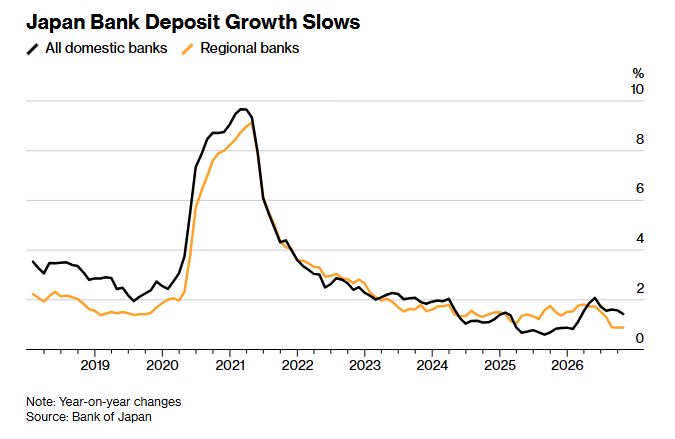
Bank of Japan data showed that the growth rate of deposits in the Japanese banking sector fell to 1.4% in October, the lowest in eight months. The slowdown in local banks is particularly prominent. In the past three months, deposits only increased by about 0.9% year on year, hitting a 20-year low.
Teruhiko Nishimura (Teruhiko Nishimura), CEO of RFM, a hedge fund focused on Japanese stocks, said the household sector is withdrawing deposits against the backdrop of continued inflation. “The weakening of bank stocks essentially reflects a slowdown in endogenous growth.”
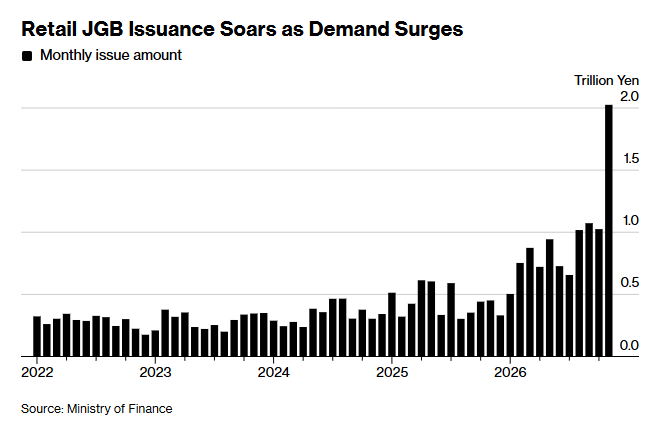
The popularity of Japanese treasury bonds, which target individual investors and whose yield is higher than bank deposits, is rising, forcing banks to raise interest rates on deposits. This type of personal treasury bond can be paid after one year of holding it, making a strong alternative to bank time deposits. The distribution scale of this product surged this year, surpassing 2 trillion yen (equivalent to 12.6 billion US dollars) this month, more than quadrupling from the previous year.
Nana Otsuki (Nana Otsuki), a senior researcher at the Japanese branch of Switzerland's Pictet Group (Pictet Group), believes that compared to private banks, government credit security is higher, and deposit interest rates ultimately need to be higher than treasury bond yields to retain capital.
Some analysts pointed out that the glorious era of bank stocks may come to an end. Macro capital, which previously fueled this round of markets, is re-examining the simple logic of “interest rate hikes = upward bank profits”; many investors previously placed local banks simply because a large number of targets were still in a broken state.
Once higher capital costs drag down profits less than expected, investors may concentrate on closing positions. The banking sector has fallen by about 17% since its high on September 28, about twice that of the Topix Index (Topix). Prior to this round of retracement, the cumulative increase in bank stocks over the past four years was close to 400%.
Bruce Kirk (Bruce Kirk), Japan's chief stock strategist at Goldman Sachs Securities, downgraded the banking industry rating from “overrated” to “standard” this month. Previously, he had maintained a bullish banking sector for four years.
Kirk said, “There is a large amount of macro-allocated capital in the banking sector.” At the same time, he warned that if bank stock trends continue to fluctuate, stock funds may shift to other sectors.