


After CXO led the strengthening of Hong Kong Pharmaceuticals on November 23, Hong Kong Pharmaceuticals ended a multi-day continuous decline.
The Zhitong Finance App observed that on the same day, driven by a rebound in the CXO sector, the Hong Kong Stock Connect Healthcare ETF Huabao (159137) index surged more than 4% in the afternoon and closed up 3.05%, ending the previous 8 consecutive declines. The recovery in market sentiment brought about by CXO's lead rise was also obvious. The Hang Seng Healthcare Index (800804) stabilized around 3,200 points during the 3 trading days from November 24 to 26, and the steady trend was obvious.
For Ted Pharmaceuticals (03880), which is in the phase of retracement and adjustment, the positive push of sector beta may become an important supporting force for the stabilization of the company's stock price when many technical oversold indicators are intensively resonating.
Positive guidance from CXO plate beta
The recent recovery in the pharmaceutical sector of Hong Kong stocks can actually be traced.
The Zhitong Finance App observed that along with the Federal Reserve's interest rate hike, the yield on long-term US bonds rose markedly, and the global high-valued assets, especially the AI-related technology sector, fluctuated markedly. Meanwhile, in the Hong Kong stock market, according to statistics from Guojin Securities's Hong Kong Stock Fund's three-quarter report, it showed the characteristics of “index fluctuations and structural differentiation” in the 26Q3 quarter. The “high and low cut” of capital was obvious: the Hong Kong stock fund allocation technology sector declined sharply by 4.99 percentage points from month to month, and the pharmaceutical sector increased by 4.10 percentage points from month to month.
Behind this, on the one hand, it has benefited from global CXO simultaneous upward guidance. According to the data, Samsung Biotech's revenue for the Q3 quarter of this year increased 24% year on year, and the 2026 revenue guidance was raised from 15% to 20%; IQVIAR&DS and Medpace's net new signing growth rates for the third quarter were 15% and 10.6%, respectively; Labcorp Central Laboratory's revenue increased 11.5%, raising revenue guidance.
On the other hand, domestic public funds that heavily stock CXO in advance are also an important driver for stabilizing the pharmaceutical sector this time.
In fact, the current market is not an overall recovery in the pharmaceutical sector, but rather the result of 26Q3 public fund pharmaceuticals increasing their holdings in the CXO sector. Statistics show that in the Q1-Q3 quarter of this year, pharmaceuticals accounted for 8.85%, 6.56%, and 9.98% of all public fund holdings, respectively. Among them, the share of pharmaceutical holdings in Q3 rose sharply by 3.42 percentage points compared to Q2.
However, the positions of public funds in the pharmaceutical industry are not “casting a wide net”; instead, they choose to be highly concentrated in the CXO industry.
According to the Huaan Securities Research Report, the CXO sector jumped from 1.84% to 3.80% of the total market value of 26Q3 public funds, accounting for 38.0% of heavy pharmaceutical holdings, and the overallocation margin further increased from +16.6 percentage points in Q2 to +23.9 percentage points. As a result, CXO became the only “overmatched and growing” sector in the 16 tertiary industries, and replaced chemical preparations as the largest tertiary pharmaceutical industry.
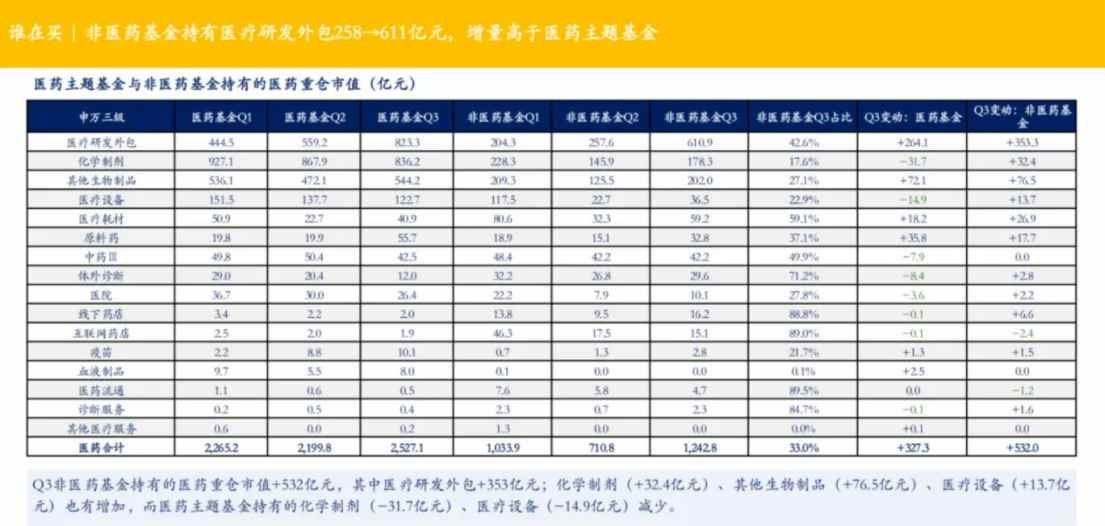
It is worth mentioning that a large part of the increase in the market value of heavy pharmaceutical holdings in public funds comes from active increases in institutional positions. Research data shows that in the Q3 quarter, the overall market value of heavy pharmaceutical holdings of public funds increased by about 85.9 billion yuan, of which the increase and decrease in holdings contributed +34 billion yuan. In other words, public funds maintained a net increase in the overall pharmaceutical sector in the current period, but the increase in the market value of their heavy holdings was mainly due to an increase in the stock price of their holdings.
However, in terms of funding details, the net increase in CXO's holdings of 29.1 billion yuan highlights the public fund's preference for this segmented circuit. On the other hand, its current operation on chemical agents was a net reduction.
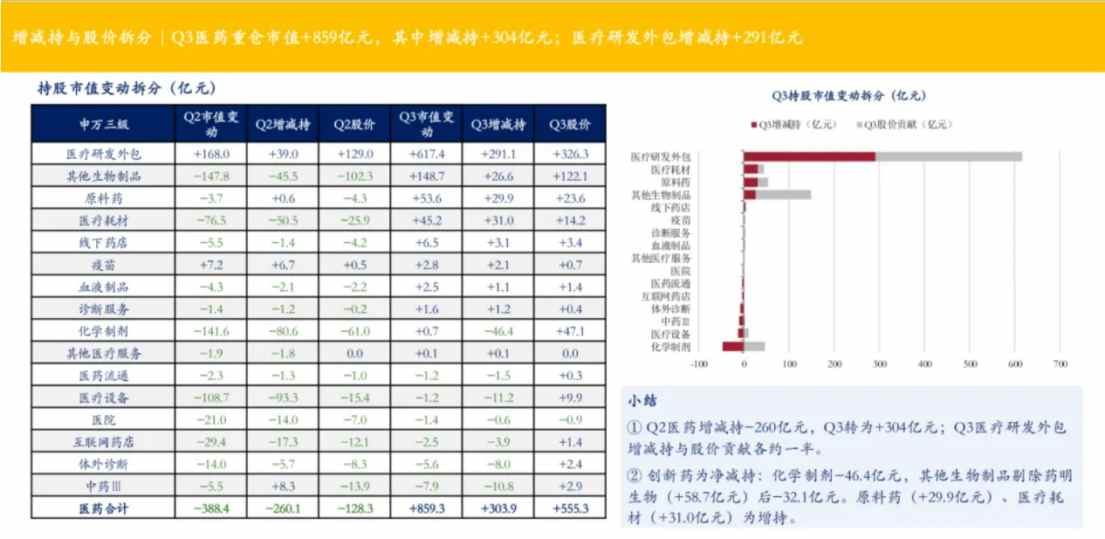
In terms of the concentration of target holdings, although the concentration of public funds in the top three targets is still as high as 77.6%, at the same time, the number of target holdings in the CXO sector has increased from 29 to 33. The spillover effect of capital within the CXO sector has undoubtedly played a role as a weather vane for other investors in the market.
Can the intensive resonance of overselling bring short-term opportunities?
Back to Ted Pharmaceuticals, since August, its overall market has shown a fluctuating downward trend dominated by technology.
The reason for this is that the company's announcement at the end of July caused a lack of fundamentals. While the market continues to absorb concerns about the decline in mid-term performance and the pace of order confirmation, technical indicators have to a certain extent become an important weather vane guiding its stock price trend at this stage.
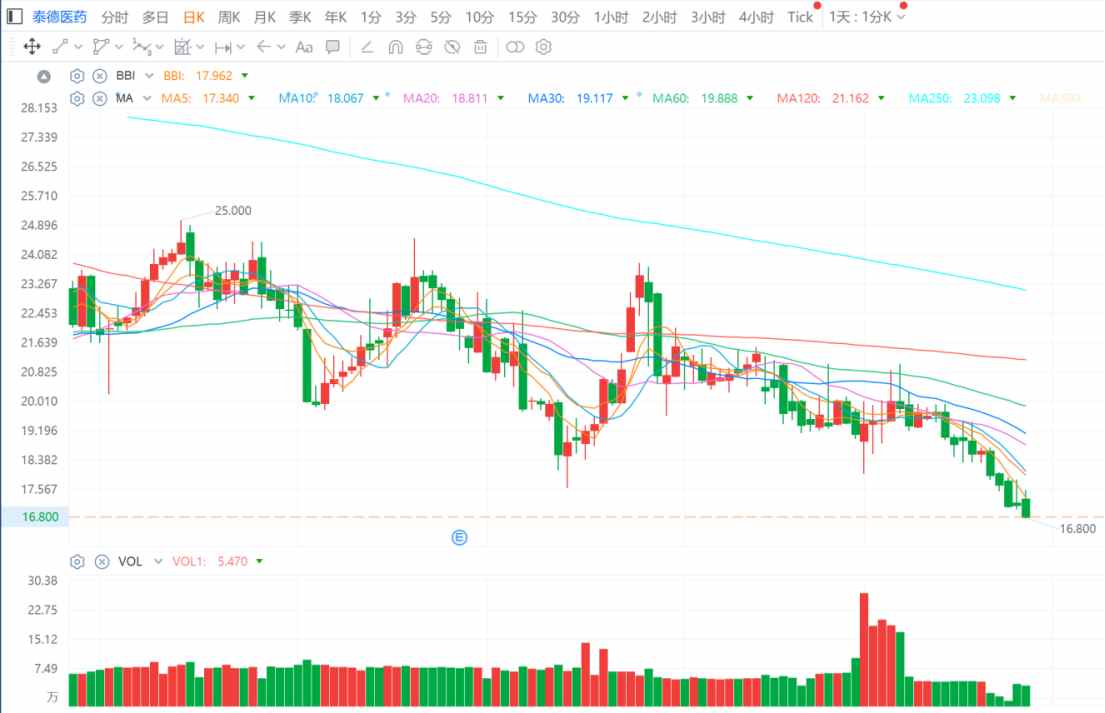
According to the Zhitong Finance App, since November 13, with the classic bearish arrangement in the moving average system, the moving average trend has been consistently downward in every cycle, and Ted Pharma's current stock price has entered a clear bearish trend.
As of November 26, its MACD indicators showed that the DIF and DEA lines were running deep in the empty area below the zero axis, and DIF was still at a record low; the KDJ-J value on the same day was -6.5, which had already penetrated the extremely oversold area below zero for the 5th consecutive trading day; in terms of RSI indicators, RSI 6 had fallen to around 11 on the same day, falling below the 20 threshold for 4 consecutive trading days and entering the oversold zone for 3 RSI indicators.
Looking at the volume and price structure, between November 13 and 26, Ted Pharma's average daily trading volume shrank from 65,800 shares in the first half (13th to 19th) to 34,900 shares in the second half (20th to 26th), reaching 46.9% month-on-month contraction.
In other words, in the recent decline in Ted Pharma's stock price, although its stock price has continued to decline, there has been no cliff-style exodus. On the one hand, it shows that pressure has been thrown out or weakened within Ted Pharmaceuticals and that the main capital has not been shipped on a large scale; on the other hand, it also means that it currently lacks incremental capital to enter the market.
According to the chip structure, compared with Ted Pharmaceuticals's in-market chip structure on September 24 and November 26, it can be seen that although the company's stock price continued to decline during these 2 months, the main capital in the market remained locked at HK$20-21. The difference is that the chips above and below the cost line have all changed significantly, indicating that during the continuous fluctuation process, Ted Pharmaceuticals continued to “lock in” or “do T” funders, so the overall chips scattered around the cost average.
However, despite the recent resonance of oversold indicators in Ted Pharmaceuticals, signs of partial bottoming divergence still indicate the possibility of a short-term rebound in stock prices.
The Zhitong Finance App observed that on November 25, when the company's intraday stock price hit a new low of HK$17.05 on the same day, its KDJ-J value rebounded from -7.98 to -5.28. At the same time, the CCI index also rebounded from -158.16 to -135.07, forming a local bottom divergence signal with a new price low but not a new low in the momentum index. This also became one of the few bullish signals in Tide Pharmaceuticals technical indicators since November 13.
From a technical perspective, although the current bearish structure of Ted Pharma's stock price has not changed significantly, the probability of a short-term rebound in Ted Pharma's stock price may continue to expand under the positive guidance of sector beta and the “extreme overselling+bottom divergence” signal, if the MACD index subsequently turns DIF, amplifies moderately, and the company's stock price stabilizes at the 5-day EMA.