


The Zhitong Finance App learned that the International Monetary Fund (IMF) said that if upward pressure on prices continues, the Australian monetary authority should be prepared to raise interest rates again; at the same time, it calls on the Australian government to fulfill its promises and tighten fiscal policy.
The IMF stated in the “2026 Australian Article IV Consultation Report”: “If inflation experiences an upward shock, including further escalation of the situation in the Middle East and prolonged high energy prices, it is necessary to further tighten monetary policy. Against the backdrop of successive multiple shocks and inflation being higher than the target range for several years, there is also a risk that inflation expectations will be unanchored.”
Judging from the content of the report, negotiations between the IMF and the Australian authorities predate the recent rate hike by the Reserve Bank of Australia: the article mentioned that the cumulative tightening during the year was 100 basis points, and after the implementation of this month's rate hike, the actual rate hike reached 125 basis points.
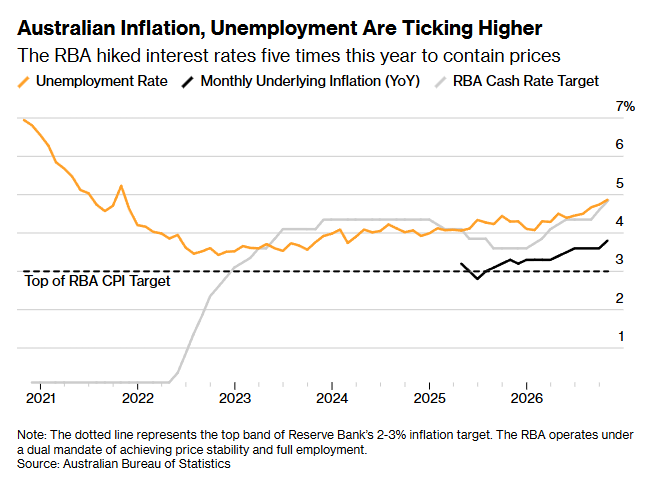
Earlier this month, the Reserve Bank of Australia raised the cash rate to 4.85%, a record 18-year high; the decision was not unanimously passed. Dissenting members feared that the Australian economy might experience a deeper decline. Even so, this aggressive cycle of austerity has failed to suppress price pressure brought about by domestic production capacity bottlenecks and the global energy shock caused by the US-Iran conflict.
According to data released on Wednesday, Australia's overall CPI growth rate rose to 4.9% year-on-year in October, higher than market expectations, and core inflation performance also weakened.
The IMF raised Australia's overall inflation forecast slightly to 4% this year, keeping the 2027 CPI growth forecast unchanged at 3.1%; at the same time, it raised the unemployment rate forecast for next year to 4.9%. This value is in line with the October unemployment rate data released last week.
At the fiscal level, the IMF believes that Australia's fiscal policy is shifting towards consolidation. The general direction is reasonable, but emphasizes the importance of implementing expenditure control commitments. The report reads: “The 2026/27 federal and state budgets have refocused on controlling structural spending in the medium term. The direction is right; however, if we want to achieve a sustainable fiscal balance, we still need to persevere for a long time.”
The IMF confirmed the Australian Government's abolition of long-term landlord tax incentives for existing homes, which previously included provisions such as capital gains tax relief and rent loss tax deductions. However, the IMF is still calling for more tax reform to improve the efficiency of the tax system and help the economy grow. Among them, it has once again put forward cliché proposals to expand the consumption tax base and reduce dependence on income tax. Due to concerns about voter backlash, Australia's opposition parties have been avoiding such reform proposals.
In terms of the financial system, the IMF assessed the overall stability of the Australian financial system, but there are some weak points. The IMF said, “In an environment where interest rates are rising and the property market is weakening, housing mortgages account for about 60% of bank credit, which is a major risk point. The relatively high share of floating interest rate loans further amplifies hidden dangers. Residents' debt levels remain high, and planned mortgage repayments already account for about 10% of residents' disposable income.”
At the same time, the report urges Australia to speed up implementation of a reform agenda to boost productivity, pointing out that Australia's per capita GDP growth rate has slowed significantly over the past few decades, and labor productivity has stagnated. Dragged down by weak productivity, the Reserve Bank of Australia has lowered the threshold for potential economic growth — that is, a level where exceeding this growth rate can easily cause inflation, from about 3% 20 years ago to 2%.
The IMF mentioned that the Australian economy is highly dependent on mining exports, and sharp fluctuations in commodity prices are dragging down productivity; at the same time, the vitality of local Australian businesses has declined.
The IMF said, “Enterprise-level data shows that the vitality of local cutting-edge technology companies is weakening, and the pace of catching up with the global technological frontier is limited. Leading enterprises (cutting-edge enterprises) with labor productivity in the top 10% of the industry have had an advantage for a long time, reflecting insufficient competitive pressure in the market and the slow spread of technology and management models that can improve productivity.”