


Qfin Holdings has seen its share price fall sharply this year, which naturally puts a spotlight on whether the current market value lines up with what its earnings can support. After a series of tough trading months and fresh financial disclosures, the central issue for you as a shareholder or potential buyer is how much profit power this business is being priced for today.
- The stock is down about 77.6% year to date, which puts the focus squarely on whether the recent slide has already reset expectations to match the underlying earnings profile.
- Management has called out an industry wide liquidity squeeze and tighter regulation that have led to a smaller loan book and weaker risk performance, which can influence how reliable and sustainable Qfin Holdings' future earnings stream looks.
- There is a second opinion on Qfin Holdings worth weighing. See what analysts think Qfin Holdings's shares could be worth.
The stock's next move may depend on whether the current price fairly reflects the earnings Qfin Holdings is generating today and is expected to produce over time.
If you want to stress test whether Qfin Holdings' earnings based valuation question is unique, compare it with a wider set of companies using the 37 high quality undervalued stocks
Is Qfin Holdings Still Cheap on Earnings?
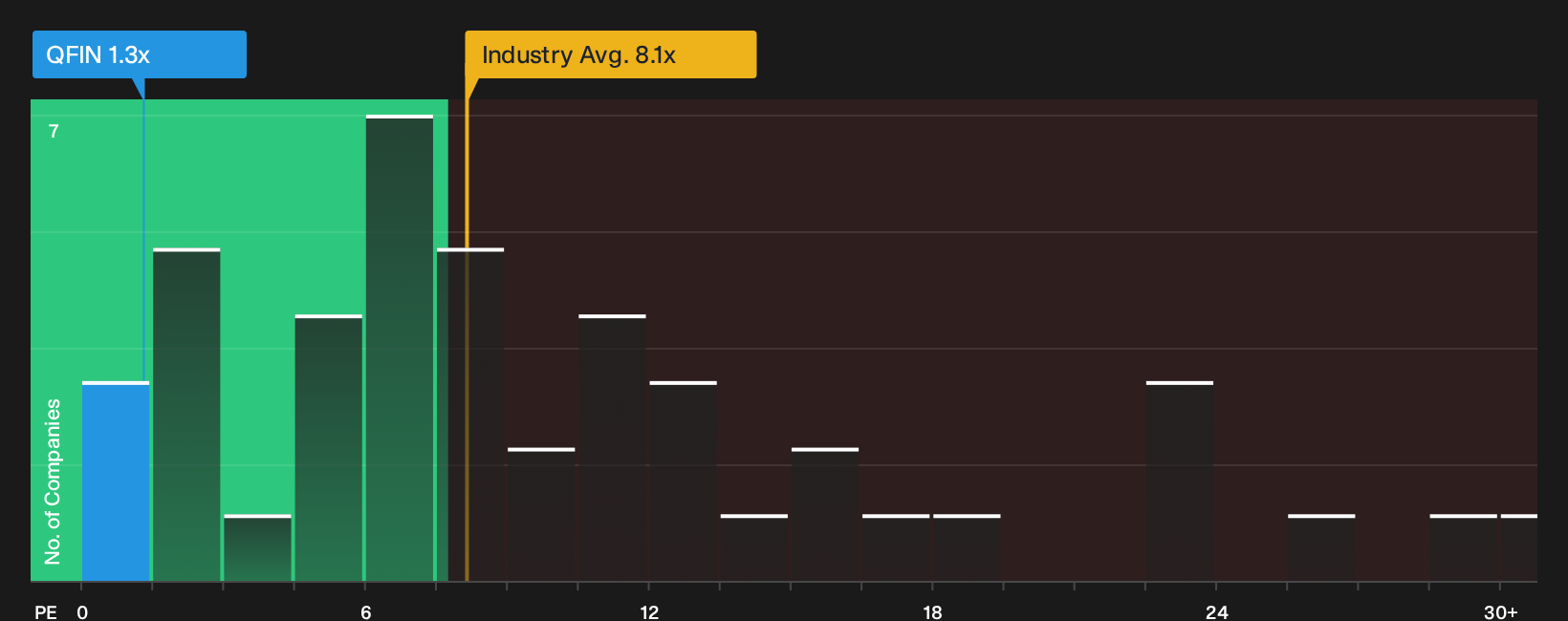
The P/E ratio suits Qfin Holdings because earnings remain the main anchor for how this lender is being priced. On current numbers the stock trades at about 1.3x P/E, compared with roughly 8.1x for the wider consumer finance industry and around 7.2x for peers in the same space. That is a steep discount on headline earnings.
Because the fair multiple implied by Qfin Holdings’ own profile sits above the present 1.3x level, the shares screen as undervalued on this earnings yardstick. The recent third quarter 2026 update pointed to a liquidity squeeze and tighter regulation. Yet despite those issues, the market is still valuing each dollar of profit well below what the model suggests might be typical for this kind of business. This gap points you back to the underlying risks, earnings quality and regulatory overhang that need to be weighed to judge whether the discount is deserved or whether it hints at mispricing. Explore the numbers behind Qfin Holdings's P/E valuation.
The Qfin Holdings Narrative: What Would Justify Today's Price?
Simply Wall St Narratives for Qfin Holdings pick up where the valuation questions above leave off, by spelling out which future paths for growth, margins and earnings would need to play out for the current price to look either conservative or demanding. Instead of a single P/E or valuation output, Narratives break out the specific earnings paths and business conditions that those numbers rest on, so you can check over time whether reality is tracking the story you are effectively paying for.
Bulls lean on Qfin Holdings’ tech shift and capital light model, while bears focus on stressed credit metrics and legal overhang.
Bull case: 68% undervalued
This view comes from the analyst consensus Narrative on Simply Wall St, which pulls together Street forecasts and targets.
"Expansion of Qfin Holdings' capital light tech solutions business, where enabled loan volumes reached RMB 10.5b in Q2 2026 and outstanding balances were RMB 16.1b, points to a growing fee based revenue stream that does not require the company to put as much capital at risk..."
Discover why this Narrative puts Qfin Holdings at 68% undervalued.
Bear case: 33% overvalued
This angle is set out in the bearish analyst Narrative on Simply Wall St, which leans on the lowest targets and assumptions.
"Although Qfin Holdings is expanding capital light technology solutions for banks with tech solutions enabled loan volume of RMB 10.5b and outstanding balances of RMB 16.1b by Q2 2026, the sharp fall in total net revenue to RMB 3.57b and non GAAP net profit to RMB 455m over the same period suggests fee income may not be scaling fast enough to offset pressure from the core credit business..."
Explore why this Narrative puts Qfin Holdings at 33% overvalued.
One last Qfin Holdings check that sits beyond the share price chart
Price and earnings only tell part of the story for Qfin Holdings, since the research also flags specific risk checks that deserve your attention before you lean on any valuation work. Take a closer look at 4 warning signs (1 major) before settling on a valuation.
Have feedback on this article? Concerned about the content? Get in touch with us directly. Alternatively, email editorial-team@simplywallst.com