


Why Zodia Custody’s data breach matters for Standard Chartered
Zodia Custody, backed by Standard Chartered (LSE:STAN), has reported a security incident that exposed some institutional client and employee contact details. No unauthorized transactions have been identified. However, phishing risk and governance questions are now in focus.
Standard Chartered’s share price has slipped over the past quarter, with a 90 day share price return of 13.41% and a 30 day return of 6.64%, even though the year to date share price return is 2.22% and the 1 year total shareholder return is 16.52%.
Contrast the Zodia incident with banks and financials that currently screen well on operational strength by scanning 8 resilient stocks with low risk scores as a curated starting universe.
Standard Chartered’s recent share price slide over 30 and 90 days contrasts with stronger 1 year and multi year returns. The key question is whether markets are reacting to fundamentals or whether sentiment has simply swung too far, potentially setting up a valuation reset.
Most Popular Narrative: 25% Undervalued
The analyst consensus Narrative on Simply Wall St points to a fair value of £25.00 for Standard Chartered, compared with a last close of £18.85. This frames the current pullback against a higher long run earnings and cash flow profile that Zodia related headlines do not fully address on their own.
Expansion of digital infrastructure and regulated digital asset activities, including a cloud based core banking roll out, a centralised AI platform and full ownership of Zodia Custody alongside tokenised deposits and stablecoin related flows of around US$11b per month, opens additional transaction and custody revenue streams that can support income growth.
See why 51 investors see Standard Chartered as 25% undervalued.
Result: Fair Value of £25.00 (UNDERVALUED)
Still, the consensus around Standard Chartered depends heavily on affluent wealth inflows and higher future P/E assumptions. Any slowdown in those areas could quickly challenge this undervalued narrative.
Find out about the key risks to this Standard Chartered narrative.
Another view on Standard Chartered’s valuation
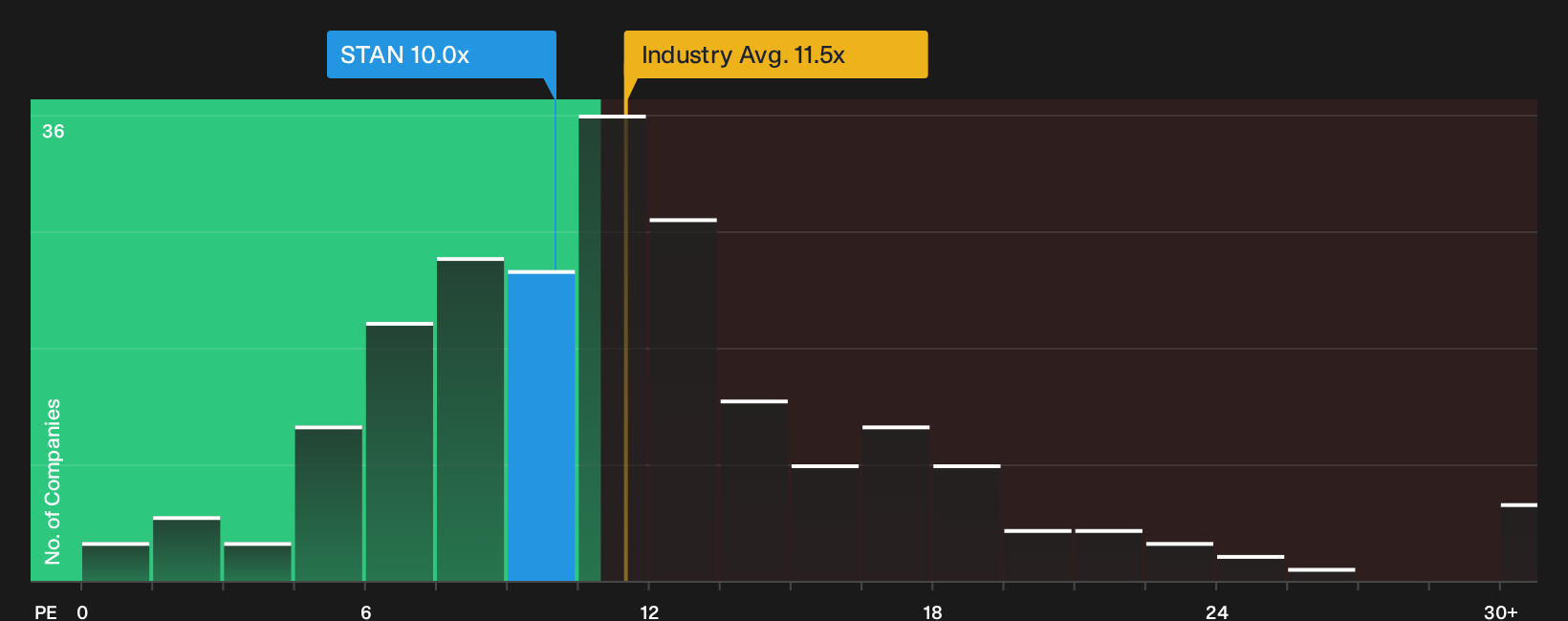
The story looks quite different once you leave fair value models behind and focus on the current P/E. Standard Chartered trades on roughly 10x earnings, compared with 11.2x for European banks, yet the fair ratio for the stock is 8.5x. That gap suggests both a valuation cushion relative to the sector and the possibility that the share price could drift toward the fair ratio if expectations cool. Which reference point do you treat as your anchor?
See what the numbers say about this price — find out in our valuation breakdown.
Next Steps
Mixed signals on Standard Chartered can be confusing, so move quickly to test the numbers, weigh the trade offs, and then judge the balance of 4 key rewards and 3 important warning signs
Looking for more investment ideas beyond Standard Chartered?
If you stop with Standard Chartered, you risk missing other opportunities that might fit your goals even better across quality, value, and income focused approaches.
- Target potential mispricing by scanning companies flagged as 17 high quality undervalued stocks that pair strong fundamentals with prices that may not fully reflect their underlying strength.
- Sharpen your focus on resilience by reviewing a list of solid balance sheet and fundamentals (7 results) so you can prioritise businesses with healthier financial footing.
- Hunt for future leaders by checking a 4 high quality undiscovered gems that highlights quality companies flying under most investors’ radar.
Have feedback on this article? Concerned about the content? Get in touch with us directly. Alternatively, email editorial-team@simplywallst.com