


The Zhitong Finance App learned that during the Asian trading session on November 27, the US treasury bond market resumed trading after Thanksgiving. Asian technology stocks continued their rebound at the end of Wednesday. S&P 500 futures rose more than 1% and Nasdaq 100 futures rose more than 2%. As investors re-embraced AI computing power and semiconductor-dominated technology stock type risk assets, the yield on US bonds rose by at least 4 basis points for each term, while the 10-year yield once rose by 9 basis points to around 4.92%, almost back to the recent high level of last Friday.
This sharp shock in global technology stocks began with Nvidia, and then experienced two tests of sell-off pressure. On November 23, Hwang In-hoon was reinstated as CEO of Nvidia. Nvidia soared 31.48% on the same day, the Philadelphia Semiconductor Index rose 14.03%, and the Nasdaq Composite Index and the S&P 500 Index rose 6.51% and 4.73% respectively.
Since then, the fee halved by 7.88% on Wednesday, and the NASDAQ Composite Index and the S&P 500 fell 1.48% and 0.50%, respectively. On Wednesday, US stocks were sold off again in the intraday period. The Fee Half, NASDAQ Composite Index, and S&P 500 fell by nearly 8%, 4.6%, and 3.2% respectively, but the closing declines narrowed to 0.65%, 0.62%, and 0.25%, respectively. The S&P 500 reported 7,182.78 points. The Dow rebounded from an intraday decline of about 1,105 points to close at 164.25 points to 50,182.95 points. Monday's rise reflected the market's reaction to Hwang In-hoon's return. Wednesday's trend showed that even if the first round of buying brought about by the news subsided, those AI computing power and semiconductor stocks, which are bullish in the market, can still attract capital acceptance even after a sharp decline.
The Asian market took over this round of rebound on Friday, but there was a clear difference in increase. In contrast, the US bond market, which recently flooded with capital due to a strong “safe-haven aura,” has fallen into a downward price trajectory. The Korea Composite Index closed up 4.34% to 4,915.68 points, while the Nikkei 225 Index closed up 2.11% to 58,711.11 points. Taiwan's weighted index closed up 0.40% to 39,308.08 points, with TSMC rising 1.63%. The A-share technology sector is more flexible. The Science and Technology Innovation 50 and GEM indices rose 4.43% and 3.79% in the afternoon, respectively. At one point, intraday gains in the afternoon extended to more than 15% and about 12%, respectively. A-shares also have local catalysts. The executive meeting of the State Council proposed increasing the role of the “national team” in stabilizing the market and further optimizing the Central Remittance's “equalization fund” function. The main indices accelerated upward after the news was announced.
US Treasury bonds fall, and a sharp rise in technology stocks weakens safe-haven demand
As Asian technology stocks relayed the “deep V” of US stocks, safe-haven purchases of US bonds can be described as cooling down drastically. The current focus of the market on US bonds is how far can AI computing power and the rebound in semiconductor-led technology go after the 10-year yield returns to 4.91%?
The US Treasury bond market resumed trading after the Thanksgiving holiday. The Asian stock market, especially the South Korean stock market and the Chinese stock market, which have an absolute leading position with AI computing power and semiconductor themes, have risen sharply, which can be described as significantly weakening investors' demand for safe-haven assets. US bonds fell during the relatively quiet trading volume of US bonds during the Asian market session on Friday.
On the US Treasury yield curve, the yield for each term rose by at least 7 basis points, and the yield on the benchmark 10-year treasury bond rose 9 basis points to around 4.92% at one point. After experiencing several changes in artificial intelligence-related transactions, the Asian stock market continued to rebound, and risk appetite initially rebounded, prompting investors to reduce their safe-haven allocation to US Treasury bonds.
Prashant Nunaha, a senior strategist at TD Securities, said, “The sharp rebound in US technology stocks at the end of Wednesday continued into the Thursday and Friday trading sessions in the Asian market. Improved risk sentiment was the main factor driving the slight increase in bond yields. The New York bond market will close early at 2 p.m. local time, and transactions are currently light.”
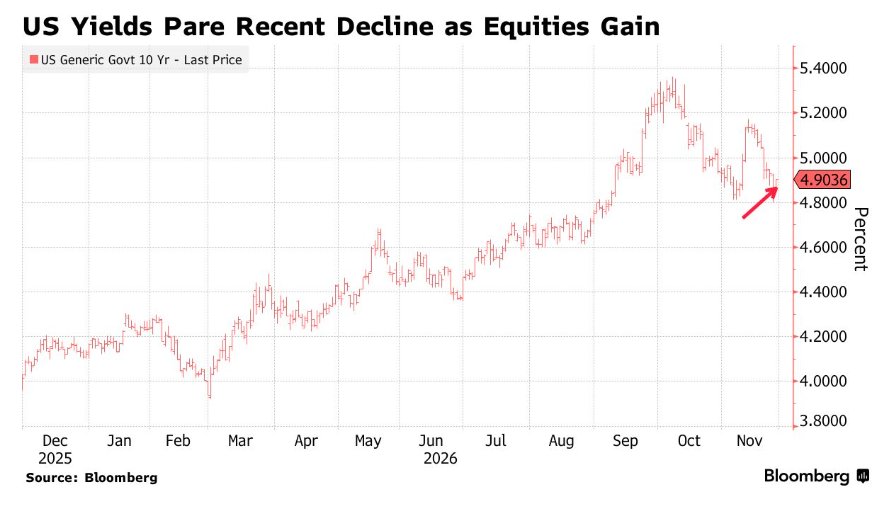
As shown in the chart above, as the stock market rises, US bond yields have narrowed significantly in recent declines.
In the latest round, the cumulative decline in 10-year US Treasury yields over the past two weeks narrowed to about 25 basis points. Previously, the market's doubts about AI trading deepened, triggering a decline in the stock market. Traders then cut their bets on the Federal Reserve's interest rate hike, driving up the price of US Treasury bonds.
The overnight index swap market has fully taken into account the expectation that the Federal Reserve will raise interest rates twice by September 2027, and reflects a 70% probability of a third rate hike during the same period. Two weeks ago, the swap market included three interest rate hikes until September next year, and thought the probability of a fourth rate hike was 35%.
Some traders now anticipate that the Federal Reserve will shift to easing later next year as the effects of interest rate hikes and falling stock markets gradually drag down the US economy.
At a time when US debt fell on Friday, the tech stock sector, dominated by AI computing power and semiconductor weight, was at the forefront of growth in the Asian market. Earlier on Wednesday, the US stock market saw bargain trading at the end of the session, pulling the Nasdaq 100 index back from the edge of a bear market.
Driven by the resurgence of “AI trading” carnival in the Asian market, S&P 500 futures once rose more than 2% during the night trading session of US stocks on Friday, while Nasdaq 100 futures once rose more than 3%.
Charlie Jamieson, chief investment officer of Melbourne bond investment agency Jamieson Coote Bonds, said: “In view of the stock market's recovery this week, the bond market is also making corresponding adjustments. This reflects the negative correlation between bond prices and risk asset trends, which recently became quite obvious again.”
Will the 10-year US Treasury yield return to around 4.92% suppress a new rebound in global technology stocks?
As far as Friday's 5 basis points are concerned, there is still room for the stock market's rebound to continue. According to US Treasury data, the 10-year US Treasury yield was 4.92% last Friday and this Monday, 4.91% on Tuesday, and fell to 4.85% on Wednesday. The Asian session returned to 4.91% on Friday, roughly taking back the bond gains brought about by Wednesday's safe-haven purchases, but yields have declined by a cumulative total of about 25 basis points over the past two weeks.
Meanwhile, the US Federal Reserve's interest rate hike pricing as of September 2027 has dropped from “three interest rate hikes with a 35% probability of raising interest rates a fourth time” two weeks ago to “two rate hikes, another 70% chance of raising interest rates a third time.” In this context, if investors are willing to hold stocks at a lower risk premium due to extreme downside risk mitigation, their valuation support can exceed the impact of a slight recovery in risk-free interest rates. This explains why US stock futures and US bond yields rose at the same time on Friday.
How far can the AI-led global technology stock market go? What is more worth watching is whether long-term real interest rates and interest spreads related to financing surrounding AI data center infrastructure will continue to rise at the same time.
The minutes of the Federal Reserve's October meeting recorded that the revenue growth of some AI companies fell short of expectations, and the capital expenditure plan disclosed by a major cloud vendor also required financing that exceeded market expectations. Subsequently, interest spreads on high-yield bonds to finance data center construction widened markedly. These have two specific transmission paths for major risk assets such as the stock market and cryptocurrencies.
On the one hand, real interest rates continue to rise, which will depress the present value of forward computing power income. On the other hand, if credit spreads on project bonds also expand, developers that rely on new bond financing will build computer rooms at a higher cost, and computer rooms will have to wait until they are connected to the grid, and the cabinets are delivered and put into operation before they can rely on rental computing power to recover their investment. In contrast, chip and networking equipment vendors that have confirmed delivery orders often recognize revenue earlier. What can be promoted from this is that as long as interest spreads on financing are stable and orders continue to be delivered, a rebound in yield due to the subside of safe-haven demand on Friday can still coexist with the upward trajectory of AI trading themes; if real interest rates and credit spreads continue to rise at the same time, computing power projects that rely on new financing will come under pressure even earlier.
Despite endless discussions surrounding inflation, interest rates, and consumer anxiety, some of Wall Street's top strategists who are extremely optimistic about the year-end market and 2027 stock market outlook still have reason to believe that the world's top retailers, including Walmart, Target, and e-commerce giant Amazon, are expected to usher in a very strong holiday shopping season. Their stock prices may also perform well all the way, and with “fast money” type quantitative buying such as CTA, it is expected that they will return to buy technology stocks that dominate AI and semiconductor market value, such as Deutsche Bank, HSBC, and Goldman Sachs Financial strategists from top institutions It seems that these positive factors may in turn drive the stock market to counter attacks until the end of the year.
HSBC's most valued upward catalyst for technology stocks is that the free cash flow of US hyperscale cloud vendors is expected to bottom out in the first or second quarter of 2027. The total remaining performance obligations of Microsoft, Amazon, Alphabet, and Oracle rose from $815 billion in the second quarter of 2025 to $2.5 trillion in the third quarter of 2026, providing a contractual basis for future revenue.
Meanwhile, in the most recent earnings season, the increase in the market's 2027 capital expenditure forecast for cloud vendors narrowed from US$145 billion in the previous quarter to US$55 billion. Capital expenditure expectations are still rising, but the amount of additions has been reduced. As new clusters are connected to the grid and customers begin to use and pay, as long as the new operating cash flow exceeds the new capital expenses during the same period, cloud vendors can recover even if they continue to expand chip procurement. This is direct evidence to ease the market's doubts about the return on AI investment.
This judgment also explains why HSBC overmatches US and emerging market stocks and favors semiconductor companies with strong balance sheets in the technology sector. Chip vendors can confirm revenue earlier with device delivery, while cloud vendors rely on subsequent computing power utilization and customer payments to redeem return on investment. The consistent market forecast quoted by HSBC is that S&P 500 earnings per share will increase by about 17% in 2027, of which Nvidia and Micron are expected to contribute about half of the total profit increase. As far as this round of rebound is concerned, what is more noteworthy than the single-day rise in US bond yields on Friday is whether long-term real interest rates continue to rise, and whether credit spreads on data center project bonds widened again. The former will depress the present value of forward profits, while the latter will raise the cost of financing new projects. If financing spreads remain stable and cloud vendor cash flows improve as scheduled, semiconductor orders and technology stock valuation repairs will be conditionally supported simultaneously.