


The Procter & Gamble Company (PG) has become a familiar name in households around the world. From Tide detergent and Pampers diapers to Gillette razors, Head & Shoulders shampoo, Oral-B toothbrushes, Olay skincare and Crest toothpaste, its products cover just about every corner of the daily routine. Based in Cincinnati, Ohio, P&G has built a vast portfolio of trusted brands and sells its products across roughly 180 countries and territories. In a way, the company has turned ordinary household essentials into a global business powerhouse.
That long journey has helped P&G reach a market capitalization of $401.5 billion, placing it comfortably in the “mega-cap” club, a category generally reserved for companies valued at $200 billion or more. Its rise to this stature has been powered by decades of brand-building, a far-reaching distribution network, steady product innovation and the ability to keep its products relevant across generations. These strengths have given P&G a formidable position in the global household and personal care market.
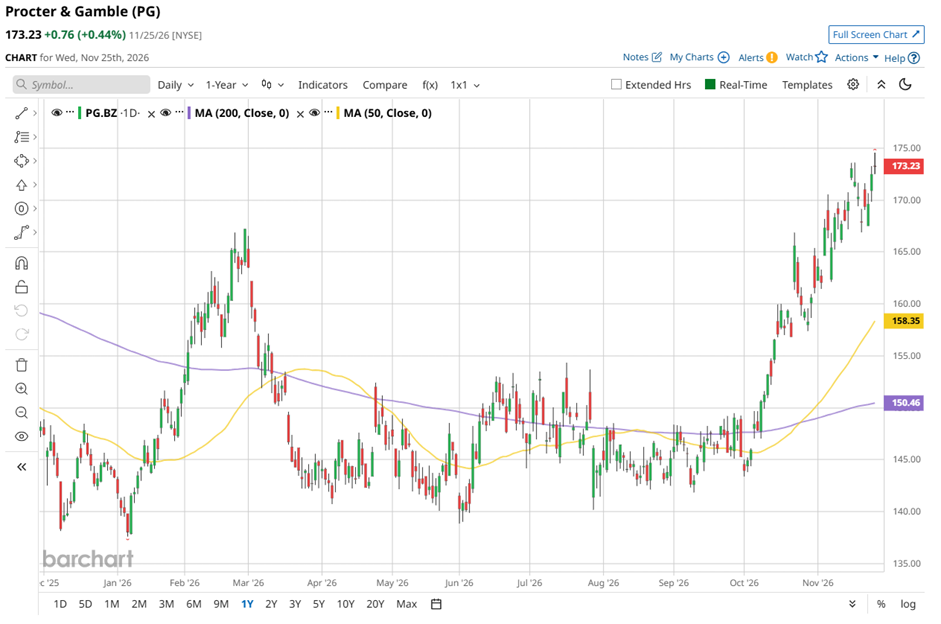
And lately, investors have had plenty of reasons to smile. PG recently climbed to a fresh 52-week high of $174.56 on Nov. 25, though the stock has edged slightly lower since then. Over the past three months, shares have surged 19.1%, leaving the Dow Jones Industrial Average ($DOWI), which declined 6.3% over the same period, well behind.
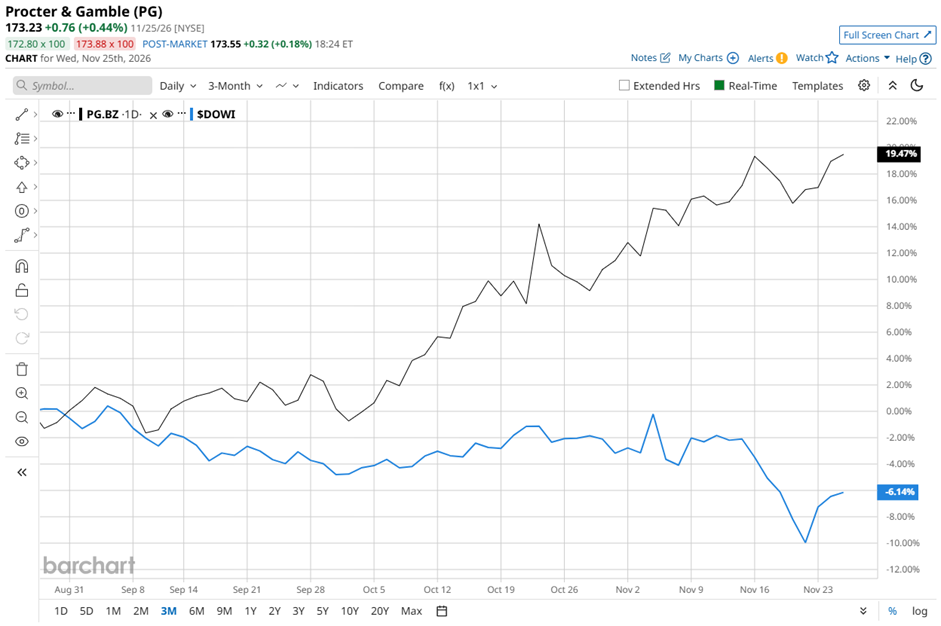
The longer-term picture is just as encouraging. PG has gained 20.9% so far in 2026 and 16.7% over the past 52 weeks, compared with the Dow’s respective advances of 4.4% and 6.5%.
The technical picture adds another positive signal. Shares have traded above both their 50-day and 200-day moving averages since October, suggesting the recent rally has firm footing and buying momentum remains broadly healthy.
P&G’s climb in 2026 has been about more than investors simply buying into a familiar household name. The company has been giving the market reasons to pay attention, with improving sales volumes, fresh product launches and stronger execution across its major brands helping keep growth on track. Tide remains a key driver, with its liquid detergent business holding up well and the newer concentrated Tide evo format expanding nationally. Brands such as SK-II have also added momentum.
Plus, P&G has been sharpening its product offerings, improving retail execution and looking for ways to become more productive without losing its competitive edge. Its reliable cash flows, dividend record and share buybacks have also made it an attractive option as investors rotate toward defensive consumer-staples stocks.
A major boost came on Oct. 22, when PG stock jumped 5.6% after the company delivered better-than-expected fiscal Q1 2027 results. Revenue increased 4% year over year (YOY) to $23.2 billion, while adjusted EPS amounted to $2 per share, both beating Wall Street analysts’ projections.
However, P&G has not been the fastest runner in its competitive race. Colgate-Palmolive Company (CL) has outperformed PG, gaining 24.9% over the past 52 weeks and 26.1% so far in 2026.
Looking ahead, Wall Street is cautiously positive on PG. The stock carries a consensus “Moderate Buy” rating from the 26 analysts covering it. Their average price target of $175.67 implies just 1.4% upside from current levels.
On the date of publication, Sristi Suman Jayaswal did not directly have a position in any of the securities mentioned in this article. All information and data in this article is solely for informational purposes. For more information please view the Barchart Disclosure Policy here.